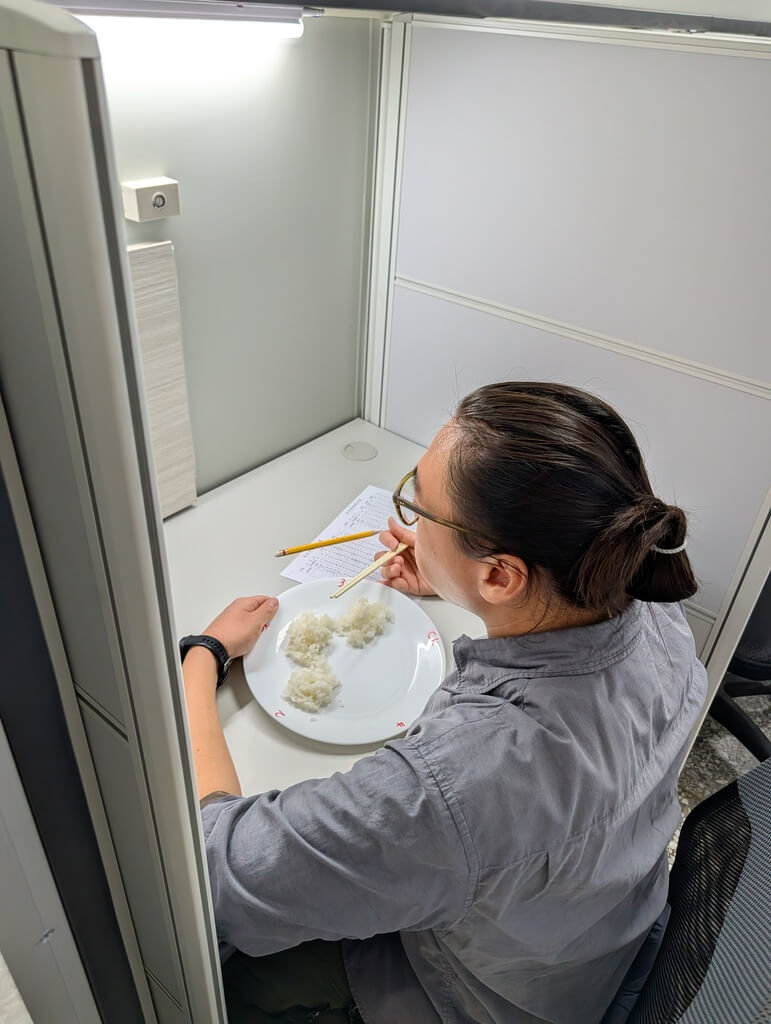
(CNA, Taipei, July 8) Taiwanese rice exports to Japan have grown significantly in the past two years, with even the Japanese acknowledging its deliciousness. Taiwan's high-quality rice is not only due to advancements in breeding technology but also thanks to a group of "rice tasters" who safeguard its quality. These tasters evaluate and score rice before it is named, ensuring only good rice passes the test.
According to Ministry of Agriculture statistics, Taiwan's rice exports to Japan are projected to exceed 12,000 metric tons in both 2024 and 2025, more than doubling previous figures. Hu Chung-i, Vice Minister of Agriculture, frequently travels to Japan to market Taiwanese agricultural products and has repeatedly stated that the texture of Taiwanese rice is virtually indistinguishable from Japanese domestic rice, with Japanese consumers finding it delicious.
The Ministry of Agriculture's website recently featured an agricultural professional: a "rice taster." Li Cheng-hung, who has been a rice taster for four years and is currently an assistant researcher at the Taichung District Agricultural Research and Extension Station, describes the role as a "gatekeeper for the quality of Taiwanese rice."
Currently, the tasting and scoring system for naming new Taiwanese rice varieties is managed by the Taichung District Agricultural Research and Extension Station. New rice varieties cultivated by district agricultural research and extension stations and the Agricultural Research Institute are sent to the Taichung station for tasting and scoring by "rice tasters."
Yang Hung-ying, director of the Taichung District Agricultural Research and Extension Station, told CNA that the Taiwanese rice palatability evaluation system was primarily established by the Taichung station. This initiative arose from a shift in rice breeding focus. Early efforts emphasized yield and resistance to pests and diseases. As food supply became more stable, consumers began to prioritize taste.
Yang Hung-ying explained that the Taichung District Agricultural Research and Extension Station established a rice quality laboratory in 1971. Subsequently, it adopted rice quality testing standards from countries like the United States and Japan. In 1982, Japanese Ministry of Agriculture, Forestry and Fisheries officials were invited to Taiwan to assist in establishing tasting techniques. The rice quality research laboratory was formally established in 1986. Since 1989, new domestic rice varieties must undergo tasting and scoring by "rice tasters" in a tasting room before being named. Only after passing this evaluation are they submitted to the Ministry of Agriculture for review and naming. The team of "rice tasters" typically consists of 8 to 10 people.
Li Cheng-hung told CNA in a phone interview that the most crucial qualification for a "rice taster" is not the ability to "eat rice," but rather stable sensory judgment. This means that when the same sample is evaluated repeatedly, the scores should not fluctuate erratically.
Li Cheng-hung stated that tasting is like an experiment, and the cooking process before tasting is also a critical part of the experiment. Each time, the weight of the rice and the water ratio must be consistent, and the rice must be cooked in an electronic rice cooker of the same model and batch to ensure similar quality in the cooked rice.
To prevent sensory acuity from being affected, Li Cheng-hung mentioned that "rice tasters" must avoid heavy-flavored foods and smoking. They should also not be too full or too hungry before tasting. During training, "rice tasters" repeatedly participate in evaluations to practice analyzing rice and assigning scores. Only after they learn to evaluate consistently are their data incorporated into the analysis. Most individuals can learn the evaluation standards after intensive tasting over 2 to 4 months.
Regarding the tasting process, Li Cheng-hung noted there's no strict rule on the number of chews. Typically, a small mouthful (about 20 to 40 grams) of cooked rice is taken, enough to perceive the aroma, stickiness, hardness, flavor, and the sensation after swallowing. If unsure the first time, a second bite is taken to confirm any differences. The tasting room uses modern partitions to prevent tasters from influencing each other through facial expressions or sounds, allowing them to focus on the tasting.
Li Cheng-hung explained that aroma is not just perceived by smell; it can also be sensed through the back of the mouth and nose during chewing and swallowing. Some aromas are floral, while others are like fresh grain. However, fragrant rice doesn't necessarily mean it's tastier; the appearance of the grains, taste in the mouth, stickiness, hardness, and overall evaluation are still important. Each tasting session lasts about 30 minutes and usually involves 10 samples, with 4 new varieties evaluated alongside 1 commercially available control variety for comparison.
When tasting becomes a job, do you still want to eat rice at home? Li Cheng-hung replied that he actually enjoys eating rice even more. Since the number of tasting samples is limited, he doesn't get overly full. At home, he prefers to buy delicious rice to cook himself or dine at establishments that are particular about their rice.
Although the rice available for sale in Taiwan is generally of good quality, Li Cheng-hung has personal preferences. He believes that Taichung No. 200 is suitable for pairing with Japanese simmered dishes, not only because of its taste but also its excellent cohesiveness, where rice grains do not separate even when mixed with soup. Taikeng No. 9, on the other hand, is an unbeatable classic with a chewy texture that is also delicious when eaten cold.
The Taichung District Agricultural Research and Extension Station estimates that over 2,000 rice varieties have been evaluated so far, with only about 200 varieties making it to market. This translates to approximately only 10% reaching the naming or commercialization stage.
Li Cheng-hung stated that any rice available for sale has undergone "rice taster" evaluation. However, not all rice that passes the "rice taster" evaluation is ultimately named and marketed. Besides taste quality, factors such as yield, stability in environmental adaptation, disease resistance, cultivation adaptability, appearance quality, and market positioning are also considered. He has indeed tasted rice with excellent texture, but its yield or agronomic traits were not ideal. The vast majority of rice varieties are decided by breeders whether to be eliminated, postponed for evaluation, or repurposed for other uses. (Editor: Li Hen-shan) 1150708
Stand with facts, your every donation is a force to protect press freedom
Download the CNA "One-Stop News" APP to get the latest news in real-time
Text, images, and videos on this website may not be reproduced, broadcast, transmitted, or used without authorization.
FACT BOX
- Source: CNA (Central News Agency)
- Category: 商业