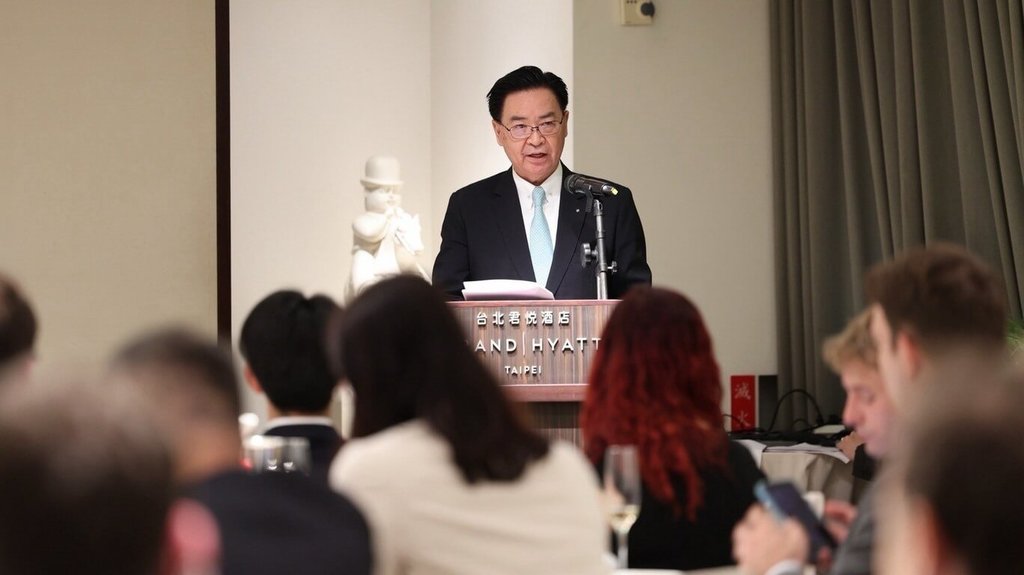
Taipei, July 8 (CNA) National Security Council Secretary-General Wu Chao-hsieh stated today that China has long adopted a strategy of "incremental expansion," gradually altering the status quo in the East China Sea, Taiwan Strait, and South China Sea. Furthermore, through large-scale military exercises and gray-zone harassment, Beijing is forcing the First Island Chain to transform into a interconnected single theater of operations. Only through the unity of democratic nations can effective deterrence be achieved.
In a press release issued by the National Security Council, Wu Chao-hsieh, speaking at the "2026 Taiwan Maritime International Forum" held at the Grand Hyatt Taipei, pointed out in his keynote speech that history has repeatedly warned the international community that silence and concession in the face of authoritarian expansion cannot bring true peace. In 1938, when the international community faced the Sudetenland issue, they believed appeasement could bring peace, but ultimately failed to prevent war.
He stated that today, from Russia's continued aggression in Ukraine, the repeated escalation of conflicts in the Middle East, to the increasingly severe security situation in the Western Pacific, all indicate that authoritarianism is seriously and continuously challenging the international order.
Wu Chao-hsieh pointed out that China's recent maritime expansion is not an isolated incident but part of a long-term, step-by-step expansion strategy. China continuously advances through means below the threshold of triggering war, attempting to shape an irreversible "new normal." This can be seen from China's unilateral establishment of the East China Sea Air Defense Identification Zone in 2013, the militarization of South China Sea islands in 2015, the unilateral declaration of the Taiwan Strait median line's non-existence in 2022, to the actions of coast guard vessels conducting fake law enforcement and real expansion in Taiwan's exclusive economic zone off its east coast in 2026.
He emphasized that Taiwan is by no means the sole target of China's regional expansionism; regional countries such as Japan and the Philippines have also long faced military threats from China. Especially with the increasingly close military cooperation between China and Russia in recent years, democratic countries should strengthen cooperation, reduce strategic dependence on authoritarian states, and enhance supply chain resilience.
Wu Chao-hsieh said he is grateful for the presence of representatives from various countries at the forum, stating that this in itself sends a clear message to the outside world that "democratic nations stand united, and coercion will ultimately fail."
The National Security Council noted that the Taiwan Maritime International Forum was established in 2024. This year's forum invited parliamentarians, official representatives, and experts and scholars from approximately 12 countries including the United States, the United Kingdom, Japan, France, Israel, the Czech Republic, New Zealand, the Philippines, India, and Indonesia. Attendees included U.S. Senator Tammy Duckworth, a delegation from the Inter-Parliamentary Alliance on China (IPAC), and a delegation from the Yokosuka Council on Asia-Pacific Studies (YCAPS). (Editor: Lin Keren) 1150708
Stand with facts, your every donation is a force to protect press freedom
Download the CNA "One-Stop News" APP for real-time updates
The text, images, and audio on this website may not be reproduced, publicly broadcast, publicly transmitted, or used without authorization.
FACT BOX
- Source: CNA (Central News Agency)
- Category: 政治/軍事