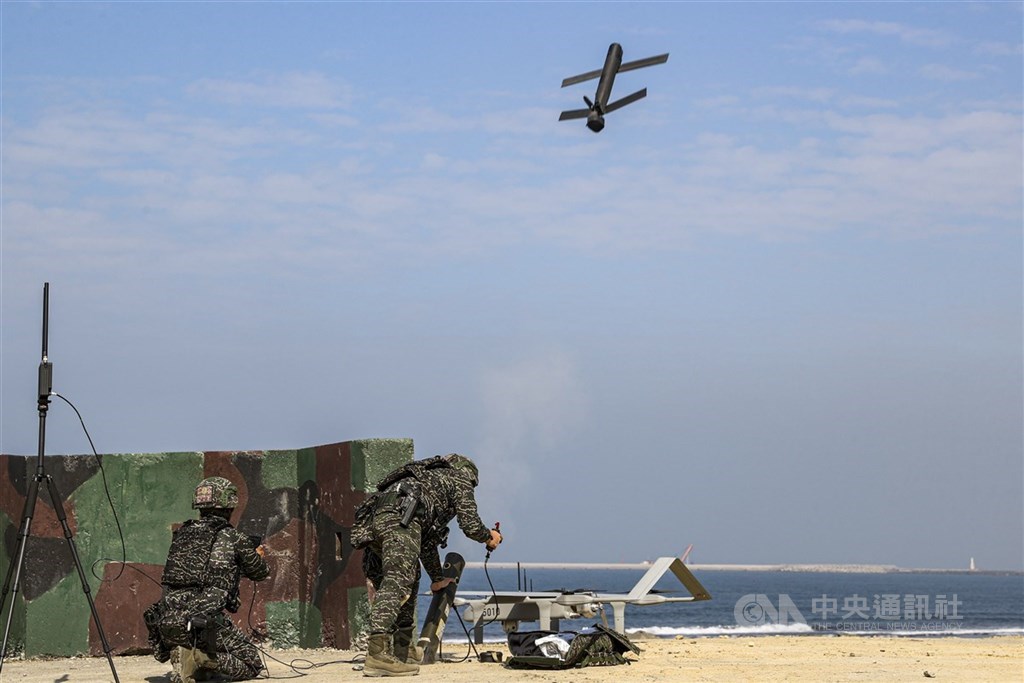
(CNA, Taipei, July 8) - Whether the development of military drones should be overseen by the Ministry of National Defense or the Ministry of Economic Affairs has recently become a focal point of debate between the ruling and opposition parties. A defense affairs expert stated that the procurement of weapon systems involves operational concepts, target specifications, production capacity, and logistical integration, which should naturally be led by the defense department possessing joint operational planning capabilities and classified information management systems. There is no substantial divergence on this matter among countries such as the United States, the United Kingdom, France, Germany, Japan, South Korea, and Australia.
The expert explained that the procurement of military equipment differs from general procurement. Taking the United States as an example, weapon systems follow the "Defense Acquisition System (DAS)" from requirement confirmation, model selection, testing and validation, to mass production and deployment. The requirements are consolidated into specific specifications by the "Joint Capabilities Integration and Development System (JCIDS)" based on the operational needs of each military branch.
He added that in July last year, U.S. Secretary of the Army Christine Wormuth announced a brand-new drone development plan, allocating $1 billion to procure 300,000 attack drones, which followed this very system: led by the Defense Logistics Agency (DLA) and executed by the Army, Navy, and Air Force. Naturally, the Department of Commerce was not involved, as the specifications of weapon systems involve target characteristics, battlefield environment, and threat levels, which are classified operational information subject to security controls. Economic affairs authorities neither possess the corresponding security clearance nor the personnel security vetting mechanisms required to handle classified data.
The expert noted that the UK's "Defence Equipment & Support (DE&S)" is subordinate to the Ministry of Defence and oversees all military equipment procurement operations. The "Defence Drone Strategy" proposed in 2024 assigns procurement reform and industrial construction to the Ministry of Defence. The "UK Defence Innovation Agency," established by the end of 2025, will invest over £142 million in drone and counter-drone technologies, and this agency remains part of the defense system.
The expert said that France's military drone procurement is handled by the "Direction Générale de l'Armement (DGA)" under the Ministry of Armed Forces. This agency manages requirement planning, technical validation, and contract management, with economic departments not intervening in the core aspects of military procurement. Germany's "Federal Office of Bundeswehr Equipment, Information Technology and In-Service Support" is subordinate to the Federal Ministry of Defence.
He stated that Japan's "Defense Equipment Agency (ATLA)" is subordinate to the Ministry of Defense. The defense budget for fiscal year 2026 allocates over 100 billion yen for the SHIELD drone combat capability construction. While small drones are dual-use technologies, and the Ministry of Defense and the Ministry of Economy, Trade and Industry are jointly promoting civil-military collaborative investment under the "Defense Industry Working Group," the authority for defining core operational requirements, approving specifications, and allocating budgets remains with the Ministry of Defense.
He added that South Korea's "Defense Acquisition Program Administration (DAPA)" is also subordinate to the Ministry of National Defense. In 2026, it will integrate the needs of multiple ministries including the Ministry of National Defense, Ministry of the Interior and Safety, Ministry of Land, Infrastructure and Transport, National Police Agency, and Korea Coast Guard, aiming to create a public demand scale of approximately 2 trillion Korean won. The agency responsible for overall procurement and award decisions remains DAPA. Australia's Department of Defence has established the "Advanced Strategic Capabilities Accelerator (ASCA)," announcing in 2025 an investment of over AUD 10 billion over 10 years in drone and counter-drone technologies, with the budget and governing authority remaining within the defense department.
The expert concluded that from the perspective of defense procurement systems, the procurement of weapon systems involves operational concepts, target specifications, production capacity, and logistical integration, which should naturally be led by the defense department possessing joint operational planning capabilities and classified information management systems. There is no substantial divergence on this matter among countries such as the United States, the United Kingdom, France, Germany, Japan, South Korea, and Australia. Even in Japan and South Korea, which also consider industrial cooperation, the agencies leading procurement decisions remain the Ministry of Defense and DAPA, respectively.
The expert stated that the reasons provided by Taiwan's opposition parties for changing the governing authority to the Ministry of Economic Affairs have consistently failed to directly answer the more critical question of "Why the Ministry of Economic Affairs?" When the system designs of various countries point in the same direction, Taiwan's opposition parties' insistence on pursuing a path that cannot be found in major defense procurement systems appears to be a contest of wills driven by an unwillingness to concede to the Executive Yuan's version, rather than a genuine debate based on defense professional considerations. (Editor: Su Lung-chi Su) 1150708)
FACT BOX
- Source: CNA (Central News Agency)
- Category: 国防
- Organizations: ASCA