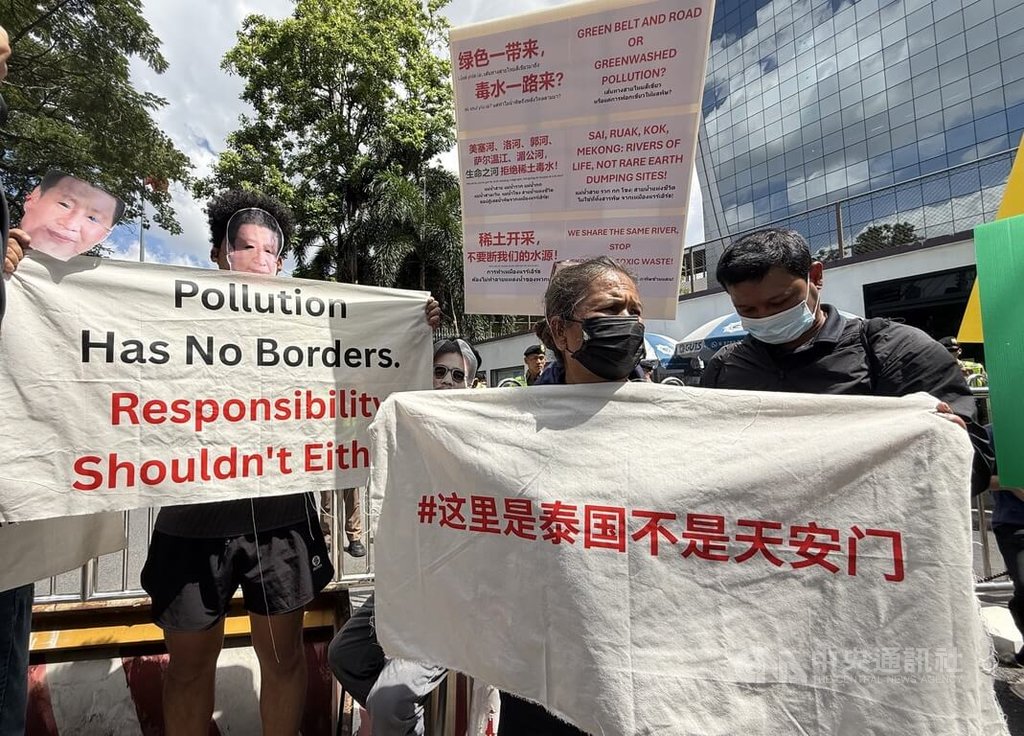
BANGKOK, July 8 (CNA) - A coalition of Thai civil society groups protested outside the Chinese Embassy in Bangkok today, holding banners and chanting slogans to condemn the police's use of force against demonstrators outside the Chinese Consulate in Chiang Mai and to demand that the Chinese government take responsibility for cross-border pollution caused by Chinese-funded mining operations in Myanmar and the environmental impact of the Belt and Road Initiative.
The "NGO Coordinating Committee on Development" (NGO-COD), composed of several Thai environmental and human rights organizations, called for dozens of people to protest in front of the Chinese Embassy in Thailand. Protesters held banners with slogans such as "Pollution Knows No Borders, Responsibility Knows No Borders" and "Green Belt and Road, Toxic Water Along the Way?" Some wore masks with the image of Chinese President Xi Jinping, chanting slogans loudly together.
Protesters stated that they not only oppose the recent forceful dispersal of demonstrators by the police in Chiang Mai, which resulted in injuries to two protesters, but also demand that the Chinese government be held responsible for the cross-border pollution caused by Chinese-funded mining operations in Myanmar.
After reading a statement in front of the Chinese Embassy, the protesters poured wastewater onto a billboard depicting a map of Thailand, symbolizing the contamination of Thai land by toxic substances discharged from the mines. Lertsak Kumkongsak, a Thai environmental and human rights advocate, stated that the incident "was not an act of God or an accident, but a direct result of the Thai government's decision to use state power."
He criticized the Thai government for "choosing to stand with Chinese capital that profits from the destruction of rivers and people's livelihoods, rather than with the people who protect their homeland's rivers and defend their rights to a good environment and life safety."
NGO-COD stated in a press release that Mekong River tributaries such as the Kok River and Sai River are facing a severe cross-border pollution crisis. This is not just an environmental issue but also involves cross-border responsibility, corporate responsibility, international legal obligations, and environmental justice in the Mekong River basin.
The statement indicated that according to investigations conducted by Thai government agencies, academics, and civil society groups for over a year, the river pollution has affected more than 90 native fish species and impacted the livelihoods of residents in the basin.
Thai PBS recently quoted protest groups as saying that fishermen are unwilling to buy fish from the Mekong River due to concerns about heavy metal contamination, impacting the livelihoods of fishermen in about 60 fishing villages in Chiang Rai Province. Additionally, businesses in riverside restaurants and related tourism sectors have seen a decline, resulting in a loss of income for approximately 40,000 households.
NGO-COD stated that the Chinese government has long claimed to promote green development through the Belt and Road Initiative. However, if investments lead to river pollution in neighboring countries, causing millions of people to lose access to clean water, food sources, and livelihoods, then the Belt and Road Initiative should not merely be a symbol of economic interests but should also bear responsibility for cross-border environmental and human rights issues.
The civil groups called on the Thai government to cease using force against peaceful demonstrators, establish an independent committee to investigate the police's law enforcement process, and urged the Chinese government to fulfill its international environmental and human rights commitments, ensuring that overseas investments comply with environmental protection and human rights standards and do not transfer development costs to the people of neighboring countries. (Editor: Chang Chih-hsuan) 1150708
FACT BOX
- Source: CNA (Central News Agency)
- Category: 抗議
- Organizations: NGO-COD