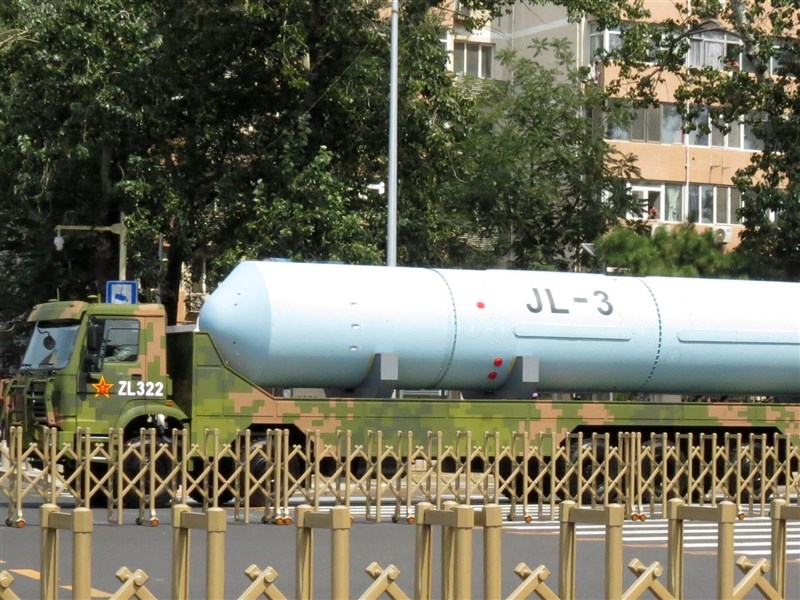
(CNA, reporter Chiu Te-chen, Sydney, July 8) David Vallance, an assistant researcher at the Lowy Institute for International Policy in Australia, told CNA that although Chinese Ambassador to Australia Xiao Qian recently criticized Australia for being caught in "China threat paranoia," China's missile test in the Pacific on the 6th not only confirms that China indeed poses a security threat but also reveals China's "cognitive manipulation" tactics targeting Australia.
The Australian edition of The Guardian's website published an article by Vallance on July 7 titled "What does China's long-range missile test in the South Pacific mean for Australia?"
The article mentioned that in early July, Xiao Qian published an op-ed in Melbourne's "The Age" and Sydney's "Sydney Morning Herald," criticizing Australian media for hyping "China-threat paranoia." Xiao Qian claimed that "rumors stop with the wise, and facts speak louder than words," and called on Australia to face "the facts."
In response, Vallance pointed out in the article that China's test of the "JL-3" submarine-launched intercontinental ballistic missile in the Pacific region, coupled with the Chinese navy's circumnavigation of waters near Australia last year, repeatedly shows that the Chinese military continues to adhere to Mao Zedong's doctrine of "deterrence," which precisely illustrates that China indeed poses a security threat to Australia.
Vallance told CNA in a phone interview today that compared to Xiao Qian's remarks and the lack of transparency in the Chinese military's actions, it is sufficient to reveal the "gaslighting" conducted by Beijing targeting Australia.
Vallance said, "We judge China based on facts. In fact, China's military expansion during peacetime is one of the largest in human history. China claims this is to support world peace and order, yet tells everyone not to overreact, which is hypocritical."
In recent years, whenever the Chinese military takes action in the Pacific island nations, the South China Sea, or waters near Australia, while public opinion criticizes China's military threat, there are also concerns about Australia "provoking" China. Regarding this, Vallance pointed out that Australia and the Pacific island nations are not currently completely intimidated by China's missile test.
Vallance believes that China's missile test this time is not because Australia provoked China. He reminded that missile tests require long preparation times and therefore should not be seen as a direct response to the security treaty signed between Australia and Fiji.
Vallance said, "The Pacific region seems to have expressed a consistent desire not to see this kind of situation (missile tests) happen." He explained that if China further releases unfavorable messages to the Pacific region, it may arouse resentment from Pacific countries.
Vallance emphasized that regarding China's missile tests or other similar military actions, countries should adopt more consistent and cautious boycott actions.
Vallance also reminded that as China and the United States' military forces contend with each other, leading to increasing tensions, the status quo in the Indo-Pacific region has changed. In this regard, small countries in the Pacific region should uphold their autonomy. He said, "Regardless of whether these provocations come from China or other countries, all countries in the Pacific region should clearly oppose such provocative missile tests and oppose any form of provocative military behavior." (actions)." (Editor: Wei Shu) 1150708
Choose to stand with the facts. Your every donation is a force to protect press freedom.
Download the CNA "One-Stop News" APP to grasp the latest news in real-time.
This website's text, images, and videos may not be reproduced, publicly broadcast, publicly transmitted, or used without authorization.
FACT BOX
- Source: CNA (Central News Agency)
- Category: 國際關係