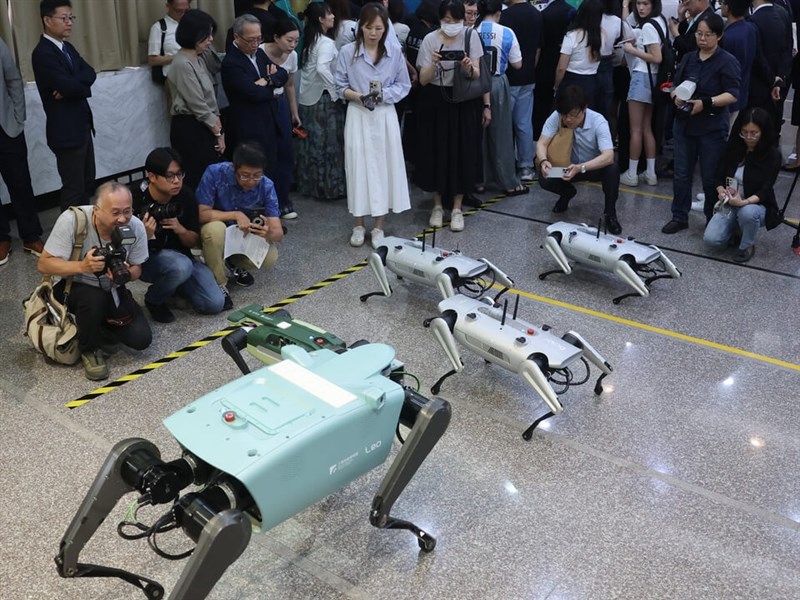
(CNA, Taipei, July 8) The Ministry of Economic Affairs' Industrial Technology Research Institute has spent a year and a half developing a domestic R&D platform for four-legged robots, collaborating with ITRI and major manufacturers like Solomon and Compal to integrate a non-red supply chain. Two four-legged robots have been completed. The Ministry of Economic Affairs stated that the robots can not only inspect underground culverts but the large four-legged robot has also passed verification for its firefighting robot dog function, offering potential assistance in disaster environment reconnaissance in the future.
The Ministry of Economic Affairs' Industrial Technology Research Institute held a "MOEA Four-Legged Robot Domestic R&D Platform Launch Press Conference" today, which opened with performances by large and small four-legged robots. The small four-legged robot demonstrated stair climbing, underground culvert equipment inspection, and collaborative group carrying along a designated path. It specifically simulated a Taipower underground culvert environment, showcasing the four-legged robot's low-angle observation and long-distance movement capabilities.
ITRI Vice President Hu Chu-sheng stated that the four-legged robot is equipped with visual sensing, enabling it to precisely step with visual feedback. To cope with environments with insufficient light where cameras cannot detect the path, the four-legged robot can switch to "blind walking" mode, using its legs to sense the environment and climb stairs independently. If it encounters low spaces, it can switch to a crawling mode to maneuver through.
Hu Chu-sheng pointed out that the small and large robots can carry loads of 5 kg and 20 kg respectively. The demonstration included laying down paper to test the robot's ability to automatically find a support point the moment it steps on an unstable surface.
The Ministry of Economic Affairs' Industrial Technology Research Institute explained that the domestic four-legged robot R&D platform covers four aspects: hardware, motion control, intelligent decision-making, and applications. This platform connects industry partners such as Compal, Inventec, and Solomon, integrating non-red supply chain components, and has completed two domestic prototype machines.
MOEA Vice Minister Ho Chin-tsang stated that the R&D team has caught up to over 20 years of foreign progress in a year and a half. The average age of the team is under 30, which is particularly rare in an era of talent scarcity. The government will provide more resources and platforms for young people to showcase their innovative capabilities. He emphasized that the industry partners participating in the platform are key members of the national team, and expressed hope that the robot industry can become another "sacred mountain" protecting Taiwan.
The Industrial Technology Research Institute introduced that the large four-legged robot has completed the first domestic firefighting robot dog function verification. It passed tests by a third-party accredited unit recognized by the Fire Department. It can stably conduct reconnaissance and transmit image information in a simulated fire scene with a heat source 2 meters away and a ceiling temperature of 100 degrees Celsius. In the future, it can be the first to enter dangerous scenes to identify the ignition point and trapped individuals, significantly increasing rescue success rates.
Several companies also shared their R&D experiences at the event. Compal Electronics Vice President Liang Chih-hsien stated that before investing in R&D, they initially believed that key components like motors and reducers were mainly dominated by Europe, the US, or mainland China. However, after more than a year of collaboration and investigation with ITRI, they found that the quality of Taiwan's key components is comparable to those in Europe and the US, with more competitive pricing. In comparative tests of over 10 domestic and European/American components, the domestic performance was on par with foreign ones, and even US clients were impressed by the performance of Taiwan's key components. He believes that soon, fully domestically produced, practical, and affordable four-legged, wheeled, and humanoid robots will be seen.
TECO Energy and Systems Automation Business Group General Manager Chen Heng-wei stated that TECO has been deeply involved in large industrial motors for the past 70 years. After undertaking the task over a year ago, they assembled a team and established a department to promote it. TECO successfully developed an integrated joint module, including a driver, reducer, and encoder, in a year and a half.
The Industrial Technology Research Institute stated that it will utilize industry R&D subsidies in the future to encourage manufacturers to invest in forward-looking technology and product development. (Editor: Lin Shu-yuan) 1150708
Stand with facts, your every sponsorship is a force to protect press freedom
Download the CNA "One-Stop News" APP for real-time updates
The text, images, and videos on this website may not be reproduced, publicly broadcast, publicly transmitted, or used without authorization.
FACT BOX
- Source: CNA (Central News Agency)
- Category: 科技產業