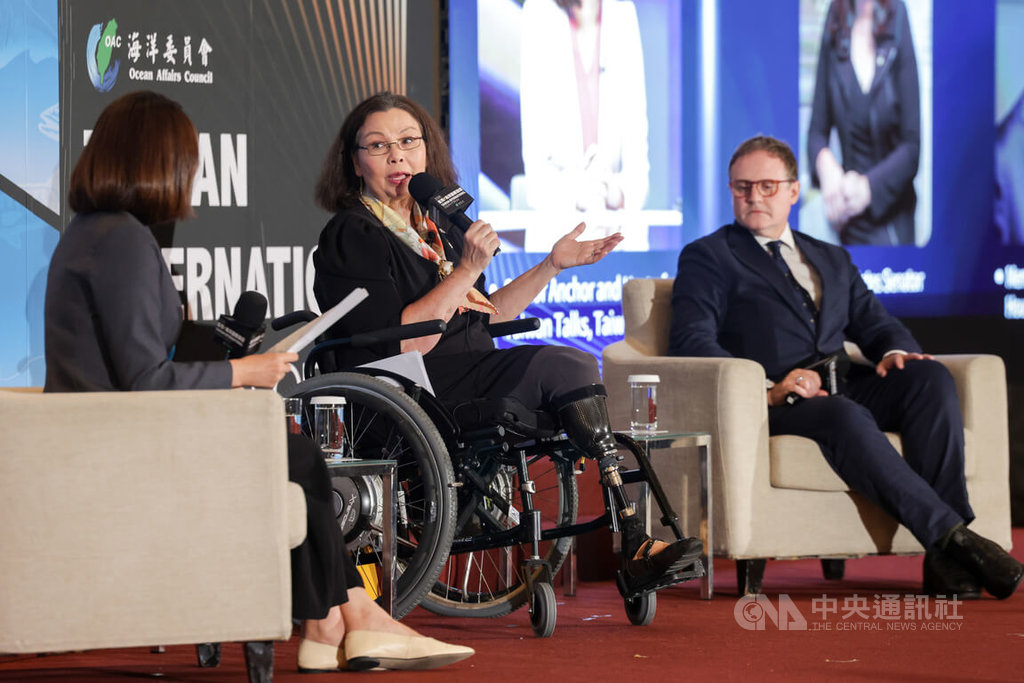
(CNA) - U.S. Senator Tammy Duckworth stated at a forum today that, drawing from experiences in the Strait of Hormuz and Ukraine, nations should not only prepare strategic reserves and medical supplies but also develop deterrence and homeland defense capabilities. Weakening these capabilities serves China's interests, which is why Taiwan's domestic production of its own unmanned vehicles is crucial.
According to China's state media CCTV News, a Chinese People's Liberation Army Navy strategic nuclear submarine successfully launched a strategic missile with a training simulation warhead at 12:01 PM on the 6th, targeting "international waters in the Pacific Ocean," and claimed the missile "accurately landed in the designated sea area."
Duckworth, speaking at a dialogue session of the "2026 Taiwan Maritime International Forum," described this as a typical Chinese action, not specifically aimed at Taiwan, but intended to send a message to Japan, South Korea, and the United States. Focusing solely on the Taiwan issue would overlook the regional message China intends to convey.
Regarding China's deployment of over 110 vessels along the first island chain, British Member of Parliament Tom Tugendhat echoed the sentiment, emphasizing that this is a regional, and even global, issue. He noted that this occurred while leaders were gathering in Ankara, Turkey, for a NATO summit, suggesting it is not a coincidence but part of the Chinese Communist Party's pattern of aggressive expansion over the past 20 years, not an isolated incident.
When asked about China's "special maritime traffic law enforcement operation" in the waters east of Taiwan, Duckworth stated directly that China is attempting to establish a "new normal" that violates the UN Convention on the Law of the Sea, not only in maritime areas but also in airspace, by denying or threatening passage to foreign aircraft. She asserted that these new norms contradict international regulations, and "we cannot allow China to do this, because China will continue to push, and this has global implications." Tugendhat added that the impact of a blockade in the Taiwan Strait would be even greater than that of the Strait of Hormuz.
Duckworth stressed the importance of recognizing the significance of drone manufacturing capabilities, drawing from the blockade in the Strait of Hormuz. She emphasized the need for preparedness in resource stockpiles, including gunpowder, weapons, and medical supplies, and understanding that events in Iran and the Strait of Hormuz have global economic impacts on all nations.
She mentioned that it is crucial for allies to express concern over China's actions. Norway's deployment of warships through the Taiwan Strait, she noted, is very important for maintaining international norms. If China is allowed to establish a new normal, it could deny passage to vessels not registered with the Chinese Coast Guard. The United States is not asking the international community to choose between the US and China, but rather for countries to choose international norms and uphold behavior that conforms to these norms.
Discussing Japanese Prime Minister Sanae Takaichi's stance on China, Duckworth pointed out that Japan is responding to Chinese pressure. She reiterated that weakening or preventing other nations from developing deterrence capabilities and domestic manufacturing capacity to protect and defend their own interests serves China's interests. Therefore, she stated, domestic manufacturing capabilities for weapons, gunpowder, and drones are crucial for Japan.
Duckworth further elaborated that this is why it is vital for Taiwan to leverage its manufacturing capabilities to produce its own drone and unmanned vessel technology. Drawing lessons from Ukraine, she said, "You can rely on allies and foreign military sales, but you must also have domestic manufacturing capabilities."
Duckworth is the first U.S. Senator to visit Taiwan since the Trump-Xi summit. She emphasized that Taiwan has bipartisan support in the U.S. Congress, a strong and cross-party government. Her visit to Taiwan for three consecutive years is to demonstrate the U.S. commitment to Taiwan, stating that Taiwan's maintenance of its democratic and independent status is crucial for the United States and the world. This support also extends to other countries facing Chinese pressure, including Pacific island nations.
The 2026 Taiwan Maritime International Forum commenced today, with opening remarks by National Security Council Deputy Secretary-General Li Wen and Maritime and Fisheries Bureau Minister Kuan Bi-ling. Attendees included industry, government, and academic representatives from 17 countries, as well as diplomatic envoys from various nations to Taiwan. (Editor: Chih Ssu-chia) 1150708)
FACT BOX
- Source: CNA (Central News Agency)
- Category: 國際