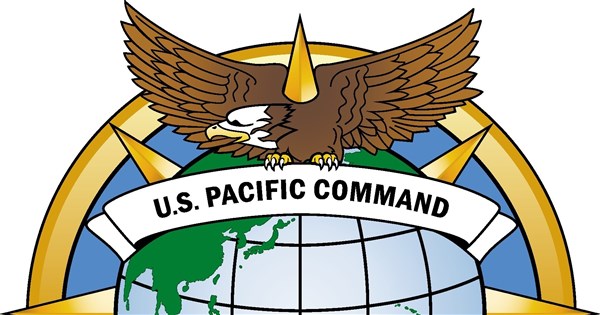
(CNA, Los Angeles, July 7) - The U.S. Indo-Pacific Command reverted to its former name, Pacific Command, in mid-June. Scholars from Washington think tanks published articles today analyzing that this indicates a shift in the U.S. Asian strategy focus from a multilateral cooperation framework encompassing the Pacific and Indian Oceans to military deployments along the First Island Chain.
The U.S. Department of Defense announced on June 16 that "Indo-Pacific Command" would revert to its former name, "Pacific Command." Officials stated that the restoration of the name, established in 1947, would not alter the command's area of responsibility, mission, or commitments to allies.
Sarang Shidore, Director of the Global South Program at the Quincy Institute, a Washington think tank, published an analytical article today titled "Goodbye Indo-Pacific, Hello First Island Chain."
He pointed out that coupled with the rising prominence of the Quad security cooperation mechanism among the United States, Japan, Australia, and the Philippines, this name change highlights the U.S.'s new strategic direction aimed at deterring China.
Shidore noted that the U.S. "National Security Strategy" for 2025 has prioritized the protection of the First Island Chain. He believes this signifies that the U.S. strategy towards China no longer solely emphasizes broad Indo-Pacific cooperation but rather a clearer focus on the Western Pacific defense line encompassing Japan, Taiwan, and the Philippines.
He cited another example: the diminished status of the "Quad" (Quadrilateral Security Dialogue) among the United States, Japan, India, and Australia, which has been downgraded from leaders' summits to the foreign ministers' level, indicating that India's role in the U.S.'s Asian security framework is less significant than before.
He also observed that U.S. officials have recently used the term "Indo-Pacific" less frequently, opting instead for "Pacific" or "First Island Chain."
Shidore believes this indicates that Washington places greater importance on military deployments around the Taiwan Strait, East China Sea, and South China Sea, rather than the broader Indo-Pacific cooperation framework of the past. The elevated status of the Quad security mechanism among the U.S., Japan, Australia, and the Philippines means that the Philippines plays a more crucial role in the U.S.'s Asian security strategy.
The website of Foreign Policy magazine published an analytical article on June 17 by Derek J. Grossman, an international relations scholar at the University of Southern California, titled "Why Trump's Pentagon Ditched 'Indo-Pacific'."
Grossman pointed out that the reversion of the Pacific Command's name will not affect U.S. military deployments or areas of responsibility, but "names are rarely just names." He noted that the "Indo-Pacific" concept originally represented the U.S. emphasis on India's role in deterring China through regional alliances.
He argued that the name change highlights the Trump administration's second term's de-emphasis on the "Indo-Pacific framework" and a shift towards direct engagement with China, adopting transactional diplomacy and prioritizing short-term diplomatic and economic goals.
Ken Moriyasu, a senior fellow at the Hudson Institute, wrote in mid-June that removing "Indo-Pacific" does not signify a cooling of U.S.-China competition; rather, it clarifies the Pentagon's China strategy.
Moriyasu interprets this name change as a message to allies: in a potential U.S.-China conflict scenario, the U.S. will focus on the Taiwan Strait, operating primarily from Japan and the Philippines. In contrast, the Indian Ocean is not central to addressing China issues. (Editor: Chen Hui-ping) 1150708
Stand with facts, your every donation is a force to protect press freedom
Download the CNA "One-Stop News" APP for real-time updates
The text, images, and videos on this website may not be reproduced, publicly broadcast, publicly transmitted, or used without authorization.
FACT BOX
- Source: CNA (Central News Agency)
- Category: 軍事
- Organizations: Squad