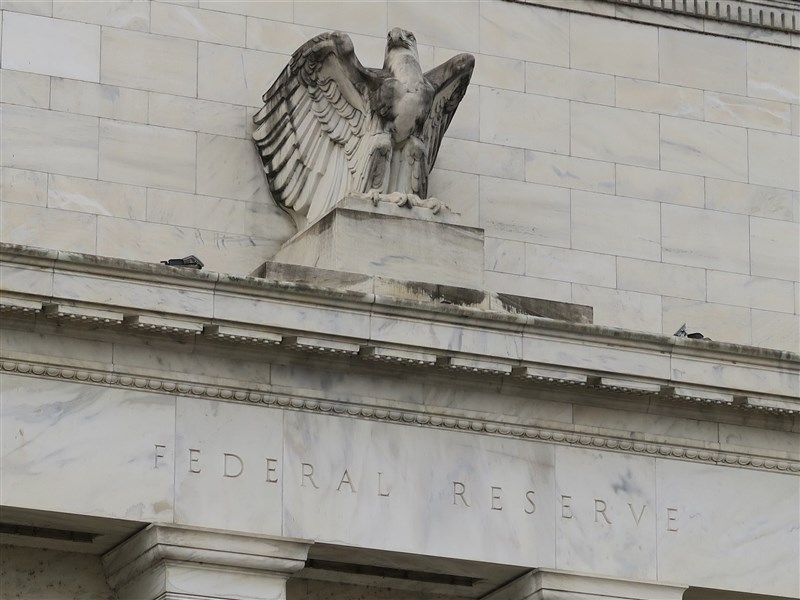
(Central News Agency, Washington, July 8, Comprehensive Foreign News) When the U.S. Federal Reserve (Fed) held its meeting last month, officials deepened their concerns about high inflation. Although they were worried about the need to raise interest rates in response to the expanding trend of price increases, they still followed Chairman Kevin Warsh in issuing a more concise policy statement.
According to Reuters, at the meeting held from June 16 to 17, "a few participants" believed that the conditions were already met to raise borrowing costs, but they ultimately agreed with other officials to "maintain interest rates unchanged at this meeting."
However, the meeting minutes show that the views of policymakers were roughly evenly divided. "Most participants" believed that inflation was likely to fall back to the Fed's 2% target on its own, but there was also a scenario where inflation might remain high. Among those who held the latter view, almost all believed that rate hikes would be necessary if high inflation persisted.
The meeting minutes show that many policymakers were uneasy about inflation developments, and new concerns were even included in the discussions for the first time, such as inflationary pressures that might arise from the artificial intelligence (AI) investment boom.
According to the minutes, "several participants noted that price pressures have become more widespread, with significant price increases observed for many goods and services, including transportation, airfares, petrochemicals, and agricultural raw materials... Several other participants also noted that inflation for services, excluding housing, has shown little sign of declining and remains elevated."
Although some Fed analysts had originally expected Warsh to significantly adjust the meeting minutes, the overall format remained largely unchanged. The document was reduced in length by about 1,000 words, a reduction of 20%.
Part of the reason for the reduction in length may be that policy views have gradually converged into two main camps. One side believes that inflation will cool down on its own, while the other believes that rate hikes are needed to effectively control inflation.
In contrast, at the last meeting held from April 28 to 29, chaired by former Chairman Jerome Powell, officials' opinions were more divided. At that time, there were the most dissenting opinions in decades, and voices supporting future rate hikes were just beginning to increase, while former Fed Governor Stephen Miran continued to advocate for immediate rate cuts.
The minutes of the first meeting chaired by Warsh no longer mention any opinions supporting immediate rate cuts.
Jeffrey Roach, chief economist at LPL Financial, said in a post-meeting report: "There is still some ambiguity in the meeting minutes, indicating that multiple different views on the policy direction are competing."
He added: "The only certainty is that future policy will be highly influenced by the political situation in the Middle East. If there is any forward guidance to be found in these minutes, it is that the committee is evaluating various scenarios and will not commit to a specific policy path until subsequent economic data provides sufficiently clear signals."
The market reacted calmly after the release of the meeting minutes. U.S. stocks were mixed, U.S. Treasury yields slightly retraced earlier gains, and the interest rate futures market still expects the Federal Open Market Committee (FOMC) to raise interest rates at its September 15-16 meeting. (Compiled by: Hsu Rui-cheng) 1150709
Stand with facts, and your every contribution is a force to protect press freedom.
Download the CNA "One-Stop News" APP for real-time updates.
This website's text, images, and videos may not be reproduced, publicly broadcast, publicly transmitted, or used without authorization.
FACT BOX
- Source: CNA (Central News Agency)
- Category: 經濟政策