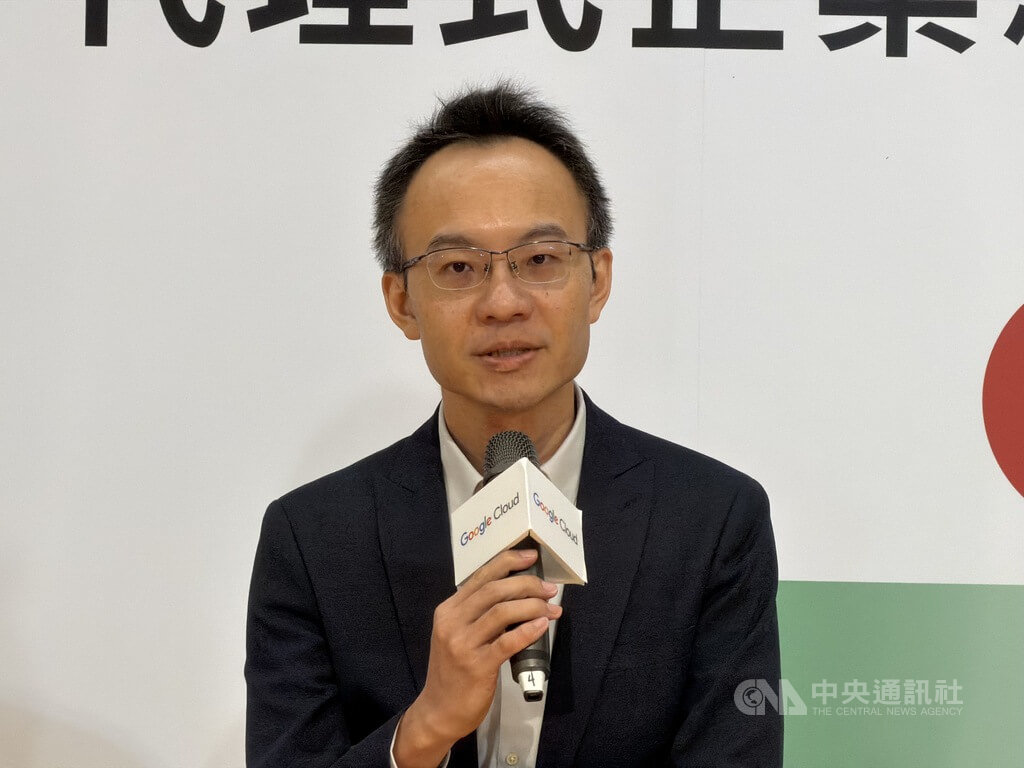
Taipei, July 9 (CNA) The artificial intelligence (AI) wave has driven global demand for computing power. Lin Shu-ping, Taiwan's General Manager of Technology for Google Cloud, stated today that computing power is indeed facing supply chain tightness from Taiwan and the Greater China region to the rest of the world. In response to the shortage of computing power, Google Cloud's approach is not to passively restrict access, but to focus on assisting customers with pre-planning their computing power needs.
Lin Shu-ping attended the Google Cloud Day Taipei annual cloud conference today and spoke with the media. A CNA reporter asked if Taiwan and the Greater China region are facing a shortage of computing power and if Google Cloud is considering temporary measures such as limiting customer access to AI models.
Lin Shu-ping explained that although the industry commonly refers to "computing power," there are actually distinctions. On one hand, there is computing power for pure AI infrastructure, referring to graphics processing units (GPUs) and tensor processing units (TPUs) used for model training or inference. On the other hand, in the era of AI agents, many computing power demands are not purely for model inference but require significant central processing units (CPUs) or storage-related computing power to manage the entire execution flow of the agent.
He pointed out that all enterprises are very interested in adopting AI, leading to exponential growth in demand for both AI infrastructure computing power and the service computing power of agents themselves over the past one to two years. This is the primary reason for the tightness in the computing power supply chain.
However, Lin Shu-ping stated that in the face of computing power shortages, Google Cloud's response is not to restrict access but to focus on assisting customers with computing power planning. When an application service goes live, there will always be phased resource allocation plans; it's impossible to suddenly go from zero to needing thousands or tens of thousands of GPUs or millions of CPUs when launching a service.
Lin Shu-ping believes that enterprises should have clear business plans, such as starting a service in Taiwan first, then expanding to the Greater China region or globally, and establishing relevant timelines. Even the daily active user (DAU) usage status of enterprise users needs to be considered. With this data, Google Cloud can assist customers in making good plans and provide sufficient computing power support as customers develop according to their plans.
In today's Google Cloud Day Taipei keynote speech, Lin Shu-ping mentioned that enterprises' focus on AI has shifted from "experimental technical exploration" to "operational reality of comprehensive enterprise implementation."
According to a recent survey commissioned by Google Cloud from IDC (International Data Corporation), 57% of Taiwanese organizations have deployed AI agents, placing them at the forefront of adoption in the Asia-Pacific region. IDC also indicated that 67% of Taiwanese organizations expect AI investments to yield a return on investment of more than three times. (Editor: Yang Kai-hsiang) 0709
Stand with the truth, and your every contribution is a force to protect press freedom.
Download the CNA "One-Stop News" APP to get the latest information in real-time.
The text, images, and videos on this website may not be reproduced, publicly broadcast, publicly transmitted, or used without authorization.
FACT BOX
- Source: CNA (Central News Agency)
- Category: 科技新闻
- Organizations: Google Cloud / IDC