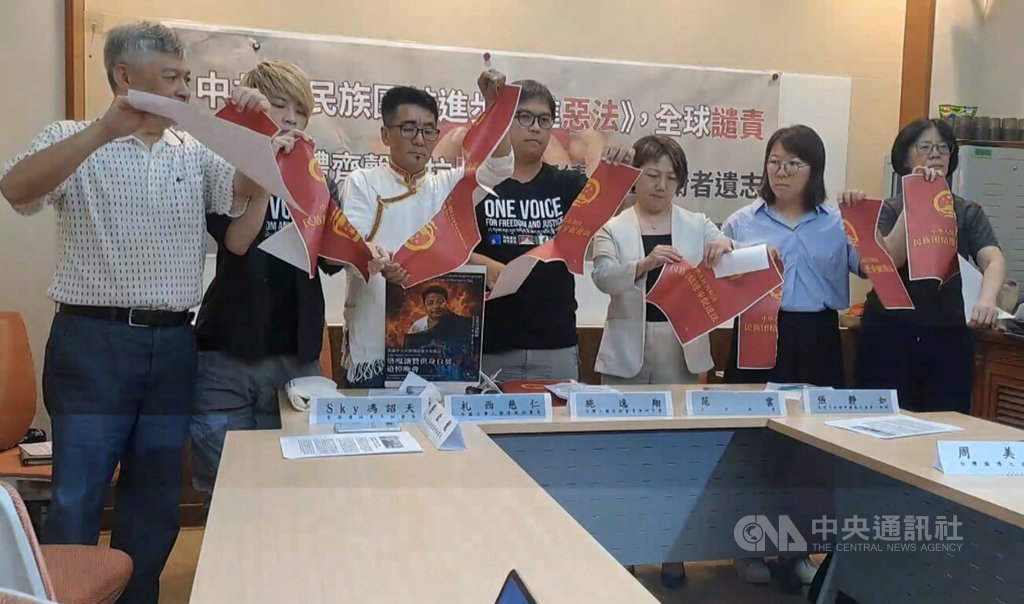
(CNA, Taipei, 5th) China's 'Law on Promoting Ethnic Unity and Progress' officially took effect on July 1. The law's provisions on extraterritorial application have drawn significant attention. Civil organizations are calling on the government to promptly establish a legal 'refugee protection system' to make Taiwan a true human rights sanctuary.
Several civil groups held a press conference today to condemn the law. Organizers and speakers tore up red paper with golden Chinese characters reading 'Law on Promoting Ethnic Unity and Progress' at the event to express their protest.
Zhang Jingru, Executive Standing Committee Member of the Civil Association for Judicial Reform and a lawyer, stated that Article 21 of the law lists 'enhancing Taiwan compatriots' sense of belonging, identity, and honor toward the Chinese nation, promoting cross-strait cultural inheritance, and strengthening the awareness of being part of the same Chinese nation' as a national goal—unilaterally defining identity for Taiwanese people. She added that Article 10 effectively imposes an obligation on Taiwanese to uphold national unity.
Zhang pointed out that under Article 63, any overseas organization or individual deemed to have undermined 'ethnic unity' could be held legally accountable.
Regarding concerns about whether Taiwan's current legal system is sufficient to address extraterritorial jurisdiction or cross-border enforcement disputes, Zhang said the Civil Association for Judicial Reform is conducting preliminary research, including clarifying the people, events, time, location, and objects involved in relevant incidents. They will then assess whether existing laws adequately protect Taiwanese citizens and consider legal amendments if necessary, with a research report expected by year-end.
Zhang emphasized that Taiwan has long lacked a refugee protection system, making civil groups' demands more urgent than ever. She urged the government to establish a legal refugee protection system instead of relying on ad hoc rescue cases, so Taiwan can become a genuine human rights haven.
Gong Qinlong, Secretary-General of the Chinese Democracy Academy Association, suggested the government establish a high-level, cross-departmental coordination mechanism to systematically respond to cross-border legal and security incidents.
In response to previous statements by some KMT legislators opposing a pre-judged stance on the law, Hsu Yi-hsiang, Senior Researcher at the Taiwan Association for Human Rights, criticized such remarks, noting that the law's definition of 'ethnic unity' remains ambiguous.
FACT BOX
- Source: CNA (Central News Agency)
- Category: Taiwan