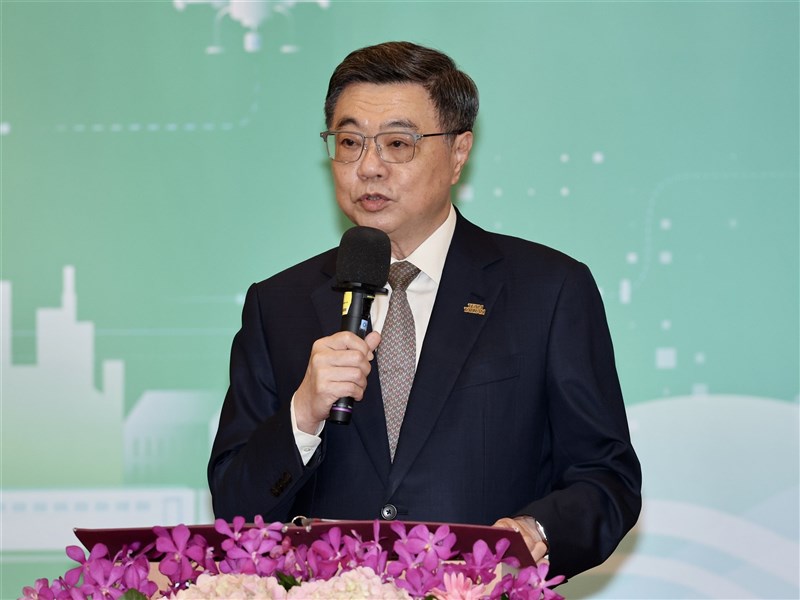
(Central News Agency reporter Kao Hua-chien, Taipei, 13th) The Chung Lien Oils case continues to escalate. Premier Cho Jung-tai convened a meeting today and issued five directives, including completing inspections on all oil product samples produced by Chung Lien within one week; allowing precautionary recalled products to be relisted under three principles—source separation, batch-by-batch verification, and supply chain alignment; submitting amendments to the Food Safety Act and its subordinate regulations within one week; and tightening inspection requirements for upstream manufacturers from semi-annual self-inspections to batch-by-batch inspections.
Executive Yuan spokesperson Lee Hui-chih released a press statement indicating that Premier Cho chaired a special meeting today on the 'Chung Lien Oils case,' inviting representatives from the Ministry of Health and Welfare, Ministry of Justice, Ministry of Economic Affairs, Ministry of Agriculture, Ministry of Education, Executive Yuan Food Safety Office, and Consumer Protection Committee. The meeting discussed expanding precautionary product recalls, improving the food safety management system, protecting consumer rights, and stabilizing the supply of edible oils and animal feed. Premier Cho issued five key directives.
First, Cho emphasized that the government is taking the most rigorous measures against Chung Lien Oils, adhering to the principles of 'food safety first, risk control, information transparency, and protection of public rights.' Problematic oil products have already been legally mandated for removal from shelves, while other oil products manufactured between April and June have been voluntarily recalled as a precautionary measure.
Cho stated that among the 29 batches of oil products produced by Chung Lien from April to June, three batches have not yet been shipped, and five downstream products were found to exceed safety standards in testing. The remaining 21 batches are undergoing accelerated testing of samples from first-tier suppliers. Therefore, he has instructed that all inspection procedures be completed within one week to thoroughly assess the level of risk.
Second, Cho noted that since Chung Lien's oil products may not be limited to a single batch, the Executive Yuan decided on the 9th to expand precautionary recalls to ensure the highest food safety standards.
However, considering the broad impact on midstream and downstream food businesses, Cho instructed the Ministry of Health and Welfare to develop relisting guidelines so that compliant businesses and products can return to shelves after passing inspections. Relisting will follow three principles: 'source separation,' 'batch-by-batch verification,' and 'supply chain verification.' Products may only be relisted after passing inspections by the Food and Drug Administration (FDA) or a third-party certified testing agency, balancing food safety with the normal operation of compliant industries.
Third, Cho directed the Ministry of Health and Welfare to complete the draft amendments to the Food Safety and Hygiene Management Act and related regulations and issue a public notice within one week. The amendments will strengthen 'source management,' including raw material inspection and acceptance standards, and enhance 'process management,' requiring trial production and testing for major changes. Additionally, 'five new provisions' will reinforce a three-tier food safety management mechanism.
Tier 1 management includes 'newly stipulated' self-inspection frequencies: upstream manufacturers must move from semi-annual to batch-by-batch self-inspections, and first-tier manufacturers from semi-annual to quarterly inspections. It also 'adds provisions' requiring manufacturers above a certain scale to operate laboratories certified by the competent authority and 'adds obligations' for laboratory management and real-time reporting.
Tier 2 management 'adds legal responsibility' for third-party verification agencies to proactively report abnormal cases. Tier 3 quality control 'increases factory inspection frequency' and expands random sampling for high-risk businesses to establish a more comprehensive food safety early warning and management system.
Fourth, Cho instructed the Ministry of Education to continue coordinating with local governments to expand investigations and tracking based on the latest list of affected products released by the FDA, supervise schools in implementing food safety management and reporting procedures, and continue to disclose information through the Campus Food Ingredients Registration Platform to safeguard school meal safety.
Fifth, regarding consumer protection, Cho directed the Consumer Protection Committee and the Ministry of Economic Affairs to coordinate with retailers to improve return and exchange mechanisms and fully protect consumer rights. For edible oil and animal feed supply, he tasked the Ministry of Economic Affairs and the Ministry of Agriculture to closely cooperate through coordination, supply regulation, and alternative solutions to maintain stable domestic market supply.
Lee Hui-chih stated that the government will continue to implement food safety management at the highest standards, adhering to the principle of openness and transparency, and promptly inform the public of the latest inspection results and progress, balancing public health, consumer rights, and stable industry development. (Edited by Su Chih-tsung) 1150713
FACT BOX
- Source: CNA (Central News Agency)
- Category: Taiwan