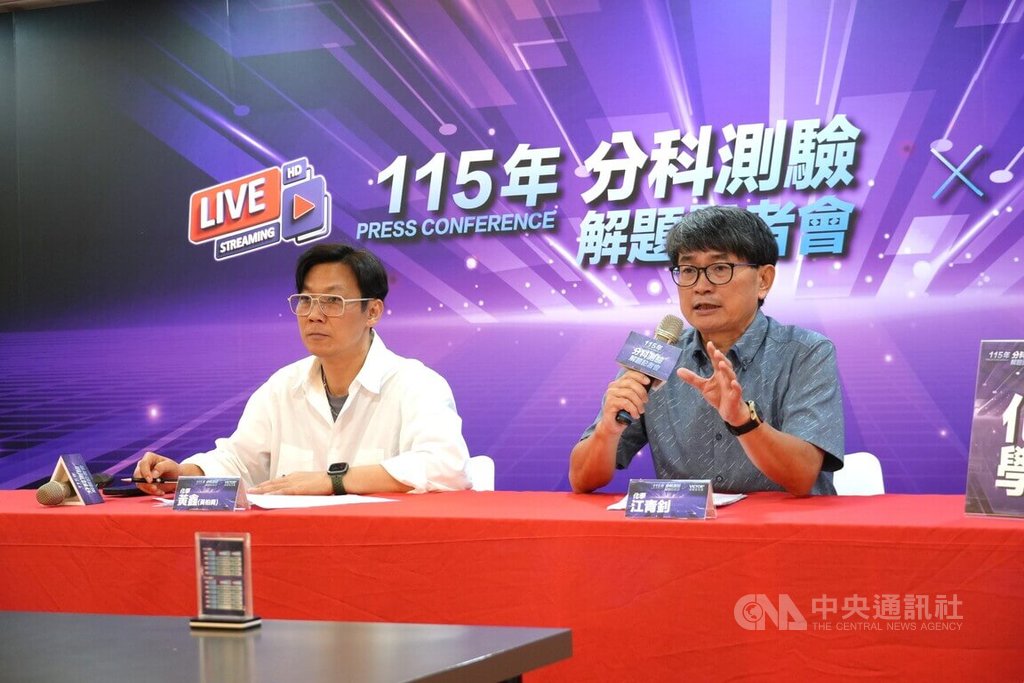
(Taipei, 13th – Reporter Chen Chih-chung) For the chemistry subject of the 115th academic year Subject Exam, tutoring educators assessed that the most notable feature was that 'all expected topics were covered.' The first half of the exam was relatively approachable, with the decisive factor being time management and performance on the later multiple-choice and integrated questions. The top benchmark score is projected to increase by one level compared to the previous year.
Today, De Sheng Education invited tutoring instructors to analyze the chemistry exam. Huang Hsin pointed out that this year featured few questions requiring complex calculations, aligning with the trends of the 108 curriculum guidelines. Additionally, two experiments taught in high school were incorporated into the exam, which could enhance students’ motivation to learn. The inclusion of contributions by three Nobel laureates further contributed to what was overall considered an excellent exam design.
Huang emphasized that the key to scoring well lies in managing time effectively during the initial multiple-choice section, reserving approximately 40 minutes for the later multiple-choice and integrated questions. Although some questions may appear difficult at first glance, carefully reading and analyzing the provided text often reveals the answers within the passage.
Chiang Ching-chao noted that last year’s chemistry exam was criticized for omitting essential textbook content—'what should have been tested wasn’t.' This year, however, he observed that 'all expected content was tested.' After speaking with several examinees, he found that none reported encountering unexpectedly difficult or disruptive questions. The exam was considered fair and accessible to average-level students, which could positively influence high school teaching practices.
Questions 29 and 30 focused on 'rare earth elements,' which Chiang described as slightly challenging. Fortunately, their placement at the end of the exam allowed students more time to work through them. These questions primarily tested understanding of the impact of extraction on concentration ratios, requiring students to interpret experimental data presented across one table and three graphs.
Tutoring institutes project the five benchmark scores (top, upper, average, lower, and bottom) at 51, 44, 32, 21, and 15, respectively. While the top score is expected to rise by one level compared to last year (114th academic year), the others remain unchanged. (Editor: Kuan Chung-wei) 1150713
Stand with truth. Every contribution you make helps safeguard press freedom.
Download the CNA 'Breaking News' app to stay updated with real-time information.
Text, images, and videos on this website may not be reproduced, broadcast, publicly transmitted, or utilized without authorization.
FACT BOX
- Source: CNA (Central News Agency)
- Category: Taiwan