Central News Agency Report (Reporter: You Kai-Xiang, Taoyuan, 13th)
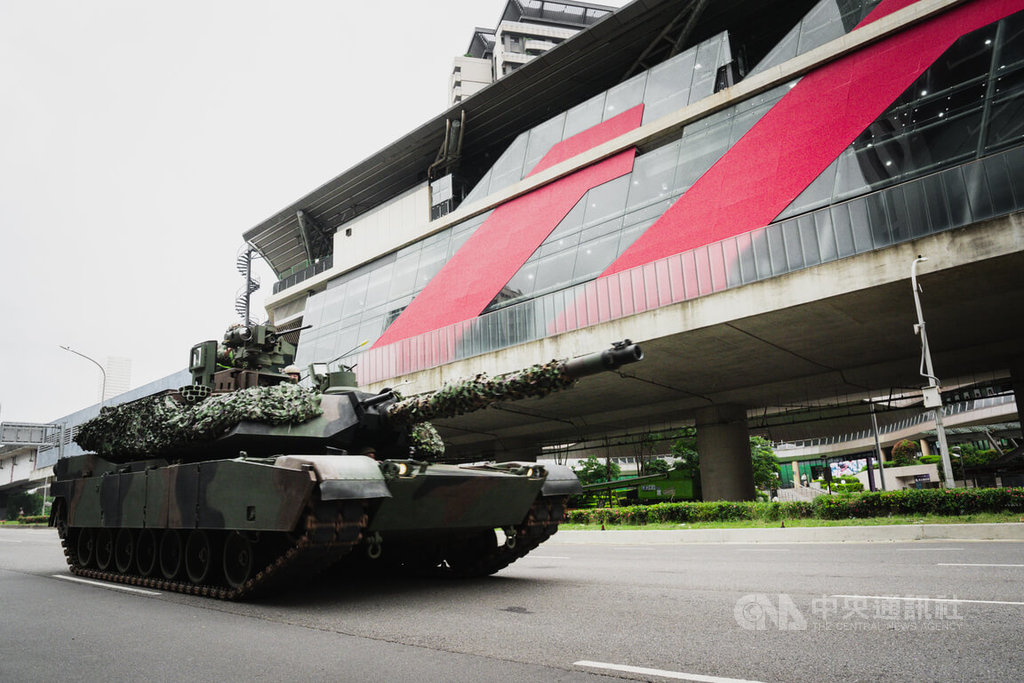
The joint defense exercise took place today, with M1A2T tanks conducting mobile maneuvers to tactical positions in Qingpu, Taoyuan, successfully crossing the Linghang South Bridge. This achievement dispels public concerns regarding the tanks' excessive weight and their potential incompatibility with Taiwan's road and bridge infrastructure. Military analysts state that this operation not only verifies heavy armored combat capabilities but also aims to establish defensive deployments along urban transportation corridors to prevent enemy advances from Taoyuan's coastal areas into city centers.
The five-day military joint defense exercise officially commenced today. Simulating threat scenarios such as detecting enemy launches and incursions into territorial waters, the drill emphasizes integrated operations across all military branches. It focuses on executing the 'kill chain' under a 'decentralized' command structure, validating 'distributed command' and command-and-control mechanisms (C2), and implementing 'Rules of Engagement' (ROE).
Due to prior typhoon preparedness activities for Typhoon Bavi, military units were in disaster prevention readiness mode before today, resulting in slight adjustments to the exercise schedule.
This morning, Central News Agency reporters observed Marine Corps units conducting mobile reinforcements to tactical zones near Taipei. In the afternoon, in the Qingpu area and near the Rakuten Taoyuan Baseball Stadium, vehicles from the Army's 269th and 584th Brigades—including tanks, Yunpao eight-wheeled armored vehicles, TOW 2B missile carriers, communication vehicles, military trucks, and light tactical wheeled vehicles—were seen moving in combat formation according to operational plans toward designated tactical positions. Civilians and children along the roadside waved at the military vehicles and shouted 'Go!' in encouragement.
Notably, the highly anticipated next-generation main battle tank, the M1A2T, participated in this exercise. Several M1A2T tanks successfully crossed the Linghang South Bridge in Taoyuan's Qingpu area, demonstrating their excellent bridge-crossing and load-bearing adaptability, effectively dispelling earlier public concerns that the heavy tank might exceed the load capacity of Taiwan's roads and bridges.
The military has revised its 'Joint Operations Plan,' retaining the 'Phase Two' while eliminating the 'Three-Stage' framework. It has added 'Combat Readiness Deployment (0)' and 'Enhanced Readiness Levels Two and One (1)' to the 'Regular Readiness Period.' The 'Defense Operations Period' now includes 'Joint Anti-Landing and Coastal Strike (2),' 'Beach Combat (3),' and 'In-Depth Defense and Protracted Warfare (4).'
Last month's Immediate Readiness Exercise focused on pre-launch scenarios, emphasizing the military's initial preparedness and the efficiency of transitioning from peacetime to wartime—roughly corresponding to Phases 0 to 1. In contrast, the Joint Defense Exercise focuses on post-launch scenarios, though it still requires going through the Immediate Readiness Exercise phases. Once units reach their tactical positions, they are expected to enter Phase 2—Joint Anti-Landing and Coastal Strike—by evening or night.
Military officials have analyzed that the Qingpu High-Speed Rail Special Zone is a convergence point for critical transportation nodes, including the high-speed rail, airport MRT, National Highway No. 2, and Provincial Highway No. 31. It serves not only as a vital transportation hub in northern Taiwan but also as a strategically significant area in defense operations.
Officials noted that from an overall defense perspective, the coastal areas of Guanyin, Dayuan, and Luzhu in Taoyuan—including the shoreline around Zhurwei Fishing Port—are considered key potential landing threat zones in northern Taiwan. If enemy forces breach the first coastal line, mechanized mobile units from the Sixth Army Corps must rapidly deploy to these threatened areas according to operational plans to counterattack and prevent inland penetration.
They added that Qingpu lies between Taoyuan's coastal regions, the Zhongli urban area, and the defensive depth toward Taipei. Establishing defensive deployments here allows forces to leverage natural barriers such as rivers and the dense urban terrain to form an in-depth defense system. This increases the difficulty for enemy breakthroughs and buys time for subsequent force assembly and counterattacks. (Edited by Lin Hsing-Meng)
FACT BOX
- Source: CNA (Central News Agency)
- Category: Event