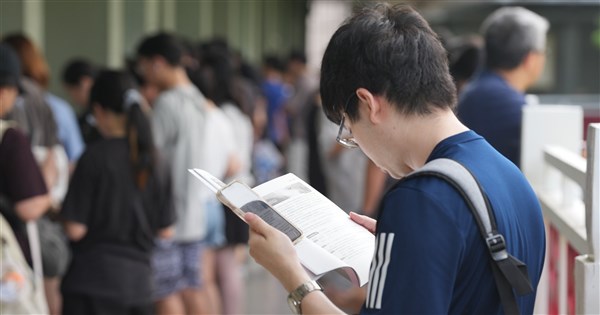
(Central News Agency reporter Hsu Chi-wei, Taipei, July 13) The first session of Taiwan's 115th academic year Subject Exam began today with the physics test. Taipei high school physics teachers analyzed that this year's exam featured calculation questions making up as much as 80% of the total, with heavy computational demands and challenging experimental questions in the non-multiple-choice section, making it the most difficult physics exam in the past five years. As a result, many students may not have been able to complete all questions in time.
The first day of the 115th academic year Subject Exam took place today, with physics as the first subject. The University Entrance Examination Center invited high school teachers into the exam-setting committee to review the questions, while the Ministry of Education invited a group of Taipei high school physics teachers to assist in analyzing the exam content.
High school teachers involved in the exam-setting process noted in written materials that this year's questions covered a wide range of topics and incorporated real-life contexts, such as the frequency range of mobile phone signals and quadcopter drones commonly used in large-scale light shows. The questions were arranged from easy to difficult, with an overall moderate level of difficulty.
The exam also emphasized experimental operation and reasoning skills. For example, questions 18 to 20 tested Newton's second law experiment, where the object under test was connected via a paper tape to a ticker timer, and students were required to analyze and infer based on the timer data. Questions 21 to 23 focused on circuit design and measurement, guiding students to consider different experimental methods.
Tsai Hao-wei, a teacher from Songshan High School, stated that the proportion of content from the final semester of senior year was higher than in previous years. Since students had less time to study this material, answering these questions was particularly difficult. Additionally, the volume of calculations was unusually high, with 80% of the questions requiring computation, and the numbers were more complex than in previous years, making it likely that students could not finish writing all answers in time.
Regarding the characteristics of the exam, Tsai noted that students likely struggled significantly with the non-multiple-choice section, which included two major experimental tasks based on the curriculum guidelines. These were more difficult and challenging than last year's. For instance, questions 24 to 26 covered the Moiré pattern (Mó'ěr Fúdié), involving wave path difference calculations, which are conceptually difficult in physics and accounted for over 10 points.
Lai Yi-fan, a teacher from Jianguo High School, pointed out that last year's calculation questions accounted for about 50%, but this year increased to 80%. Questions 18 to 23 were all experimental questions, with high weight and high quality, incorporating inquiry-based components that required deeper thinking, placing a heavy burden on students. Overall, the difficulty level is considered the highest in the past five years. (Edited by Chen Jen-hua) 1150713
FACT BOX
- Source: CNA (Central News Agency)
- Category: Taiwan