By Central News Agency Reporter Li Ya-wen, Taipei, April 14
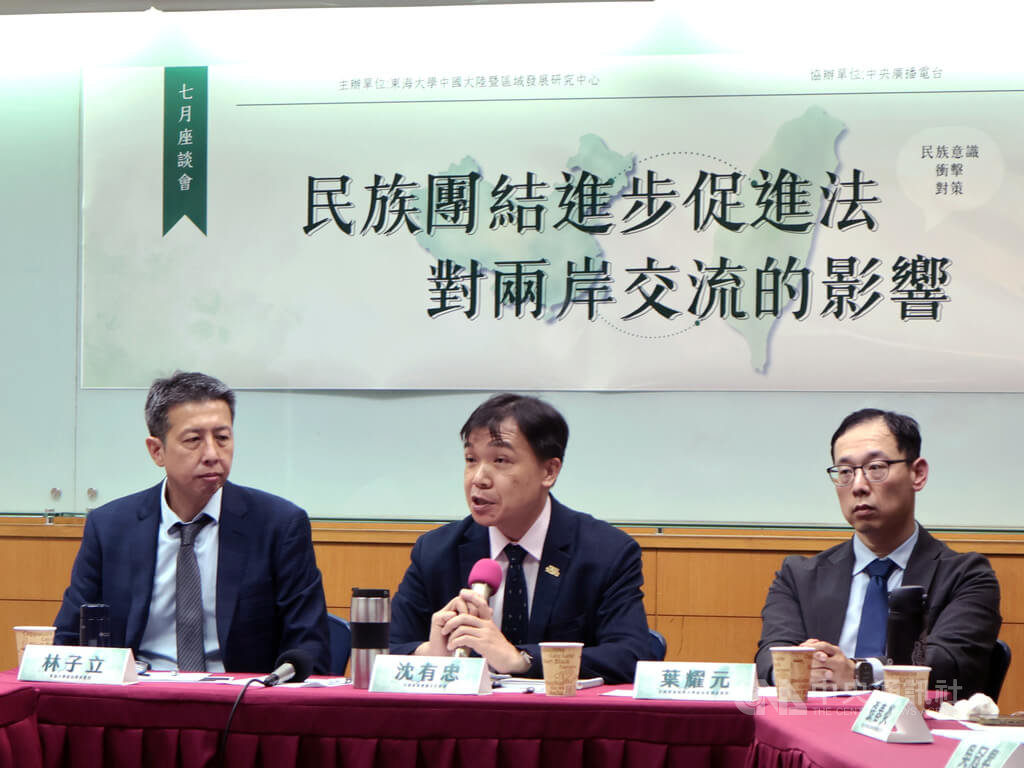
Following the implementation of China's 'Law on the Promotion of Ethnic Unity and Progress,' Shen You-zhong, Deputy Minister of Taiwan's Mainland Affairs Council (MAC), stated today that future cross-strait exchange activities may all be required to comply with the principle of 'ethnic unity,' thereby increasing uncertainty and political risks in cross-strait exchanges.
Shen spoke at a symposium titled 'The Impact of the Ethnic Unity Promotion Law on Cross-Strait Exchanges,' hosted by the Center for China and Regional Development Studies at Tunghai University at the National Taiwan University Alumni Association Hall. He criticized the law as a formalization, institutionalization, and normalization of China's recent attempts to exercise long-arm jurisdiction and cross-border suppression over Taiwan, actions he said would undermine the current state of cross-strait relations and pose challenges to Taiwan's national security and social stability.
Shen noted that the law's content is ambiguous and grants extraterritorial jurisdiction, effectively extending the Chinese Communist Party's political control and ideological influence globally, enabling cross-border suppression of overseas democratic and freedom advocates. He added that the law has already triggered significant international concern from Japan, the United States, and the European Parliament shortly after its announcement.
He emphasized that while the Taiwanese government advocates for healthy and orderly cross-strait exchanges, China's implementation of this law casts a shadow over such interactions and increases uncertainty. According to Shen, Beijing can now use this law to assign political objectives to cross-strait exchanges, making united front operations more explicit and institutionalized.
Shen expressed concern that future cross-strait exchange activities could face accountability if they are deemed not to comply with or promote 'ethnic unity.' Under such circumstances, all exchange activities might be required to 'promote unity and unification,' thereby exposing participants to political risks.
Shen further stressed that domestically, this law serves to consolidate the centralized leadership of Chinese Communist Party leader Xi Jinping, while internationally, it functions as a tool for cross-border suppression, human rights violations, and interference in democratic governance. For cross-strait relations, he warned it risks turning exchanges into united front operations, potentially legitimizing forced unification and cross-border repression. (Edited by Feng Zhao)
FACT BOX
- Source: CNA (Central News Agency)
- Category: Taiwan