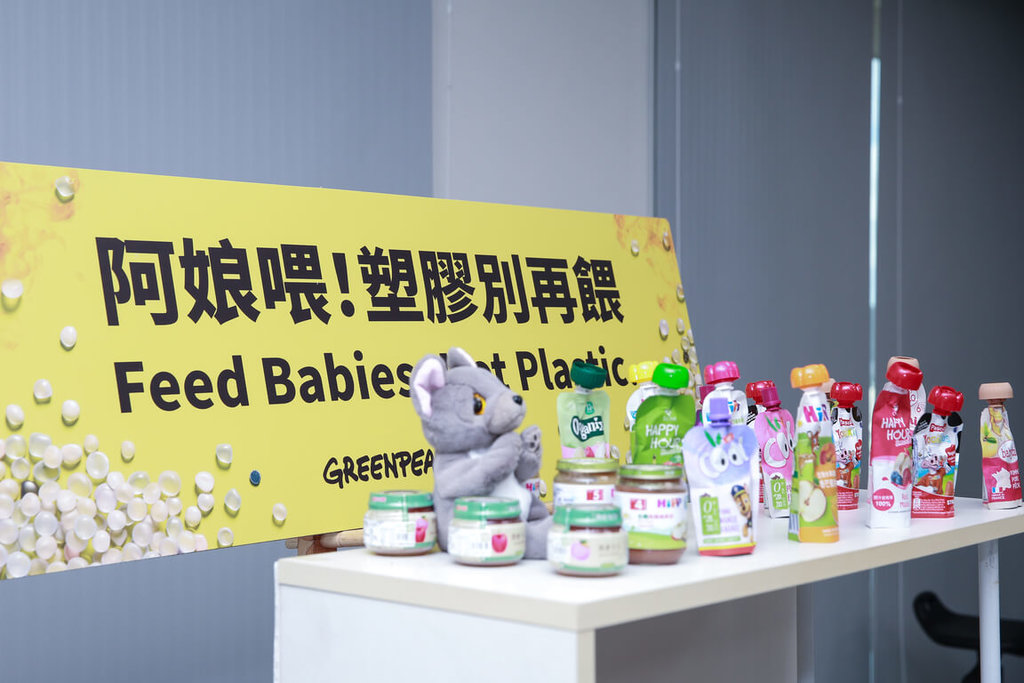
(Taipei, April 14, CNA) Greenpeace today revealed that nearly 80% of commercially available infant foods in Taiwan are packaged in plastic spout pouches, making them a hidden source of microplastic exposure for infants. The organization is calling on the government to immediately initiate a nationwide investigation into infant food packaging and swiftly establish a risk assessment mechanism.
Greenpeace today released the findings of its survey titled 'Packaging of Infant Foods (Fruit Puree, Yogurt) in Major Taiwanese Distribution Channels.' The survey analyzed 718 products—325 from online retailers and 393 from physical stores—and found that nearly 80% use plastic spout pouches. In supermarkets and hypermarkets, the rate reaches 100%, meaning parents have virtually no non-plastic packaging options when selecting complementary foods for their children.
According to Greenpeace, spout pouches are made of multi-layer composite materials, including PET, aluminum foil, and PE. The inner layer, spout, and cap that directly contact food are made of PE (polyethylene). Recent studies have shown that the risks of plastic packaging extend beyond environmental pollution after disposal—they may also be a significant source of human microplastic exposure.
Dr. Yen Tsung-Hai, a nephrologist at Linkou Chang Gung Memorial Hospital, stated that while the scientific community has not yet fully determined the level of microplastic exposure that causes health harm in humans, animal and cell studies have shown that high-dose microplastics may cause oxidative stress, inflammatory responses, and even organ damage.
Dr. Yen emphasized that action should not wait until human health damage is fully proven. Instead, the precautionary principle should be followed to actively reduce human exposure to microplastics. He added that infants, whose bodies are in a rapid development phase, are more vulnerable to harmful environmental substances than adults and therefore deserve priority in risk reduction.
Dr. Hsiao I-Lun, Director of the Center for Food Safety Inspection and Functional Development at Taipei Medical University, noted that plastic spout pouches may not only release microplastics but could also generate other complex chemical substances during manufacturing or use.
Dr. Hsiao pointed out that compared to the relatively comprehensive food packaging regulatory systems in the EU, the U.S., and Japan, Taiwan's management and disclosure of chemical substances in plastic packaging remain inadequate. When multiple chemicals enter the human body simultaneously, they may interact and increase health risks through a 'synergistic effect.'
Greenpeace urges the government to immediately conduct a nationwide investigation into infant food packaging and establish standardized testing and risk assessment mechanisms for microplastics. It also calls for improvements to the 'Hygiene Standards for Food Utensils, Containers, and Packaging' under Taiwan's Food Safety Act, aligning with EU, U.S., and Japanese regulations by allowing only substances that have undergone safety evaluation and approval for use as food packaging materials or additives. (Edited by Lung Po-An) 1150714
FACT BOX
- Source: CNA (Central News Agency)
- Category: Survey