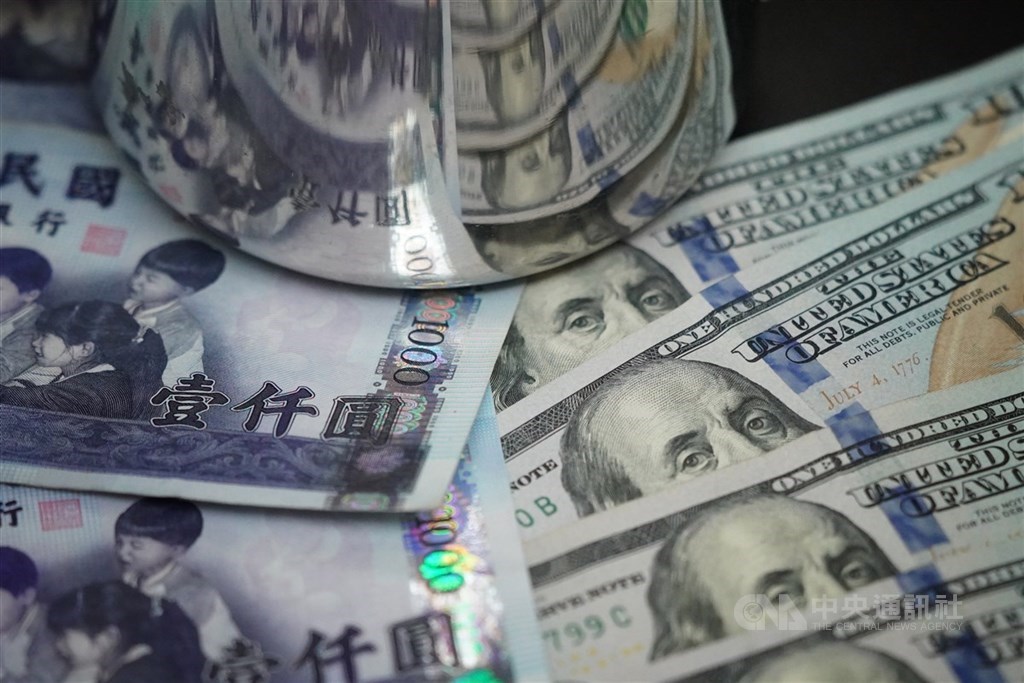
(Central News Agency reporter Chao Min-ya, Taipei, July 14) On the eve of the release of the U.S. June Consumer Price Index (CPI), market sentiment remained cautious. Foreign investors continued their adjustment strategy, selling off Taiwanese stocks and repatriating funds, causing both the stock and foreign exchange markets to decline simultaneously. The New Taiwan dollar closed at 32.172 against the U.S. dollar, depreciating by 0.2 cent. Total trading volume in the Taipei and Yuan Ta foreign exchange markets reached 2.162 billion U.S. dollars.
A new round of military conflict erupted between the United States and Iran. On the 13th, U.S. President Trump stated that the U.S. would 'strongly' strike Iran again, prompting a rise in international oil prices and keeping market risk aversion high. The four major U.S. stock indices closed lower, and the U.S. dollar index strengthened.
The Taiwan stock market opened lower and continued to decline throughout the day, fluctuating by as much as 1,710.36 points. It closed at 44,737.95 points, down 642.57 points. The three major institutional investors collectively sold 75.36 billion New Taiwan dollars worth of stocks, with foreign investors accounting for 51.893 billion, marking the eighth consecutive day of net selling.
The New Taiwan dollar opened at 32.19, briefly turned positive during the session, and reached a high of 32.161. However, depreciation pressure intensified in the afternoon, hitting a low of 32.229. The losses narrowed toward the close, allowing the currency to hold above the 32.1 level.
Foreign exchange traders noted that foreign investors engaged in two-way trading in the morning but increased capital outflows in the afternoon. However, export-driven foreign exchange selling helped limit the currency's decline. The central bank intervened toward the end of the session, clearly aiming to prevent the New Taiwan dollar from closing at or below 32.2, as it did the previous day.
Traders pointed out that with Middle East tensions escalating again, 'tonight's U.S. CPI data is crucial.' If inflation data shows further heating, it could strengthen market expectations of a Federal Reserve rate hike, extending the U.S. dollar's strength. Meanwhile, the New Taiwan dollar's short-term downward trend remains unchanged.
According to central bank statistics, the U.S. dollar index rose 0.23% today. Asian currencies showed mixed results: the Japanese yen fell 0.15%, the Singapore dollar declined 0.02%, and the New Taiwan dollar dropped 0.01%; the South Korean won rose 0.26%, and the Chinese yuan gained 0.05%. (Edited by Chang Chun-mao) 1150714
FACT BOX
- Source: CNA (Central News Agency)
- Category: Taiwan