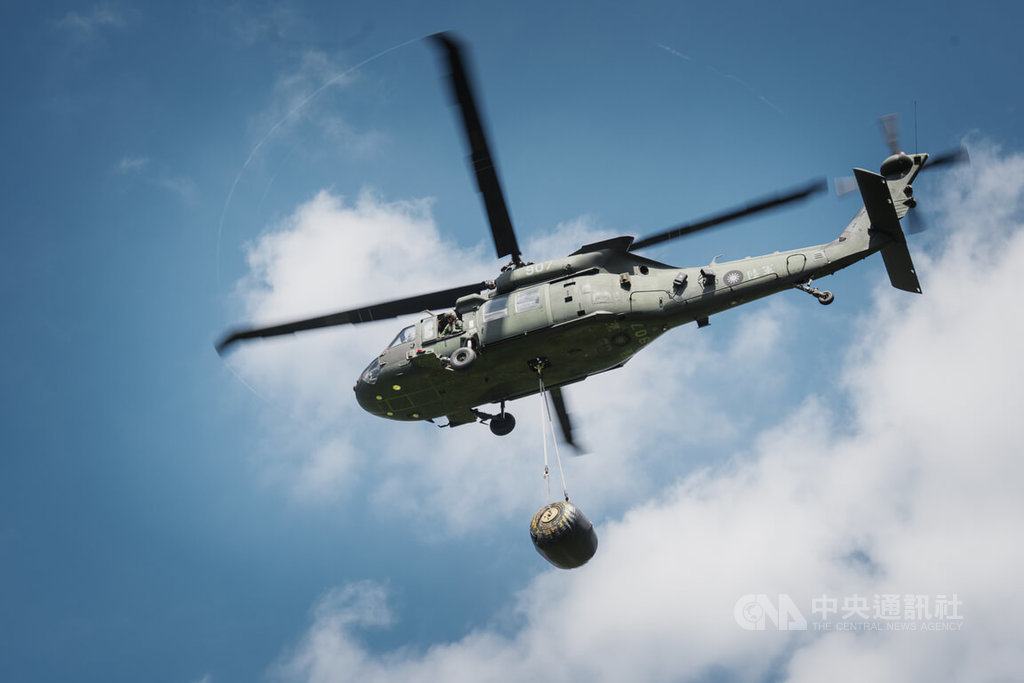
(CNA reporter You Kai-xiang, Taoyuan, July 14) — The second day of Taiwan's five-day Joint Defense Drill saw the Third作战 Zone conduct a critical resupply exercise. One UH-60M Black Hawk helicopter flew along the Dahan River, precisely hovering over a designated location in the Daxi area of Taoyuan. It successfully hoisted and delivered a 500-gallon aviation fuel bladder, which ground forces promptly assembled and connected to fuel lines—all within the required 20-minute window.
The five-day Joint Defense Drill, now in its second day, simulates scenarios where enemy forces have launched and entered Taiwan’s territorial waters, shifting focus from the earlier Readiness Drill (held in June) that emphasized pre-attack preparedness and civil-military transition. This phase emphasizes integrated joint operations across all military branches, validating decentralized command (C2), kill chain execution under 'decentralized' conditions, and adherence to Rules of Engagement (ROE).
The Third作战 Zone, responsible for northern defense and disaster response, deployed the UH-60M Black Hawk from its Aviation Special Forces 601 Brigade. The exercise involved hoisting a 500-gallon aviation fuel bladder along the Dahan River in Daxi, Taoyuan. The bladder can carry various fuel types depending on mission needs, enabling rapid forward deployment of critical supplies to frontline combat units and ensuring sustained operational capability.
On-site reporting by CNA observed the Black Hawk flying along the Dahan River to the designated coordinates, hovering steadily in mid-air. The aircraft’s undercarriage release mechanism lowered the black fuel bladder gently to the ground. Immediately upon touchdown, military trucks and personnel rushed in to assemble the unit and connect fuel hoses. From hoist initiation to full ground readiness, the entire process was completed within the stipulated 20 minutes, showcasing high-efficiency logistical support.
Notably, during last year’s Han Kuang 41 live-fire exercise, Black Hawks and AH-64E Apache attack helicopters from the Aviation Corps conducted hot refueling and weapons loading drills at riverside parks in the Shulin area along the Dahan River, with flight paths following the river corridor for ingress and egress.
In addition to the fuel bladder hoist, the site simulated wartime position shifts and firepower resupply. Thunder 2000 multiple rocket launchers from the 21st Artillery Command rapidly moved into position. Crews completed reloading MK-15 and MK-30 rocket pods, raised the launch tubes to firing elevation, and assumed combat readiness.
Military analysts noted that from a 'point' perspective—field resupply—last year’s hot refueling drill in Shulin demonstrated the Army Aviation’s ability to operate without reliance on conventional bases, enhancing decentralized survivability. This year’s Daxi hoist operation goes further, with helicopters actively establishing mobile resupply nodes.
From a 'line' perspective—concealment and cover—the Dahan River’s deep, winding corridor serves as a natural low-altitude flight path. Flying along the river allows helicopters to avoid radar detection, increasing operational stealth. At the 'surface' or regional defense level, expanding mobile resupply points along the Dahan River corridor enables the integration of resilient logistical networks across the Greater Taipei and Taoyuan operational zones.
Su Tzu-yun, Director of the Institute for National Defense and Security Research’s Strategic and Resources Institute, told CNA that Daxi’s proximity to low-elevation hills and its western adjacency to the Longtan base (home of the 601 Brigade) offers complex terrain and excellent concealment. It has long been a strategic location for the Third作战 Zone to block enemy advances and pre-position fuel and ammunition.
Su emphasized that beyond frontline combat units, the inclusion of Army Aviation hoist operations in the Joint Defense Drill highlights the military’s accelerated shift toward a 'predictive, precise, modular, and decentralized' logistics transformation—aligning with U.S. and NATO doctrines on 'logistical resilience.'
The core strategy lies in 'dispersed stockpiling' and 'establishing independent supply centers.' By storing large quantities of wartime supplies and munitions across multiple locations during peacetime, the risk of total loss from a single enemy strike is minimized. In wartime, if ground supply lines are severed, C-130 transport aircraft or multipurpose helicopters can conduct tactical airdrops or hoist operations to maintain frontline combat power.
He also stressed that flying along river corridors allows helicopters to exploit terrain clutter and river surface noise, which can interfere with enemy radar detection from above, thereby evading lock-ons and enhancing the endurance of central defense operations. (Editor: Yang Lan-hsuan) 1150714
FACT BOX
- Source: CNA (Central News Agency)
- Category: Event