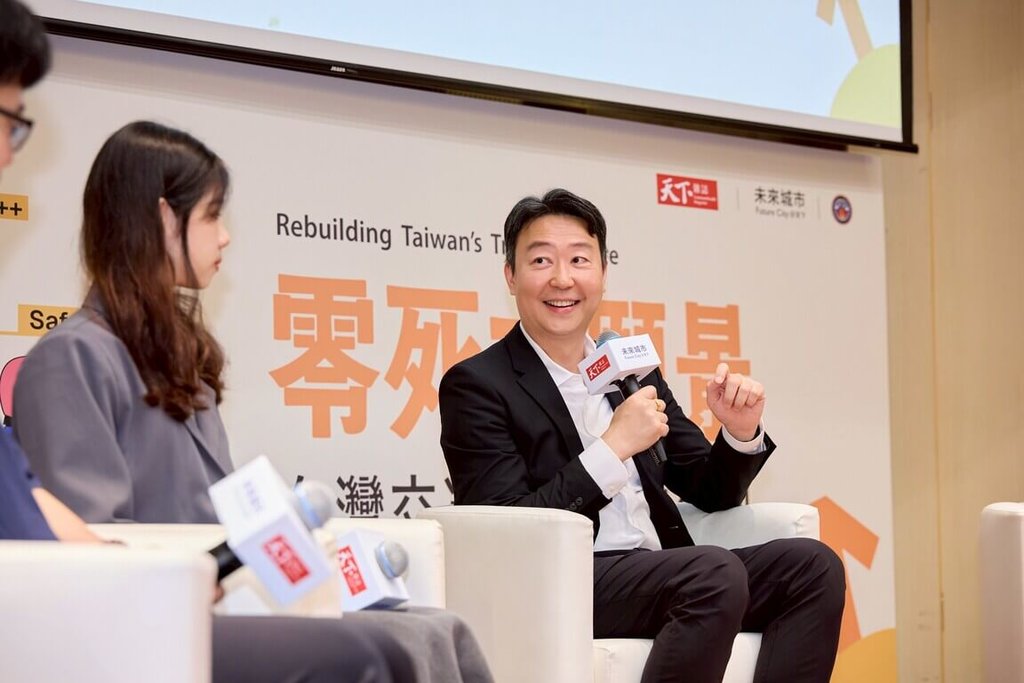
(Central News Agency reporter Yu Xiaohan, Taipei, 15th) Transportation Minister Chen Shikai attended the 'Vision Zero Forum' yesterday and engaged in face-to-face dialogue with young students. Chen stated that in recent years, Taiwan has been promoting human-centered transportation and actively advancing smart transportation infrastructure. He also said that the recommendations proposed by youth teams will be incorporated into future policy discussions.
The 'Vision Zero Forum,' hosted yesterday by Commonwealth Magazine, brought together domestic and international traffic safety experts to share global implementation experiences. The winning teams from the '2026 Vision Zero: Reshaping Taiwan's Traffic Culture Action' workshops—selected after intense regional competitions across northern, central, and southern Taiwan—also presented their outcomes.
According to a press release issued today by the Ministry of Transportation, the forum featured Claes Tingvall of Sweden—known as the 'father of Vision Zero'—who shared online Sweden's practical experiences in speed management and the Vision Zero initiative. Dr. Seol Jae-hoon, Honorary Research Fellow at the Korea Transport Institute, introduced South Korea's 'Safe Speed 5030' policy and achievements in technology-based enforcement.
Domestically, Dr. Chiu Yu-chun, Dean of the College of Management at National Yang Ming Chiao Tung University, explained the Vision Zero concept and safe speed principles. Dr. Chen Chao-wen, Chief of Trauma and Critical Care Surgery at Kaohsiung Medical University Chung-Ho Memorial Hospital, shared insights from frontline emergency treatment experiences, illustrating the relationship between speed, impact, and severe injury risks. This allowed participants to deeply understand the importance of traffic safety from engineering, medical, and policy perspectives.
Minister Chen Shikai attended the forum and held direct conversations with young students, listening to their observations and suggestions on traffic safety. He emphasized that youth are the most important partners in Taiwan's transportation reform and a key force in driving cultural change in transportation.
Chen said, 'As a fellow motorcyclist, I deeply understand young people’s expectations for road safety during their daily commutes and school travel.'
He stated that the core goal of transportation policy is to ensure every road user can leave home safely and return home safely. A truly safe transportation environment is not only about preventing accidents but also about reducing the risk of death and serious injury when accidents do occur—creating road environments with 'forgiving' capabilities.
Chen added that the Ministry has been continuously promoting human-centered transportation policies, improving road engineering, enhancing motorcycle safety, advancing traffic safety education, and pushing forward smart transportation systems. Through collaboration with local governments and various sectors of society, the ministry is enhancing overall road safety.
Chen praised the innovative perspectives offered by youth teams, noting that many of their suggestions align closely with the ministry’s current policy directions. He affirmed that these inputs will continue to be integrated into future policy planning.
The Ministry of Transportation stated that it will continue to learn from international success stories and unite the efforts of government, local authorities, industries, and the public to advance traffic safety culture and move toward the 'Vision Zero' goal. (Edited by Li Heng-shan) 1150715
Stand with the truth. Your support safeguards press freedom.
Download the 'First-Hand News' app by Central News Agency to stay updated instantly.
Unauthorized reproduction, broadcast, public transmission, or use of the text, images, and videos on this website is strictly prohibited.
FACT BOX
- Source: CNA (Central News Agency)
- Category: Event