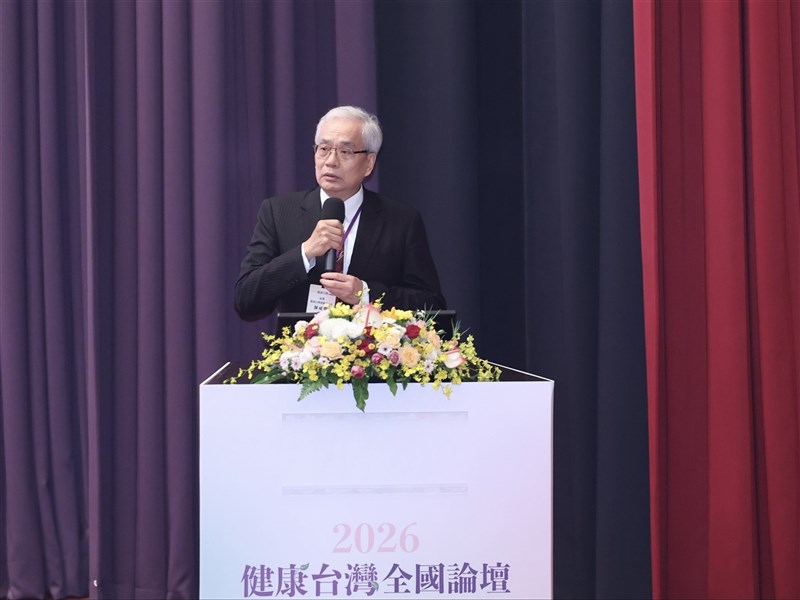
By Central News Agency reporter Shen Pei-yao, Taipei, July 15
Typhoon Bavi recently struck Taiwan, reigniting debate over typhoon-related work and school suspensions. Chen Wei-ming, President of Taipei Veterans General Hospital (TVGH), stated today that such closures have a major impact on hospital operations. Rescheduling outpatient appointments, diagnostic tests, and surgeries is far more complex than simply missing one day of patient care. He stressed that his remarks carry no political considerations.
In an internal open letter, Chen said, "I would like to take this opportunity to explain, from the medical frontline perspective, how Taipei Veterans General Hospital prepares for natural disasters and why we place such high importance on the continuity of medical services."
Chen noted that nearly 3,000 medical staff members reside in on-campus dormitories, while many others live near the hospital. This allows rapid mobilization during emergencies or disasters, forming a key part of TVGH’s long-established medical resilience and serving as a critical safety net for inpatients.
"In recent years, facing extreme weather, TVGH has held multiple cross-departmental meetings to continuously review and improve disaster response measures. The public can rest assured: we have comprehensive and rigorous contingency plans for emergency care and essential surgeries. For example, last Friday (July 10), the hospital successfully completed 95 surgeries," Chen said.
He added, "In fact, not just during typhoons, but also during Lunar New Year, long holidays, or national holidays, TVGH proactively plans and deploys resources in advance. We maintain uninterrupted medical services within legal frameworks and while respecting staff rights. Ensuring care continuity—especially for critically ill patients—remains our core value."
"Many may wonder why a typhoon day off affects hospitals so profoundly," Chen said. The reason is simple: hospitals operate at near-full capacity daily. When work and school suspensions are suddenly announced, not only are patients’ schedules disrupted, but hospitals also struggle to quickly mobilize sufficient staff. Many staff are also parents needing to care for children during school closures. Even with increased overtime pay, immediate return to duty isn’t always feasible.
The real challenge, however, comes after the typhoon. Rescheduling postponed outpatient visits, tests, and surgeries doubles the workload and requires individual coordination and explanations to patients. We understand patients’ anxiety, and the pressure on our staff is equally immense," Chen emphasized.
The impact of canceled outpatient services goes far beyond missing one day of treatment. "Recent comments of mine may have been interpreted differently by some, but I want to reiterate: my sole motivation has always been to consider patients’ perspectives and to faithfully represent the realities of frontline healthcare as the director of a national medical center. There is no political intent, nor any intention to provoke political associations," Chen concluded. (Edited by Kuan Chung-wei) 1150715
FACT BOX
- Source: CNA (Central News Agency)
- Category: Taiwan