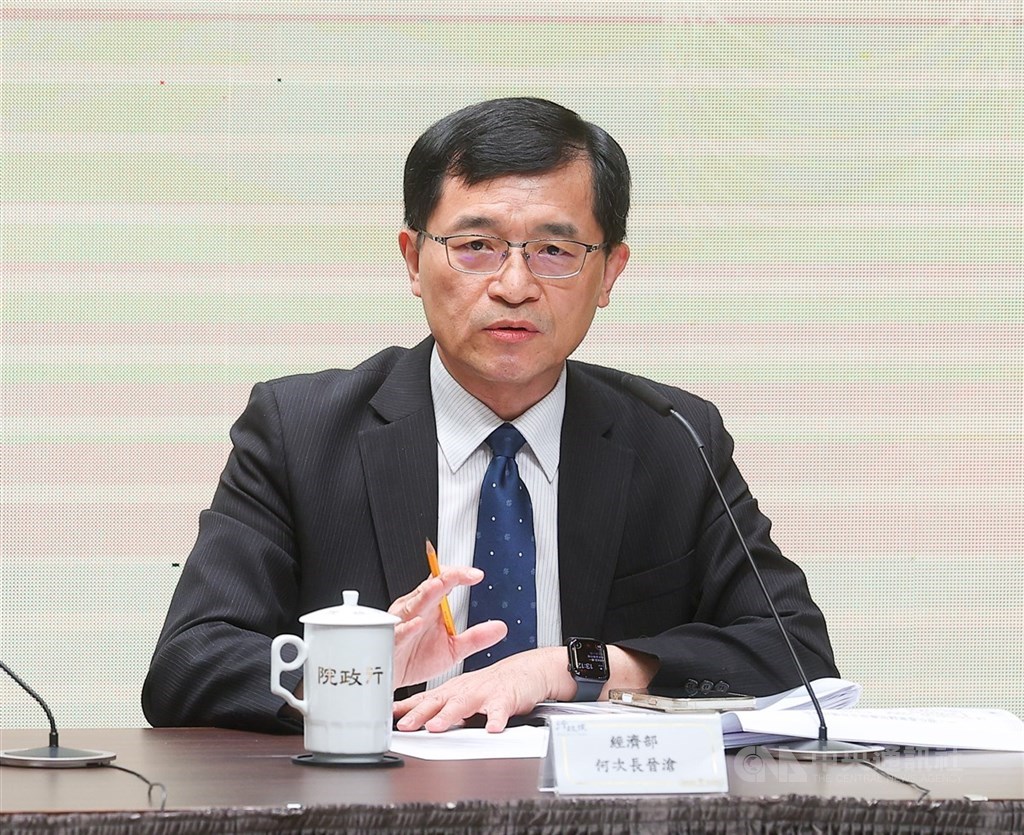
TAIPEI, April 15 (CNA) -- With the Middle East conflict ongoing for over a month, US President Trump recently indicated a possibility of new negotiations with Iran, leading to speculation about future oil price stability. Vice Minister of Economic Affairs Ho Chin-tsang stated today at the Legislative Yuan's Economic Committee that it would be difficult for international oil prices to return to pre-war levels in the short term, and future trends would depend on geopolitical changes. The government will closely monitor the situation.
The Economic Committee today invited the Ministry of Economic Affairs, National Development Council, Sports Administration, Ministry of Education, and Ministry of Finance to report on "Policy planning for Taiwan's sports industry development, talent cultivation, cross-ministerial resource integration, effectiveness of related tax incentives, future output value targets, and comparative analysis of sports industry policies in advanced countries," and to answer questions.
Kuomintang Legislator Hsieh Yi-feng inquired about the impact on Taiwan's energy supply if the US-Iran conflict, which President Trump recently suggested was nearing an end, were to conclude, and whether the costs absorbed by CPC Corporation, Taiwan (CPC) and Taiwan Power Company (Taipower) would decrease.
National Development Council Minister Kung Ming-hsin stated that US think tanks previously estimated the conflict might end within 4 to 8 weeks, which is still within the observation period. Recent international crude oil and natural gas prices have shown signs of decline. Although the conflict's impact on the Consumer Price Index (CPI) might be delayed until April, if the conflict ends in the short term, the overall impact on annual CPI and economic performance will be relatively limited.
Ho Chin-tsang said the Ministry of Economic Affairs would continue to observe, but even if peace talks emerge, international oil prices would still find it difficult to return to the pre-war level of February 28 in the short term. However, a drop in oil prices would help reduce the costs absorbed by CPC due to rising energy prices.
Democratic Progressive Party Legislator Lai Jui-lung expressed concern about the US's announcement of a blockade of the Strait of Hormuz, its potential impact on Taiwan's oil sources, and whether domestic oil prices would continue to rise.
Ho Chin-tsang explained that domestic oil and gas supply would not be affected because CPC has continuously adjusted oil sources and prepared in advance. Supply until June is secure, and July's supply is also being arranged. As long as crude oil sources are stable, the domestic petrochemical industry chain supply can be maintained without issues.
CPC Vice President Lin Ke-ju pointed out that international oil price trends still depend on the conflict's development, but CPC will cooperate with the government's price stabilization policy, and domestic oil prices have not been adjusted in the past two weeks.
Regarding foreign media reports that Taiwan is highly dependent on imported energy and has low liquefied natural gas (LNG) reserves, which could affect power supply and impact livelihoods and economic operations if sea transport is interrupted, Ho Chin-tsang emphasized that the current overall allocation is not problematic. The government will closely monitor the conflict situation and require major importers like CPC and Formosa Plastics to continue strengthening allocation and advance planning. (Editor: Pan Yi-ching) 1150415
FACT BOX
- Source: CNA (Central News Agency)
- Category: financial