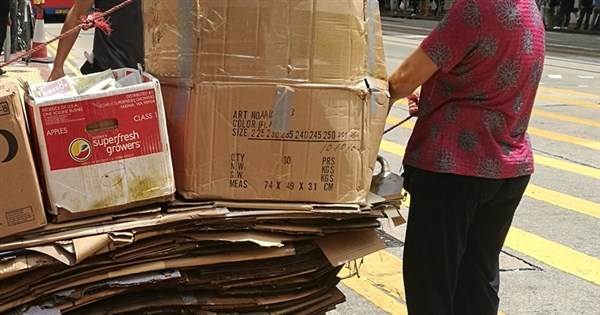
In Hong Kong, one of Asia's wealthiest cities, a group of scavengers known as "cardboard grannies" are hard to ignore. Most are over 70, pushing carts loaded with dozens of kilograms of waste cardboard to sell, yet their earnings are barely enough for two meals. CNN followed one "cardboard granny" for a night and interviewed other elderly scavengers. They endure sun and rain, navigating steep slopes and narrow streets, with the constant risk of their carts and cardboard being confiscated by municipal authorities. On a lucky day, they might earn HK$100 (about NT$400), just enough for two meals. 71-year-old Wu Sau-jing hits the streets at 2:00 AM daily to collect cardboard discarded by shops and restaurants. By the time she sorts and sells it to local recyclers, it is usually 11:00 AM. She told CNN, "I make a living from this, and it's also my hobby. If you don't like it, it's very tiring." Ms. Lai, in her 70s, says she earns about HK$100 a day, barely enough for lunch and dinner. She notes that her earnings have halved over the past year, as recyclers now pay HK$0.3 per kilogram, down from the government-recommended minimum of HK$0.6. Worse, sometimes strangers or government workers discard her collection as trash, leaving her with nothing. 95-year-old Chan Ngai-kan spent an afternoon pushing her cart only to find her usual recycler wouldn't take the cardboard, forcing her to dump it at a nearby trash site. She told CNN it was a huge blow, adding, "My children are in Canada, and I have no money." 80-year-old Mr. Cheung is one of the few "cardboard grandpas." A 2024 report by Oxfam Hong Kong estimates that 580,000 elderly people in Hong Kong live in poverty. While the government provides small subsidies, in one of the world's most expensive cities, some choose to earn extra income to cover living expenses. Hong Kong generates about 1.51 kg of waste per person per day, higher than Tokyo (0.88 kg), Seoul (0.95 kg), and Taipei (1.139 kg). Official data shows only 30-40% of Hong Kong's waste is recycled, compared to over 50% in Taiwan and South Korea. For 30 years, Wu has returned to the same street every night. Despite the instability and hardship, she jokes, "It's like smoking or gambling. You can't quit this hobby... I will do it until I can't anymore."
FACT BOX
- Source: CNA (Central News Agency)
- Category: Taiwan
- Organizations: CNN