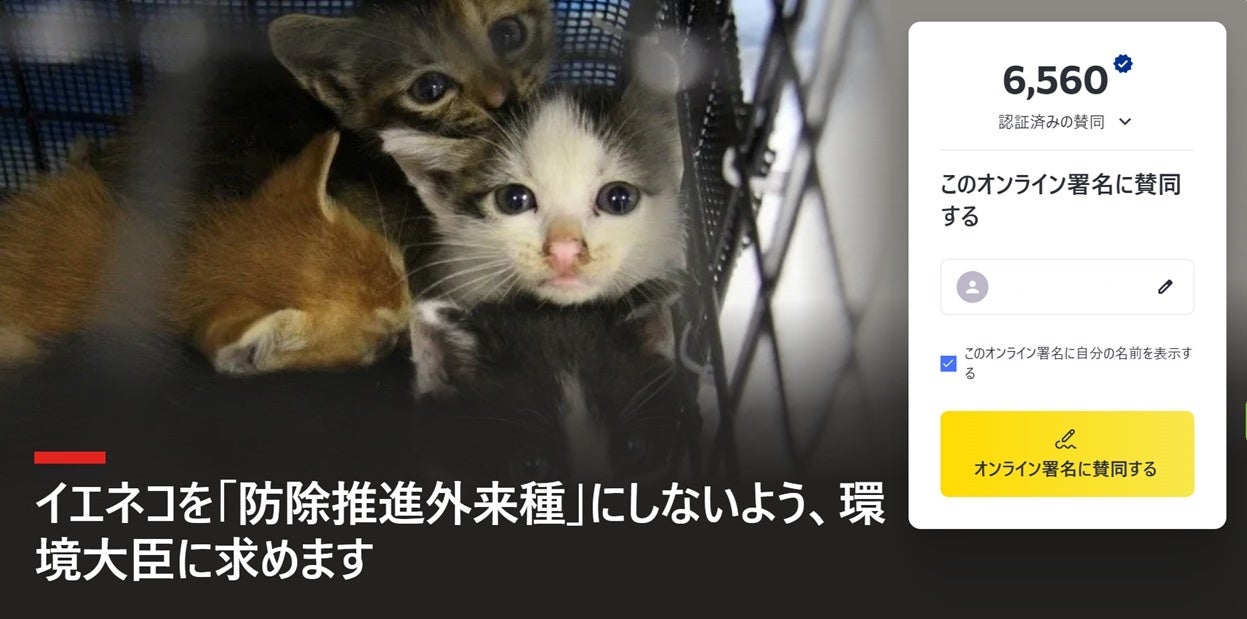
The Dobutsukikin Foundation (Location: Ashiya City, Hyogo Prefecture / Director: Kunihisa Sajo) has initiated an online signature campaign on Change.org starting July 4th and submitted a petition to the Minister of the Environment on July 6th, opposing the Ministry of the Environment's consideration of designating domestic cats (pet cats and stray cats) as "Invasive Species for Eradication Promotion" in its review of the "List of Invasive Alien Species to Prevent Ecological Damage."
"Eradication" means removal. The Dobutsukikin Foundation believes that positioning cats within the framework of invasive species countermeasures as targets for "eradication as a precaution" is fundamentally erroneous, both scientifically and institutionally.
Background: What is Currently Under Consideration?
According to multiple news reports, the Ministry of the Environment is in the final stages of adjusting its approach to broaden the scope of its invasive species list review, which is being conducted for the first time in about 10 years, from "feral cats" to "domestic cats," including stray and pet cats, designating them as "Invasive Species for Eradication Promotion" (Kyodo News / Yahoo! News).
Upon confirmation with the Ministry of the Environment, the ministry stated that it is currently in the final phase of refining this policy. The public comment period, during which citizens could submit their opinions (April 2, 2026 - May 1, 2026), has already concluded, and the formal decision and announcement are imminent. Amidst rapidly growing public interest in this issue since the reports at the end of June, the Dobutsukikin Foundation decided to launch a signature campaign and submit a petition to voice its opposition before the decision is finalized.
【Confirmation of Facts】 This list is an administrative list intended to broaden understanding of invasive species and encourage appropriate action; it has no legal binding force or penalties in itself. Cats will not be designated as "Specially Designated Invasive Species" (under the Invasive Alien Species Act) like black bass, etc. The Dobutsukikin Foundation opposes this for the following reasons, while accurately acknowledging this point.
Four Requests Detailed in the Petition
Cease treating domestic cats (pet cats and stray cats) as "Invasive Species for Eradication Promotion."
Agree to the policy of removing cats from the "Invasive Species for Eradication Promotion" list (even if scientific evidence proves that domestic cats pose a risk of driving native species to extinction and action against cats becomes absolutely necessary, such action should be humane and scientific, not eradication. This does not mean abandoning the conservation of rare species).
Cat ownership and population management should be conducted under the Act on Welfare and Management of Animals as proper care, not as invasive species countermeasures, using humane methods such as TNR and community cat programs, and should not involve restrictions on outdoor cats, community cats, TNR, feeding, or undue pressure on related parties.
Decisions regarding the handling of cats should be reconsidered with the inclusion of expert knowledge in animal welfare and relevant stakeholders.
Main Reasons for Opposition (from the Petition - all based on primary sources)
No scientific evidence found that cats threaten the ecosystem on the mainland: The Ministry of the Environment's Red List does not include a single native species that has been driven to extinction solely by pet or stray cats.
The recovery of the Amami rabbit is not explained by feral cat eradication: The primary factor contributing to the recovery of the Amami rabbit is stated to be mongoose eradication, not feral cat eradication.
IUCN's high-risk assessment is based on "oceanic islands without native predators": The premise differs between places like Hawaii and the Amami/Okinawa islands, which have native predators (IUCN GISD).
Committee members themselves consider "proper care and human management" to be core: In the minutes of the 5th meeting, even a committee member promoting the inclusion stated, "the idea that countermeasures equal eradication is outdated."
International standards (ICAM) also recommend humane management such as TNR, not eradication.
Cat ownership falls under the scope of proper care in the Act on Welfare and Management of Animals and should not be regulated as an invasive species countermeasure.
The members of the committee that made the decision do not include representatives from animal welfare administration (Ministry of the Environment's Animal Welfare Management Office) or animal protection/welfare organizations.
"Why is this an issue if the list has no legal binding force?"
This list has no penalties. However, as the name suggests, "Invasive Species for Eradication Promotion" is a classification that directs the nation's policy towards "eradication" of wild populations (stray cats and feral cats). Furthermore, this matter targets domestic cats (pet cats and stray cats) nationwide, not just specific regions like Okinawa.
Even if "pet cats are excluded," this exclusion is conditional on "proper indoor keeping," meaning outdoor cats that go in and out of the house are not included (approximately 8.85 million pet cats - Pet Food Association). Reports cite "cats being fed outdoors preying on rare animals" as the background for the target, and the Ministry of the Environment's explanation that "cats inside homes are excluded" implies that "cats that go outside are included."
In fact, in the minutes of the 5th committee meeting, a member promoting the species' inclusion stated, "The main players in the cat problem are stray cats," and "If stray cats are excluded, the effectiveness will be lost," explicitly stating that the target is stray cats in towns. There is a concern that outdoor cats, regardless of whether they are owned, community cats, or stray cats, are indistinguishable and may be uniformly targeted nationwide. The official name of the list is "List of Invasive Alien Species that May Cause Damage to Our Country's Ecosystems," and it is a framework that allows for eradication measures before damage occurs.
Additionally, with "Specially Designated Invasive Species," which have legal binding force, measures such as release prohibition by ordinance, collection, intensive eradication, and penalties have been gradually accumulated after a species is classified as an "invasive species to be eradicated" (e.g., invasive fish countermeasures in Shiga Prefecture, mongoose eradication in Amami). The Dobutsukikin Foundation is concerned that even inclusion on an advisory list could lead to pressure on outdoor cats, feeding, and community cat programs, and could serve as a starting point for future measures.
While there are explanations that "eradication includes protection and TNR," there is no need to handle them under the classification of "eradication promotion," which emphasizes "removal." If the goal is truly proper care and TNR, it should be conducted within the framework of the Act on Welfare and Management of Animals.
Regarding the Signature Campaign and Petition
The Dobutsukikin Foundation has launched an online signature campaign on Change.org. The collected voices will be used, along with the petition, to lobby the Ministry of the Environment.
▶ Signature Page: We urge the Minister of the Environment not to designate domestic cats as "Invasive Species for Eradication Promotion." ▶ Full Text of Petition: Petition Regarding the Handling of Domestic Cats in the Review of the List of Invasive Alien Species to Prevent Ecological Damage.
Representative's Comment (Director, Kunihisa Sajo)
A cat waiting at the entrance when I return home in the evening. A person quietly placing food for the neighborhood cats they've named at dawn. "Sakura Cats" with their ear tips cut like cherry blossoms --
What we have protected over a long time, in collaboration with municipalities and local communities across the country, are these precious individual lives. We have consistently advocated for the importance of indoor keeping and zero euthanasia, together with the government. Yet, the same government is considering calling cats living outdoors "eradication targets as a precaution." We cannot remain silent in the face of this reality. At a time when the fate of cats is about to be decided without the involvement of those who know cats best, please lend your strength, many who care for cats.
【References and Sources】 (All primary information)
List of Invasive Alien Species to Prevent Ecological Damage (Advisory, no legal binding force): https://www.env.go.jp/nature/intro/2outline/iaslist.html
News Reports (Kyodo News / Yahoo! News): https://news.yahoo.co.jp/articles/db04ddc0904f9d56de72ab42c8bfb5d283e1626a
Meeting Minutes (5th Meeting): https://www.env.go.jp/nature/intro/2outline/iaslist/gairailist/byseitailist5/gaiyou.pdf
Regarding the Convening of the Meeting (Expert Panel on Biology, etc.): https://www.env.go.jp/press/press_03718.html
List of Meeting Committee Members: https://www.env.go.jp/content/000250866.pdf
Ministry of the Environment Red List / Red Data Book: https://www.env.go.jp/nature/kisho/hozen/redlist/
Ministry of the Environment Declaration of Mongoose Eradication in Amami Oshima: https://www.env.go.jp/press/press_03661.html
IUCN Global Invasive Species Database (Felis catus): https://www.iucngisd.org/gisd/speciesname/Felis+catus
ICAM "Humane Cat Population Management Guidance": https://www.icam-coalition.org/download/humane-cat-population-management-guidance/
Ministry of the Environment Guidelines for Proper Keeping of Dogs and Cats in Densely Populated Areas: https://www.env.go.jp/nature/dobutsu/aigo/2_data/pamph/h2202.pdf
Ministry of the Environment Guidelines for Multi-pet Ownership Issues: https://www.env.go.jp/nature/dobutsu/aigo/2_data/pamph/r0303a.html
Ministry of the Environment Prohibition of Cruelty and Abandonment (Act on Welfare and Management of Animals): https://www.env.go.jp/nature/dobutsu/aigo/1_law/aigo.html
e-Gov Act on Welfare and Management of Animals: https://laws.e-gov.go.jp/law/348AC1000000105/
Pet Food Association National Dog and Cat Ownership Survey: https://petfood.or.jp/data-chart/
Shiga Prefecture Invasive Fish Eradication Project: https://www.pref.shiga.lg.jp/ippan/shigotosangyou/suisan/18681.html
Ministry of the Environment Q&A on the Invasive Alien Species Act (Regulations and Penalties): https://www.env.go.jp/nature/intro/1law/qa.html
Dobutsukikin Foundation
Since its establishment in 1988, the Dobutsukikin Foundation has consistently worked on the welfare and proper management of animals, including cats. In collaboration with 598 municipalities (governments) nationwide, it has implemented the "Sakura Cat Free Sterilization Project (TNR)" and has provided free sterilization surgery to over 440,000 stray cats and cats from multi-pet ownership collapses (cumulative total of 441,876 cats). It also collaborates with the Ministry of the Environment in the field of animal welfare and management and has received awards and commendations from over 35 municipalities.
<Organization Overview>
Name: Dobutsukikin Foundation (Animal Action Fund) Address: 71-7 Okui-Minamicho, Ashiya City, Hyogo Prefecture Established: June 1988 Director: Kunihisa Sajo Official Website: https://www.doubutukikin.or.jp
FACT BOX
- Source: PR TIMES
- Category: 政策反対
- Organizations: Change.org / IUCN / ICAM