Fancl Corporation has jointly developed an "AI for Tablet Design" with Kirin Holdings Company, Limited, utilizing formulation data accumulated through its supplement development. This AI supports tablet design, enabling a data-driven approach that moves away from the traditional reliance on the experience and intuition of skilled researchers, as well as extensive trial-and-error processes. This is expected to shorten the development time for easy-to-swallow, high-quality supplement formulations.
This research outcome was published in April 2026 in the international academic journal "Pharmaceutics," a leading publication in the field of formulation and DDS (Drug Delivery System). Its novelty and effectiveness as a next-generation formulation design technology utilizing AI have been academically recognized.
[Research Objectives and Background]
Tablet design requires simultaneously satisfying multiple physical properties, such as ease of swallowing, sufficient hardness for transport, and appropriate dissolution in the body. However, because these properties influence each other, deriving an optimal formulation design traditionally necessitated extensive prototyping and trial-and-error.
Therefore, this research aimed to develop an AI for tablet design to rapidly identify formulation conditions that satisfy each property, and further, to find the most efficient and optimal formulation conditions.
[Research Methods and Results]
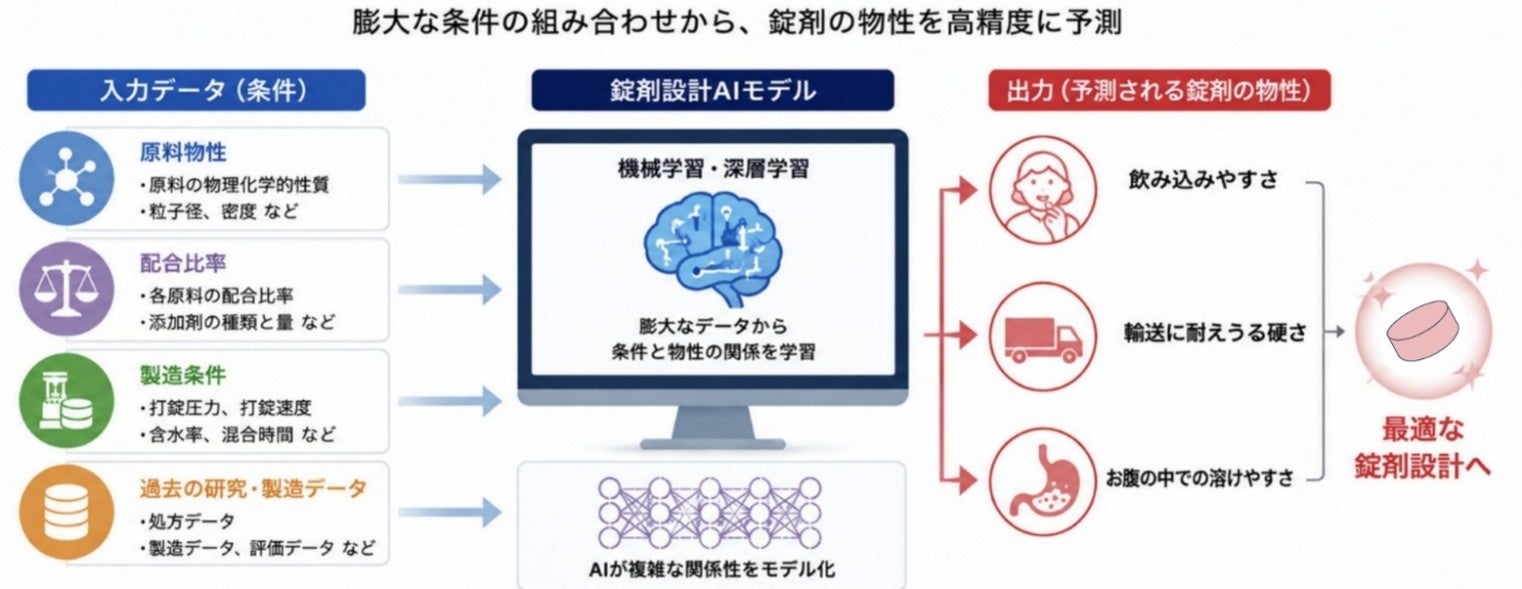
The developed AI was trained on past research and manufacturing data to predict multiple factors of tablets, including "ease of swallowing," "hardness resistant to breakage during transport," and "dissolution rate in the body." The AI can rapidly and accurately predict and compare thousands to tens of thousands of formulation condition combinations that would be difficult for humans to examine.
This is expected to lead to improved quality through the calculation of optimal formulation solutions (e.g., faster dissolution, smaller and easier-to-swallow designs), stabilization of product quality (achieving consistent design quality regardless of the person in charge), shortened development periods, and reduction in raw material loss (see Figure 1).
Figure 1: Image of the Tablet Design AI Model
[Future Outlook]
Our company has conducted product development based on our long-held philosophy of "delivering value to customers with only the truly necessary ingredients." By utilizing this technology, we aim to evolve supplement tablet design from a trial-and-error process to data-based development, further improving ease of swallowing and advancing technologies that enhance in-body efficacy.
Moving forward, we will continue to focus on developing high-quality, easy-to-swallow formulations and further enhancing product value, leveraging our strengths through human-AI collaboration.
[Published Paper]
Journal Name: Pharmaceutics
Paper Title: Application of AI in Tablet Development: An Integrated Machine Learning Framework for Pre-Formulation Property Prediction
Authors: Masugu Hamaguchi, Tomoki Adachi, Noriyoshi Arai (and other co-authors)
Publication Information: Journal: Pharmaceutics Year: 2026 Volume: 18 Issue: 4 Article Number: 452
FACT BOX
- Source: PR TIMES
- Category: 共同開発