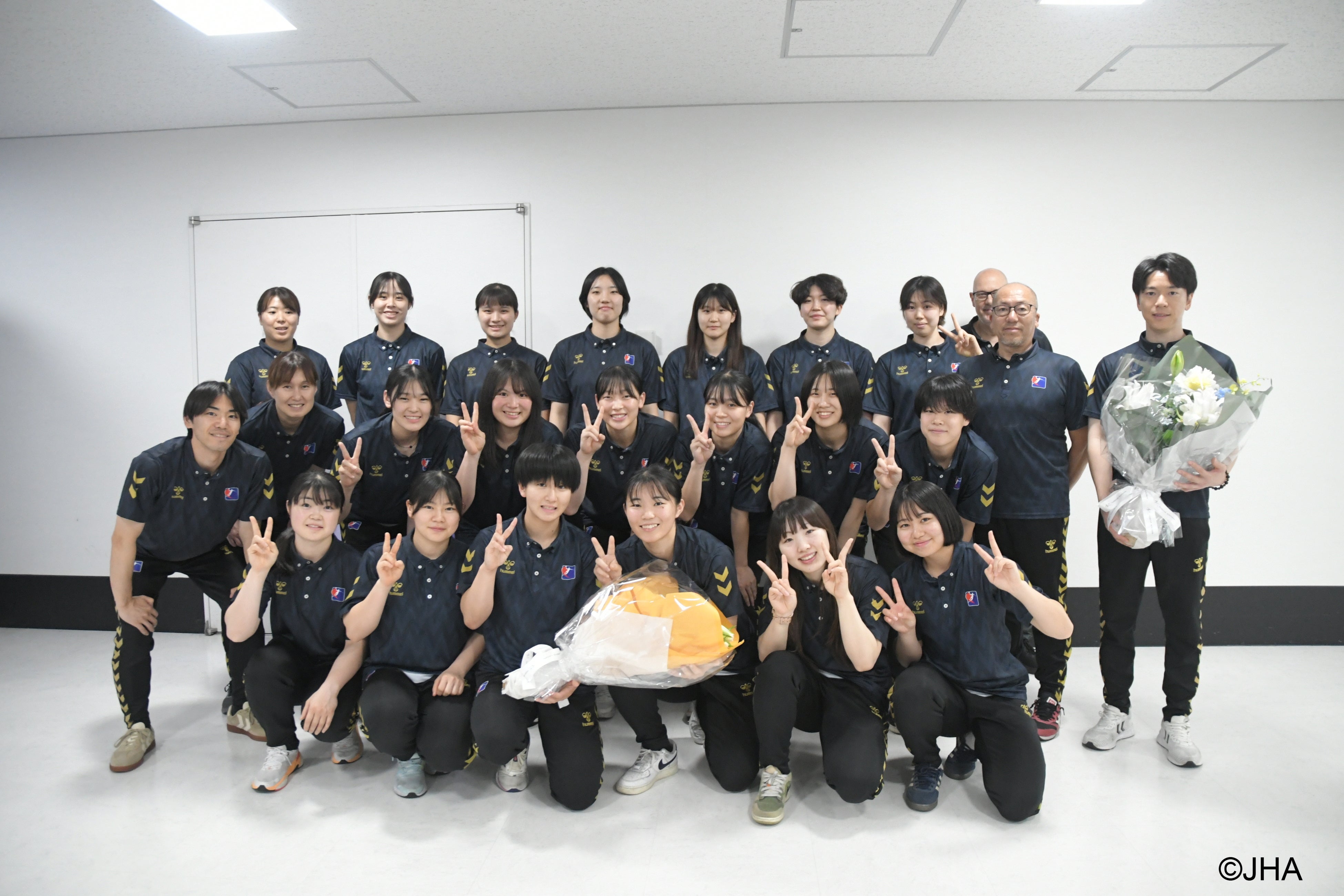
July 6 – Players Return Home with Confidence and Regret
We sincerely appreciate your continued support of our association.
The Japan Women's Junior National Handball Team, having secured 7th place—the highest ranking in its history—at the 25th IHF Women's Junior (U-20) Handball World Championship, returned to Japan on July 6 from the host country, China.
The players returned home carrying both confidence earned from competing on equal terms with elite European teams, and regret from narrowly missing their medal goal despite coming close.
Here, we reflect on the team’s inspiring performance, which has given the future of Japanese handball renewed hope.
First-Time Group Stage Top Finish
Japan was placed in Group H of the preliminary round, alongside Croatia (8th at the 2025 Women's U-19 European Championship), Norway (14th), and the Faroe Islands (20th)—all established European powerhouses.
Although Japan entered the tournament with a clear medal target and strong preparation, the group was extremely tough—any minor misstep could have led to elimination.
In their opening match against the Faroe Islands, Japan seized early momentum with relentless, high-energy defense, quickly building a lead and securing a dominant 32–22 victory.
Riding the momentum, Japan narrowly defeated Norway 26–24, preserving their halftime lead. With this win, even a loss to Croatia in the final group match would not prevent Japan from finishing top of the group—marking the first time in the team’s history they advanced from the preliminary round as group leaders.
Players celebrating with broad smiles after defeating Norway and securing their first-ever top finish in the preliminary round.
Dominating the Main Round
However, Japan could not fully recover from their 23–26 loss to Croatia in the final preliminary match. In their first main round game against Hungary, who had studied Japan’s tactics, they fell behind early and lost 25–32.
This loss placed Japan in a do-or-die situation: a win against Poland in the next match was essential to keep their semifinal hopes alive.
Yet, Japan regrouped under pressure. With tenacious defense, they stifled Poland’s momentum and took an early lead. Despite a tense second half, they held on to win 22–18.
Meanwhile, Norway—also from Group H—won both of their main round matches against Poland and Hungary, tying Japan at 2 wins and 1 loss. However, since Japan had defeated Norway in the preliminary round, they advanced as group winners based on head-to-head results.
This marked another historic achievement: Japan became the first team in its history to top both the preliminary and main rounds and advance to the knockout stage.
Players overwhelmed with joy after defeating Poland.
Closing In on the Medal Dream
In the quarterfinals, Japan faced Spain—the 2nd-place team from the 2025 Women's U-19 European Championship. Spain had defeated Japan 32–23 in the semifinals of the 2023 Women's Youth (U-18) World Championship, where Spain went on to win gold.
Spain came out strong in the first half, using their height and power to seize control. Japan recovered and fought evenly. In the second half, despite allowing Spain two separate 4-point scoring runs, Japan refused to give up. With 11 seconds left and trailing 32–33, Spain scored a final goal to seal the 34–33 victory.
Although the medal dream ended here, the match demonstrated Japan’s remarkable growth since their 9-point loss to Spain two years ago. It proved Japan now possesses world-class resilience.
Challenging Spain’s towering defense—just one goal short. (Photo: Wakanami Kitahara)
Securing the Highest-Ever Finish
In the 5th–8th place semifinal, Japan faced Serbia—a team they had narrowly lost to 20–21 in the same match two years ago.
A win would have guaranteed Japan 5th or 6th place—their best-ever finish. Despite a tightly contested match that lasted until the final minutes, Japan narrowly lost 27–29.
As a result, the 7th-place playoff against Norway became a decisive match: win, and Japan would claim its highest-ever ranking; lose, and they would tie their previous best.
At halftime, Japan trailed Norway 15–16—the same scoreline as their preliminary round match. In their previous seven games, Japan had won all three matches where they led at halftime but lost all four where they trailed. Breaking this pattern was critical.
Applying lessons from past losses, Japan equalized and then took the lead early in the second half. Their fast, agile defense—leveraging their foot speed—dominated the final stretch, and they pulled away to win 32–27.
Japan secured 7th place—the highest in team history.
Players celebrating the moment they clinched 7th place by defeating Norway again, following their earlier group stage victory.
Competing on Equal Footing with Europe
Japan faced European teams in all eight matches of the tournament, finishing with a 4–4 record. Three of their four losses were by three points or fewer, demonstrating their ability to compete at the highest level.
This 7th-place finish is the best ever for Japan in this age category and ties the best overall result across all categories in World Championship history. In a tournament often seen as a predictor of national team futures, Japan took a major step forward.
Every Player a Star
Finishing first in both the preliminary and main rounds is a notable achievement. Sashiki Haruhi (University of Tsukuba), with 37 total goals (ranked 22nd in scoring), was the team’s top scorer. Ozaki Hina (Osaka University of Health and Sport Sciences), named Player of the Match in all four wins, ranked 24th in save percentage (71 saves out of 219 shots, 32.4%). While no individual stood out statistically, each player stepped up at critical moments, showcasing unity and collective strength.
Looking Ahead
As reflected in the comments below, neither Head Coach Shota Arai nor the players are fully satisfied with 7th place. They believe several of their losses could have been wins.
Especially painful was the one-goal loss to Spain—had they won, they would have reached the semifinals and come closer to their medal goal.
To win these close matches, Japan must strengthen their physical conditioning to match the world’s elite athletes. On this foundation, they must adapt to the longer limbs and faster pace of international players—something not experienced in domestic play—and reduce errors.
Many countries already field professional-level junior players, and the global game continues to evolve. Each player is expected to carry forward their current regrets and sensations as they grow into key members of “Orihime Japan.”
Please continue to follow the journey of these young athletes.
Armed with the experience from this tournament, the players are moving to the next stage.
Coach and Player Comments
[Coach Shota Arai’s Comment]
Entering this tournament with the belief that winning a medal would contribute to the development of handball in Japan, I aimed for a medal.
FACT BOX
- Source: PR TIMES
- Category: News