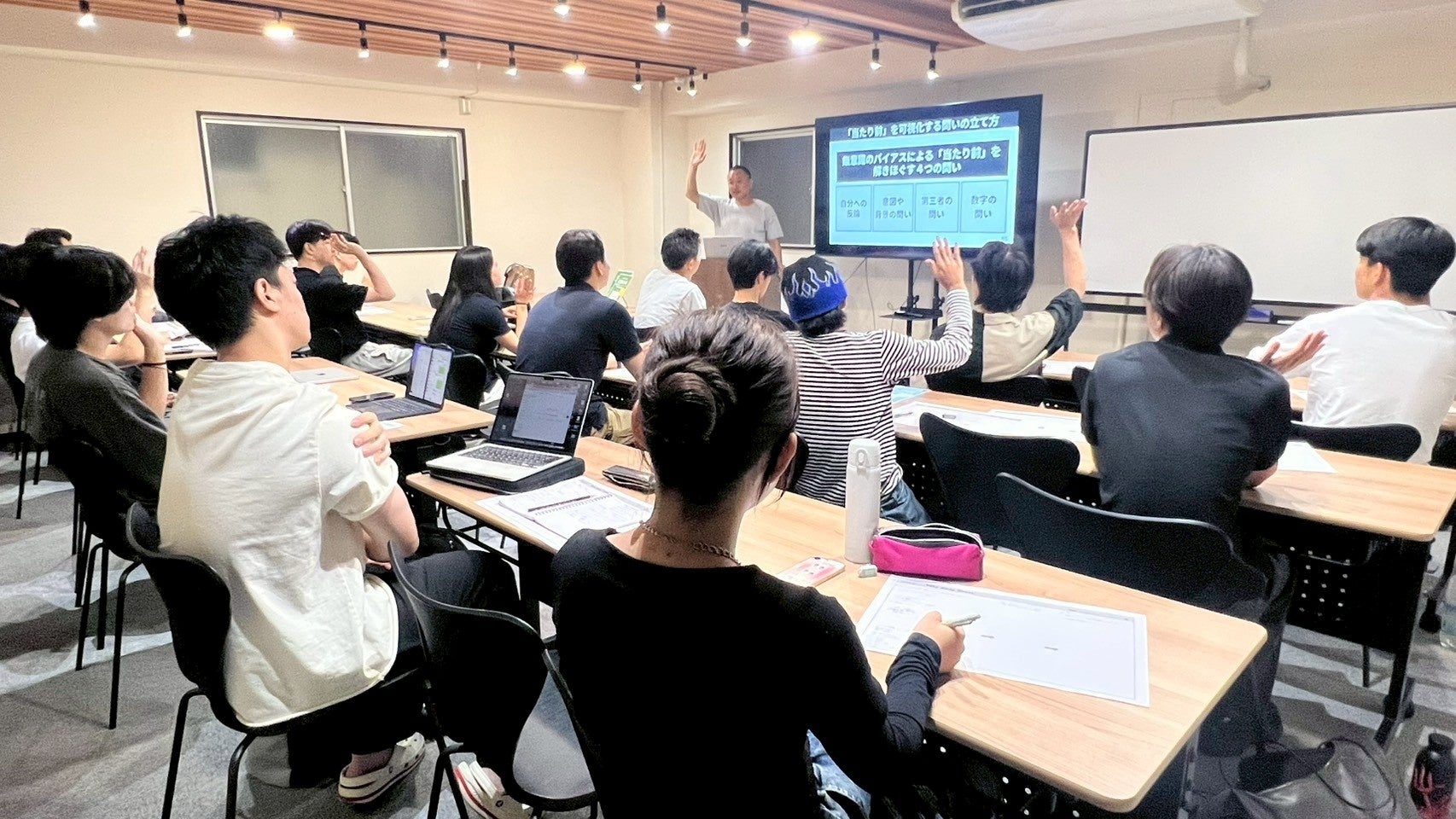
A venue filled with enthusiasm
Imajina Co., Ltd. (Headquarters: Chiyoda-ku, Tokyo; President & CEO: Yoshiki Sekino), which has supported branding for over 3,000 companies, specially hosted a free 'Contributive EQ Enhancement × Self-Understanding Workshop' on July 9, 2026, as part of its social contribution initiative, targeting 17 students from Waseda University’s intercollegiate job-hunting circle 'Bizme'.
In an era where AI technology is replacing the domain of 'IQ (Intelligence Quotient)', this 120-minute program delved into the essence of 'EQ (Emotional Intelligence)'—the irreplaceable human skills that serve as the sole fortress for young talent to thrive in society.
Free on-site workshops nationwide are now available upon consultation!!
1. Essential Skill in the AI Era: 'EQ (Human Skills)' and the Trap of Cognitive Bias
According to research by Harvard University's Professor Daniel Goleman, 90% of the factors determining success in organizations stem from EQ. In the first half of the workshop, using experiments from visual psychology and neuroscience, participants learned how humans are unconsciously dominated by 'cognitive biases' (thinking habits). Sekino pointed out that 'the brain prioritizes energy conservation and sees only what it wants to see.' He emphasized the importance of 'self-awareness'—objectively recognizing one’s own emotional and cognitive biases—and introduced a framework of four EQ elements essential for collaboration: self-awareness, self-regulation, social awareness, and a mindset of mutual contribution.
2. Four Questions to Unlock Media Literacy and 'Essential Improvement Thinking'
In an age where misinformation and disinformation are cited by the World Economic Forum as 'the greatest global risks,' 'media literacy'—the ability to see through information without blindly accepting it—is an essential 'national defense' for survival. Cultivating 'essential improvement thinking,' which involves objectively viewing situations and continuously improving them, is grounded in 'intellectual humility'—acknowledging the limits of one’s own knowledge. During the workshop, students were taught a concrete approach: 'Four Questions' to unravel unconscious biases and visualize the taken-for-granted—(1) Counter-argument to oneself, (2) Question of intent and background, (3) Third-party perspective, and (4) Question of data and evidence.
3. Kohlberg's 'Contributive Morality' and a New Axis for Growth
To break free from common pitfalls among job seekers—such as prioritizing 'cost-performance' and 'time-performance' or being 'instruction-dependent'—the workshop introduced the 'Six Stages of Contributive Moral Development,' applying the theory of developmental psychologist Lawrence Kohlberg. The starting point of human maturity lies in the awareness of how much benefit and opportunity one has 'received' from others and society (Stage 0). Without this awareness, individuals often fall into the role of the 'tragic heroine,' fearing change and blaming others. By shifting one’s growth axis from 'comparison with others' to 'comparison with yesterday’s self' and embracing roles that are needed by future generations and society (a sense of indispensability), people can unlock their true potential, the workshop explained.
4. Sharp Dialogue and Dramatic Mindset Shifts Among Participants
The workshop was conducted entirely in a two-way discussion format. In response to a sharp student question—'Why don’t Japanese companies invest in EQ?'—Sekino gave a direct answer grounded in Japan’s unique employment practices and management structures. He also passionately addressed the trend of 'delegating all decision-making to AI,' stating that decisions involving responsibility, emotion, and empathy are within the domain of human EQ that AI cannot replicate. Members of 'Bizme' reported a wave of reflections, reevaluating their previously passive 'student mindset.'
[Voices from Participants]
From 'Question = Resolving Doubts' to 'Question = Tool for Improving Reality'
'I used to think asking questions was simply about resolving uncertainties. But now I’ve completely changed my perspective: questions are tools to identify current challenges and create future improvements. From now on, I’ll consciously verbalize my current situation and add my own hypotheses or ideas before asking questions.' (Female, Year 4)
Designing Active Questions with Purpose
'I realized it’s important to set a 'purpose' for what I want to know and think about what I want to achieve afterward. Since I’ve learned how to ask good questions, I want to move beyond passively listening to lectures and instead consciously ask questions that lead to improvement, directly connecting this to my future career development.' (Female, Year 2)
Shifting from Blaming Others to Taking Ownership
'I realized the importance of deeply considering the other person’s position before asking questions, and of EQ itself. This was a major turning point that made me reconsider my previously passive 'student mindset.' (Male, Year 1)
5. Free Provision as Social Contribution and Future Outlook
Imajina Co., Ltd. is offering this workshop free of charge to universities and student organizations nationwide, aiming to cultivate self-driven talent from within campuses—talent for whom 'joining a company is not the end goal'—and to transform Japan’s labor market. The 17 'Bizme' students who participated have taken a solid step beyond mere job-hunting techniques, acquiring a lifelong compass for growth as professionals.
FACT BOX
- Source: PR TIMES
- Category: Event