The Japan Consumer Cooperative Union (JCCU, Chairperson of the Representative Council: Chitose Arai) has compiled and announced the results of its spring 2026 'Survey on Rice.'
Rice production for the Reiwa 7 harvest season has turned out to be abundant despite drought and extreme heat, contrary to initial expectations. Statistically, rice shortages have been resolved, and private stock levels have recovered to sufficient levels. However, due to market instability caused by the 'Reiwa rice crisis,' competition among distributors for procurement has intensified. Continued high prices have led to reduced rice consumption, resulting in a current supply-demand gap characterized by 'sufficient quantity but high prices.' Going forward, domestic supply and demand are expected to shift toward easing.
To continue monitoring rice consumption patterns, supporting members' livelihoods, and supporting rice-producing regions, JCCU conducted a web-based survey targeting its nationwide cooperative members. (Survey period: March 12–16, 2026; Valid responses: 7,165)
~Main Findings from the Survey~
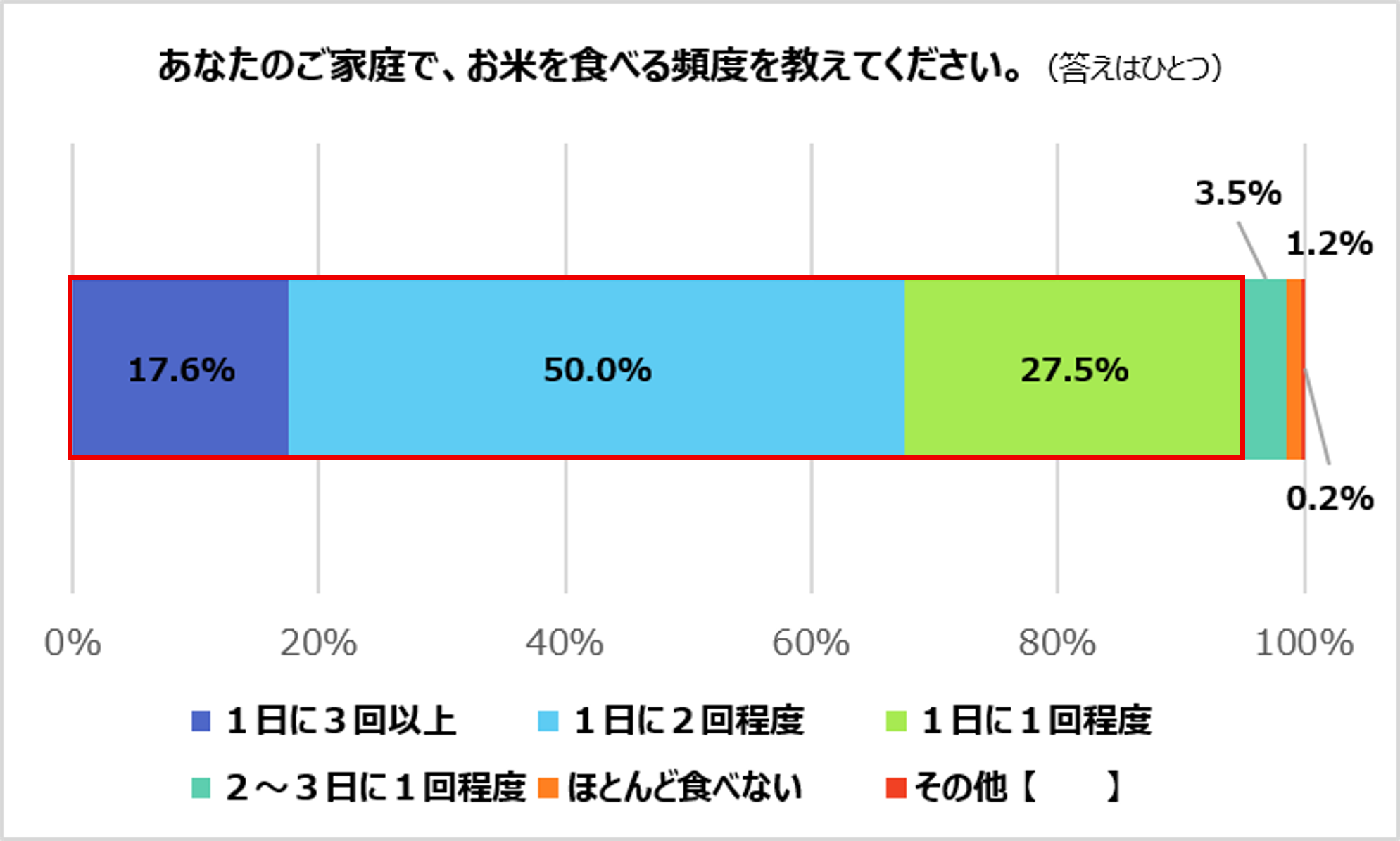
95.1% of respondents eat rice at least once a day, a slight increase from the previous survey. Frequency of rice consumption per household was highest for 'about twice a day' (50.0%), followed by 'about once a day' (27.5%) and 'three or more times a day' (17.6%). In total, 95.1% of respondents eat rice at least once daily. Compared to the previous survey, 'about twice a day' decreased by 1.0 percentage point, while 'three or more times a day' increased by 0.8 points and 'about once a day' by 0.6 points, indicating a slight overall increase in daily rice consumption frequency.
Q. How often does your household eat rice? (Select one) ※ Includes mixed rice, brown rice, etc. ※ Includes processed rice products (packaged rice, frozen fried rice), and ready-made meals or takeout.
When purchasing rice, 'domestically produced' (84.9%) and 'brand' (41.3%) were top priorities, with 'low price' (36.7%) ranking third for the first time. When asked what factors are prioritized when buying rice, 'domestically produced' ranked first (84.9%, +1.5 pts from previous), followed by 'brand' (41.3%, +3.3 pts), and 'low price' (36.7%, +4.9 pts), all showing increases. For the first time since the survey began, 'low price' surpassed 'origin region' (33.7%) to rank third. When asked what factors they would prioritize less if prices remain high, 'brand' (35.3%, +1.1 pts), 'origin region' (22.4%, +0.5 pts), and 'domestically produced' (18.8%, -3.1 pts) ranked highest. This suggests a growing consumer preference for affordable pricing over brand or regional specificity amid sustained high rice prices.
Q. What factors do you prioritize when buying rice? (Multiple answers allowed)
Q. If rice prices continue to remain high due to production and distribution disruptions, which factors would you prioritize less when purchasing rice? (Multiple answers allowed)
The most acceptable price point for continued rice purchases is '3,001–3,500 yen per 5 kg of milled rice' (22.6%). The most acceptable price for rice, if prices remain high, was '3,001–3,500 yen per 5 kg' (22.6%), followed by '2,501–3,000 yen' (21.0%), '3,501–4,000 yen' (20.5%), and '2,001–2,500 yen' (13.7%). Compared to the previous survey, responses for '3,500 yen or less' slightly increased, while those for 'over 3,501 yen' slightly decreased. This likely reflects consumer expectations for more affordable pricing as market supply-demand conditions are expected to ease.
Q. If rice prices continue to remain high due to production and distribution disruptions, what price per 5 kg of milled rice would you still be willing to pay? (Select one)
Most respondents (73.4%) report no change in diet, but 26.6% say they are eating alternatives to rice more often, showing an increasing trend. When asked whether they have started eating alternatives to rice more frequently, 73.4% answered 'no change' or 'nothing in particular,' while 26.6% said 'yes.' This represents a 2.8 percentage point increase from the previous survey. Among those who answered 'yes,' analysis of frequently mentioned items showed 'bread' (27.1%), 'pasta' (16.9%), and 'udon' (15.7%) as the top substitutes.
※ Items with different spellings but similar meanings (e.g., 'white bread, pastries, bread products,' 'udon, udon noodles, frozen udon,' 'pasta, spaghetti') were grouped under the same term for analysis.
Q. If your household has started eating alternatives to rice more frequently, please specify. (One answer)
Top 10 most frequently mentioned substitute items among 'yes' respondents (n=2,044 mentions)
Survey Overview 'Survey on Rice' Method: Online survey Target: Cooperative member monitors Period: March 12–16, 2026 Valid responses: 7,165
End
FACT BOX
- Source: PR TIMES
- Category: Survey