A.T. Kearney Japan (Minato-ku, Tokyo; Japan Representative: Takeya Fumifumi) has released a new issue paper titled "Reimagining How Executives Handle Geopolitics," addressing the organizational frameworks needed to integrate geopolitics into corporate strategy.
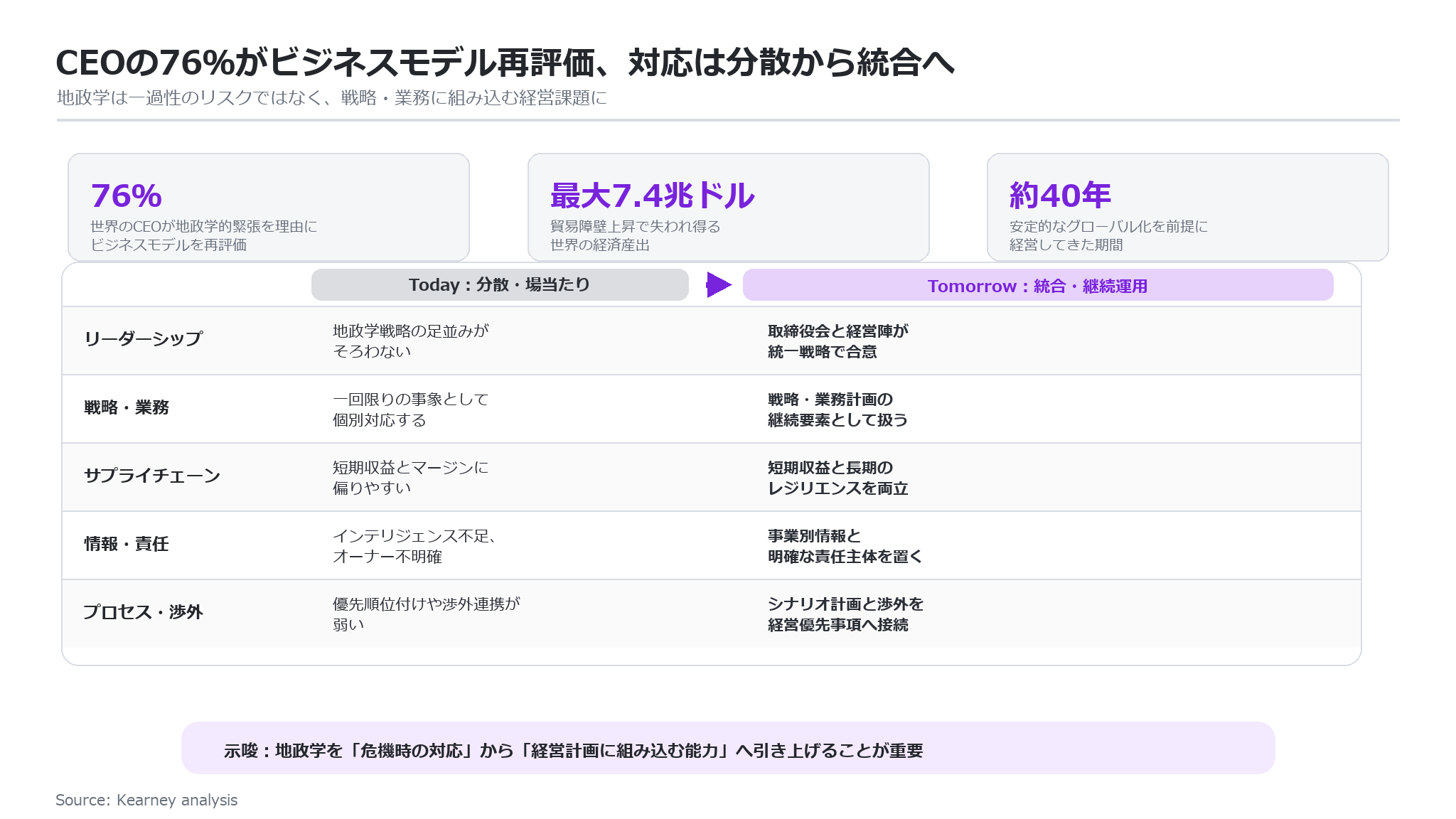
The paper highlights that the business environment—once based on unfettered globalization—is now shifting toward regional blocs, trade restrictions, and prolonged conflicts. It argues that geopolitics should no longer be treated as an ad hoc crisis response, but as a continuous management capability. According to The Conference Board's CEO Confidence Index, 76% of CEOs worldwide are reassessing their business models due to geopolitical tensions.
Additionally, with rising trade barriers threatening to fragment the global economy, the IMF estimates that global economic output could decline by up to $7.4 trillion. The paper recommends establishing dedicated geopolitical teams at the heart of executive decision-making, connecting boards, CEOs, business units, and external affairs and risk functions, transforming uncertainty from a mere risk into a source of competitive advantage.
76% of CEOs Reassessing Business Models: Geopolitics as a Permanent Management Issue
Today’s executives are adapting to an environment where uncertainty is no longer an exception but the norm. Political events—such as changes in sanctions regimes, shifts in technology standards, and trade policy reviews—are increasingly shaping market dynamics directly.
For nearly 40 years, companies have operated under the assumption of relatively free-flowing goods, services, and capital through globalization. However, the paper argues this assumption is no longer sufficient. Geopolitics must be treated not as a one-off topic, but as an ongoing element of strategy and operational planning.
A 2024 survey by Foreign Affairs of 500 institutional investors identified geopolitics as the "single greatest risk to the global economy and markets." Companies that embed geopolitical foresight into their strategies may be able to pivot faster than competitors, reallocate resources, and capture new growth opportunities in emerging regions.
Figure 1: 76% of CEOs Reassessing Business Models—Response Shifting from Fragmented to Integrated
Even Fortune 500 Companies Lack Dedicated Functions—Fragmentation Slows Response
In many organizations, responses to geopolitical issues are fragmented across risk committees, external affairs teams, procurement, strategy departments, communications, and ad hoc task forces. The paper notes that even among large Fortune 500 companies, the absence of dedicated geopolitical functions is common.
This fragmentation risks critical signals slipping through organizational cracks or being disconnected from business priorities. Without a clear owner for geopolitical intelligence, accountability for translating insights into actual decision points becomes ambiguous.
The paper warns that such fragmentation leads to slower response times, unclear accountability, and organizational vulnerability when the geopolitical landscape shifts. Sole reliance on expensive, generic external intelligence often fails to translate into actionable business intelligence or executable strategies.
Six Foundational Blocks and Six Key Functions: Integrating Geopolitical Teams into Strategy and Operations
To excel in an increasingly complex environment, a consistent framework for addressing geopolitical challenges is essential. The paper outlines six foundational blocks: business-relevant intelligence, executive ownership, prioritization mechanisms, exposure monitoring, dual consideration of risks and opportunities, and clear functional accountability.
Furthermore, it identifies six core functions of a geopolitical team: intelligence integration, prioritization leadership, enhanced visibility, unified government engagement, organizational agility, and feedback loops. These are practical functions designed to align external intelligence with the company’s unique business footprint, focusing on revenue-critical markets, suppliers, and policy changes.
Crucially, the geopolitical team must not become a new silo. With support from the board and C-suite, and by embedding into existing business processes, geopolitics can be understood not just as a risk factor, but as a source of competitive advantage.
Figure 2: Integrating Geopolitics into Corporate Strategy Through Six Functions
About the Issue Paper
Title: "Reimagining How Executives Handle Geopolitics"
URL: https://www.jp.kearney.com/issue-papers-perspectives/reimagining-how-executives-handle-geopolitics
Supervised by:
Hiroshi Sasamata, Senior Partner
Graduated from the Department of Nuclear Engineering, Faculty of Engineering, Kyoto University; holds an MBA from Columbia Business School.
Provides consulting services in scenario planning, business strategy, international expansion, and M&A support, primarily for the electric power and city gas industries undergoing regulatory reform, as well as for companies and related industries (oil and natural gas development, equipment manufacturers, engineering firms, financial institutions, government agencies, etc.) planning market entry or business expansion. Also supports material companies affected by the shale revolution (petrochemicals, government agencies, and other material sectors) with scenario planning, business strategy, and M&A/partnership support. Additionally supports consumer goods manufacturers (food, beverages, daily necessities) and other B2C companies with brand portfolio strategy, marketing and sales strategy, organizational restructuring, and operational reform. Served as a member of the Cost Verification Committee (2011) and the Supply-Demand Verification Committee (2012) of the Cabinet Office's Energy and Environment Council, and as a specially appointed professor at Kyoto University (2014–2016).
Frequently contributes to media including TV, newspapers, and magazines on topics related to the energy industry.
About A.T. Kearney
A.T. Kearney (global brand name: Kearney) has been a trusted partner to leading corporations and government agencies worldwide for over 100 years. Serving more than three-quarters of the Fortune Global 500, the firm operates in over 40 countries. Its greatest strength lies in its people. Committed to impact-first, Kearney leverages innovative thinking and execution capabilities to tackle the most challenging issues faced by clients and drive transformative change. In Japan, Kearney has been present since 1972, providing end-to-end support—from strategy formulation to execution—for leading companies across all major industries. For more information, visit www.jp.kearney.com.
FACT BOX
- Source: PR TIMES
- Category: Survey
- Organizations: The Conference Board / IMF / Foreign Affairs