A.T. Kearney Co., Ltd. (Minato-ku, Tokyo; Japan Representative: Takeshi Hagari) has published a report on AI data center site selection titled 'AI Data Center Location Attractiveness Index.'
This paper presents a comprehensive framework for comparing potential greenfield AI data center sites across 25 major North American markets, evaluated using six key factors and 18 parameters. This comes as North America’s data center capacity exceeds 20 gigawatts (GW), with further large-scale expansions planned.
The analysis reveals that traditional hubs like Virginia and Silicon Valley are not necessarily optimal for new AI data centers. Emerging markets such as Austin/San Antonio, Iowa, and Montreal have risen to the top. The overall score for Austin/San Antonio, the top-ranked market, is 4.2, while Silicon Valley scores 2.9—the lowest among the 25 markets.
AI is fundamentally transforming infrastructure requirements—power equivalent to 100,000 households, cooling equal to 1,000 home AC units per rack
AI is reshaping data center infrastructure requirements at their core, demanding unprecedented power density, specialized cooling solutions, and unique operational parameters. Conventional facilities were not designed to handle the extreme power consumption of GPU clusters or the specialized cooling required for high-density hardware.
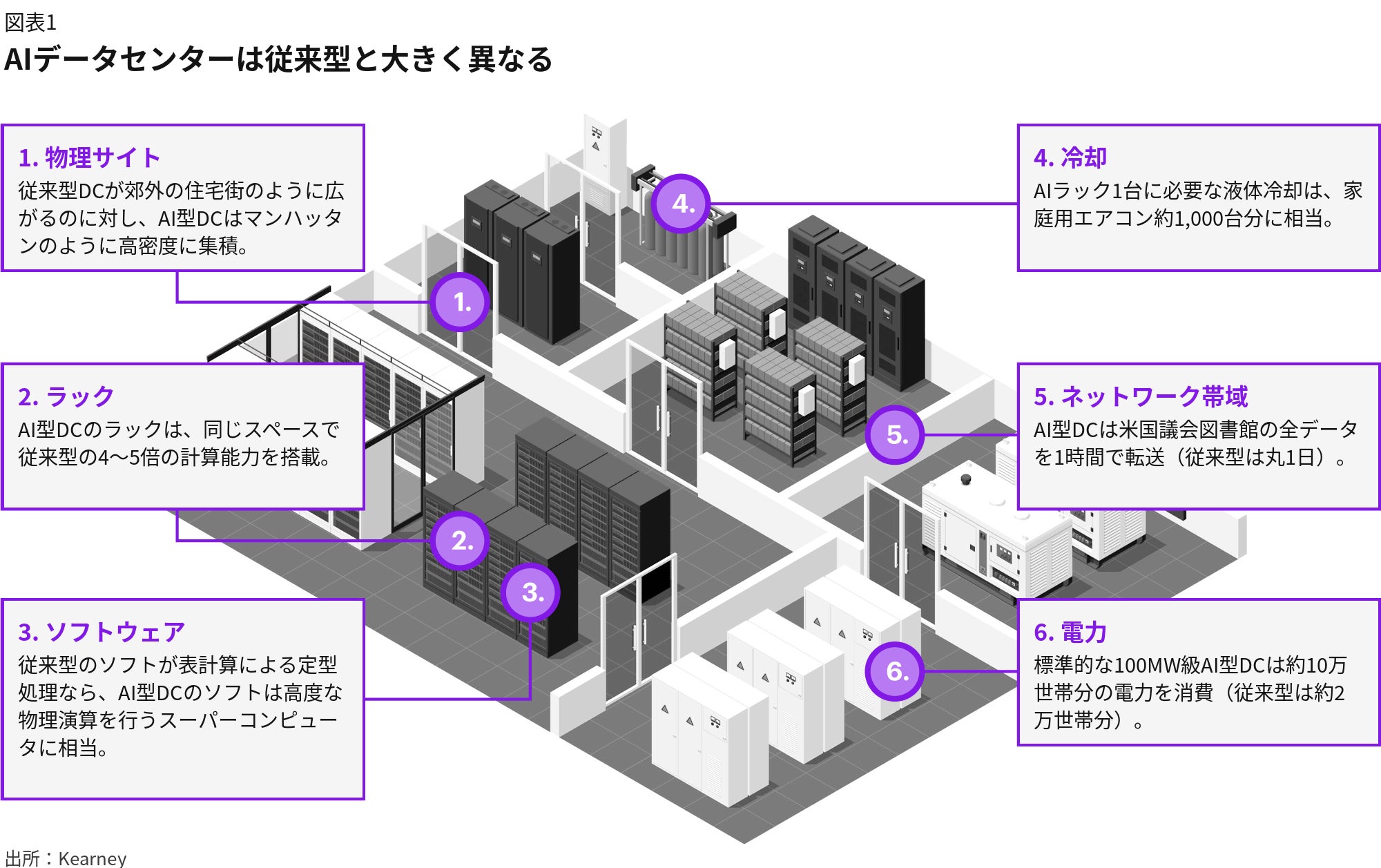
Specifically, a standard 100-megawatt (MW) AI data center consumes power equivalent to approximately 100,000 average households—far exceeding traditional facilities (around 20,000 households). Additionally, the liquid cooling required for a single AI rack equals about 1,000 household air conditioners, and computing capacity per rack reaches 4 to 5 times that of traditional setups in the same space.
These technical differences directly influence which geographic markets can best support AI data center investments. This paper focuses on new, purpose-built facilities designed to support high-load AI computing workloads, rather than retrofitting existing facilities, forming the foundation of the location attractiveness analysis.
Figure 1: AI data centers differ significantly from traditional ones—power for ~100,000 households, cooling for ~1,000 AC units
25 markets evaluated using 6 factors and 18 parameters; overall scores range from 2.9 to 4.2
The index evaluates each location using standardized scores based on 18 parameters organized into six key factors: power infrastructure and cooling requirements, land, network connectivity, labor market, business environment, and climate/resources. It incorporates emerging critical factors such as sustainability, water availability, and natural disaster risk, enabling meaningful comparisons between established data center hubs and emerging locations.
The evaluation results show Austin/San Antonio in first place (4.2), followed by Phoenix (4.1), Iowa (4.1), and Columbus (4.0). Historically dominant Virginia scores 3.8, while Silicon Valley scores 2.9, highlighting a clear divergence between established markets facing significant constraints and emerging locations offering reliable infrastructure, operational efficiency, and growth potential.
Top emerging markets share strong power infrastructure and available land. The Austin/San Antonio corridor boasts the highest pre-leasing rate for AI data center capacity. Iowa is recognized for its superior power infrastructure as a major wind power producer and proactive tax incentives. Montreal/Quebec in Canada offers low-cost hydropower and price stability from provincial energy policies, making it an attractive option for AI companies facing volatility in U.S. energy markets.
Figure 2: Overall score leader is Austin/San Antonio at 4.2; Silicon Valley last at 2.9
Virginia’s power constraints hinder mature hubs; site competition expands to Middle East and Asia
Meanwhile, Virginia, the most mature hub, faces pressure on businesses to seek alternatives due to severe power supply constraints and skyrocketing land prices, despite having the industry’s highest connectivity density. Silicon Valley, despite unmatched connectivity and AI talent, faces major challenges in large-scale AI data center expansion due to grid constraints, extremely high land costs, and regulatory barriers.
Alternative hubs are rising rapidly outside North America. In the Middle East, Groq secured a $1.5 billion commitment from Saudi Arabia to expand AI inference infrastructure. France is investing €30–50 billion with the UAE in a 1GW-class AI data center. South Korea plans a massive 3GW facility with an investment of approximately $35 billion, which, if completed as scheduled in 2028, is expected to become the world’s largest data center.
Major cloud providers have already pre-leased capacity for the next 3–5 years. As power constraints become a decisive bottleneck for growth, state and local governments are intensifying site attraction efforts through power infrastructure investment, tax incentives, and streamlined permitting processes. This paper provides a quantitative framework to support decision-making for future AI data center investments by combining operator-specific requirements—such as latency needs, sustainability goals, and deployment scale—with attractiveness scores.
Figure 3: Diverging fortunes between established and emerging markets—breakdown of scores by six factors
About the Paper
Report Title: 'AI Data Center Location Attractiveness Index' (English: AI Data Center Location Attractiveness Index) URL: https://www.jp.kearney.com/issue-papers-perspectives/aI-data-center-location-attractiveness-index
Supervisors
- Takeshi Hagari, Japan Representative, Managing Director Japan / Senior Partner
Graduated from the Faculty of Liberal Arts, University of Tokyo. After working in sales planning, business strategy, and service development at a major telecommunications company, joined A.T. Kearney. With over 20 years of consulting experience primarily serving telecom, high-tech, and media companies, he delivers practical, high-impact consulting services focused on digital transformation, overseas business strategy, new business development, portfolio restructuring, and business turnaround, drawing on extensive cross-functional leadership experience in corporate settings.
- Kenta Taki, Senior Partner
Graduated from the Department of Economics, Faculty of Economics, University of Tokyo, and joined A.T. Kearney. With approximately 10 years of consulting experience, he has worked on a wide range of management topics including strategy, new business, R&D, M&A, marketing, operations, cost, HR, and organization, primarily for telecom, financial institutions, and consumer goods companies. He specializes in large-scale digital transformation at the corporate level.
About A.T. Kearney
A.T. Kearney (global brand name: Kearney) has been a trusted partner to governments worldwide and more than three-quarters of the Fortune Global 500 companies for over 100 years as one of the world’s leading management consulting firms. With a presence in over 40 countries,
FACT BOX
- Source: PR TIMES
- Category: Survey
- Organizations: Groq / UAE