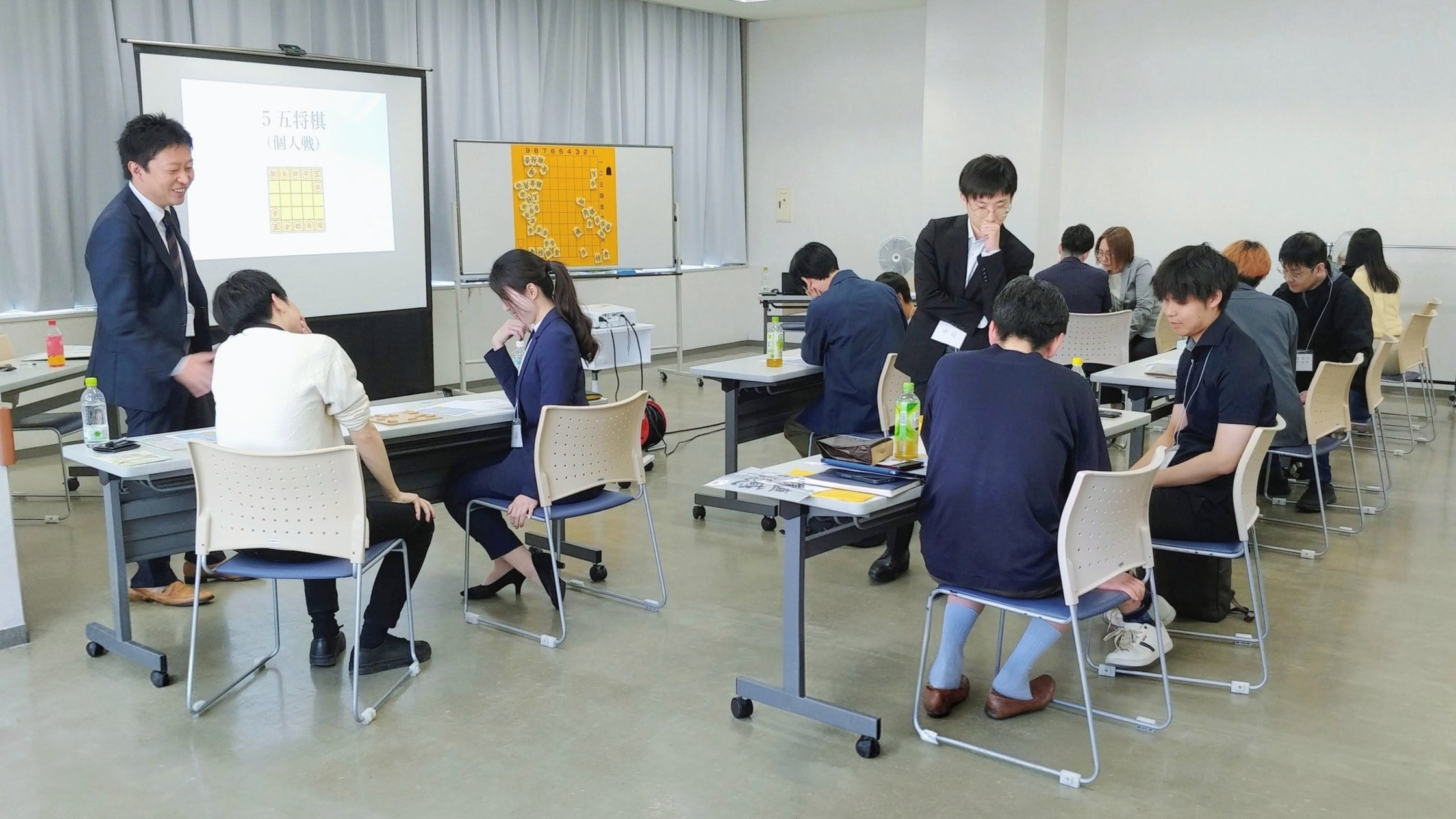
Scenes from the "Shogi-Based Organizational DevelopmentTM" verification seminar, where participants experience dialogue, information sharing, and decision-making through Shogi (June 13, 2026, Takatsuki City, Osaka Prefecture).
On June 13, 2026, in Takatsuki City, Osaka Prefecture, Keatomo General Incorporated Association (Representative Director: Mizuo Matsumoto) held an
"Shogi-Based Organizational DevelopmentTM" verification seminar.
Can Shogi reflect the "state of an organization"?
This question marked the beginning of this verification.
Shogi is a traditional Japanese cultural pursuit of competition and victory. Organizational development, on the other hand, is an initiative to foster relationships, dialogue, decision-making, and trust between people and organizations. At first glance, the two may seem unrelated, but we believe there is wisdom within the experience of "Shogi" that can be applied to organizational building, and we continue our verification. In our previous press release, we shared the results of a post-seminar questionnaire. Participants provided many insights regarding psychological safety, dialogue, information sharing, proactivity, and self-understanding.
Team Shogi in action: beginners and experienced players form teams, engaging in dialogue and decision-making.
*Previous Press Release (Organizational Development Verification Seminar Using Shogi Conducted / Released June 22, 2026)
Why did such changes occur?
One question remained, but the questionnaire results alone did not reveal the reasons.
Therefore, this time, we conducted interviews with individuals in different positions – a "professional Shogi player," a "corporate executive (Shogi beginner)," and a "training company representative (Shogi novice)" – to re-examine the verification results.
What is "Shogi-Based Organizational DevelopmentTM"?
"Shogi-Based Organizational DevelopmentTM" (hereinafter referred to as "Shogi-Based") is an organizational development method that utilizes Shogi.
The objective is not merely to compete for victory or defeat through Shogi, but to experientially visualize organizational characteristics and relationships through the dialogue, decision-making, role allocation, information sharing, and post-game analysis (kanso-sen) that occur on the board. In this verification, the process followed the sequence of "Animal Shogi," "5x5 Shogi," "Team Shogi," and "Kanso-sen."
Not only experienced Shogi players but also beginners gathered around the same board, made decisions from their respective standpoints, and concluded with a collective review.
What beginners felt initially
A corporate executive, participating as a Shogi beginner, shared their candid feelings before the seminar:
"I heard we would be playing Team Shogi, so I didn't want to be a burden to my teammates." They also added, "I didn't want to be thought of as saying strange things." Reflecting on this feeling on the day, they said it was similar to "when I was a new employee, finished OJT, and was first assigned to the field."
The anxiety felt as a Shogi beginner overlapped with the psychology of entering a new environment at work.
This is not unique to Shogi. Within organizations, feelings of "I don't understand," "I don't want to cause trouble," and "Is it okay to say this?" are experienced by many. By facing the common challenge of Shogi, this psychology was revealed in a short period.
"I didn't even know what I didn't know."
On the other hand, there were also moments where they felt safe to speak up. Teammates said, "It's okay," and "The team will cover for you if anything comes up," and they felt a sense of security from their expressions, tone of voice, and body language.
Conversely, in the Team Shogi match, when the leader asked, "What should we do next?" the participant was in a state of "not even knowing what they didn't know." They didn't understand the strategy, the current situation, or what to think about. Therefore, they couldn't speak up. The participant described this situation as "similar to a meeting where you proceed without a clear objective or direction."
This statement was one of the symbolic insights from this verification. The reason for not speaking up is not necessarily a lack of motivation. If the objective and information are not shared, it becomes difficult for people even to think.
Conversely, with reassuring words and attitudes, people naturally begin to speak. On the Shogi board, that change manifested in a short period.
"Past successes can narrow the scope of thinking."
Professional Shogi player Kohei Funie, 7-dan, of the Japan Shogi Association, also participated in this verification seminar. Reflecting on Team Shogi, Funie said:
"The best move cannot be found alone."
This statement was not only the theme of his talk but also a phrase that symbolized the entire verification.
In actual games, there were instances where ideas that one wouldn't have thought of alone naturally emerged through sharing information within the team. In "5x5 Shogi," experienced players did not always make the correct decisions. While experienced players tended to prioritize major pieces based on past successes, it is said that Shogi beginners, unburdened by fixed notions, chose moves that were essentially "good moves." Isn't this a phenomenon common in corporate organizations as well?
Experience is a great strength. However, sometimes past successes can narrow the scope of thinking. On the other hand, those with less experience or from different backgrounds offer perspectives that might otherwise be missed. The endeavor to find the best move as a team mirrored situations in corporate decision-making.
Why could a beginner leader make the team function?
Fumika Sato (株式会社アイ・イーシー|ラーニング・システム開発局 企画開発部 セールスコーディネート室) also participated in this verification. Although Ms. Sato was a Shogi beginner (inexperienced), she served as the leader in Team Shogi.
She reflected, "I think I was an unreliable leader." However, organizing her interview revealed a different reality. By "honestly consulting about what she didn't know," "delegating roles to experienced members," "entrusting the decision on timeouts to those skilled in it," and "learning only the minimum necessary information while observing the team as a whole," her team, led by a beginner, functioned smoothly.
Ms. Sato stated, "I experienced that even without specialized knowledge, you can move forward by trusting the team and delegating." Isn't this also a reflection of new managers assigned to specialized departments?
Leaders do not need to know everything. The fact that trusting the team and drawing out individual strengths is also a form of leadership was visualized on the board.
She was observing the "organization," not Shogi.
What Ms. Sato found most impressive was not Shogi itself, but people's behavior.
Within the same team, "Who speaks up first?" "Who consults with others?" "Who organizes the situation?" "Who lightens the mood?" "Who takes responsibility for decisions?"
Even more impressive was the realization that "doing nothing can also be seen as a form of action." By facing a common challenge, behavioral characteristics that are usually difficult to see in the workplace naturally emerged on the board.
"Shogi-Based" observes not Shogi skill, but organizational behavior: how people think, consult, delegate, and make decisions.
What did the training company evaluate?
Ms. Sato participated as an attendee but also observed the verification from the perspective of a training company. When she first heard about "Shogi-Based," she had doubts about "whether Shogi and organizational development could be connected." However, after actually experiencing it, her view changed significantly.
She was particularly impressed by the fact that "it is a training program for learning about organizations, not for learning Shogi."
Furthermore, she felt the potential to propose the same program with different approaches depending on the company's challenges, such as "psychological safety," "proactivity," "decision-making," "team building," and "communication."
She also highly praised the aspect that "it doesn't end with just thinking; it makes you want to change your behavior."
Although they were supposed to be experiencing Shogi, they found themselves reflecting on their own behavior in the workplace, such as "consulting," "delegating," "sharing background information," and "considering others' perspectives." Ms. Sato believes that this change is the true value of the program.
The "State of the Organization" Seen in Common
Figure: Correspondence between "On-board Events" and "Workplace Events" Revealed by this Analysis, Based on Verification and Interviews.
In this verification, we heard from individuals in different positions: a professional Shogi player, a corporate executive (Shogi beginner), and a training company representative (Shogi novice). Their experiences and roles varied. However, when we organized the interviews, there were surprisingly many common points.
These were phenomena occurring in "organizations," not in "Shogi" itself.
For example, "When there is a safe environment, people find it easier to speak up," "If information and objectives are not shared, people don't know what to think about," "While experience is a great strength, it can also become a fixed idea," "The presence of beginners and people from different backgrounds creates new perspectives," and "By acknowledging what they don't know, consulting, and delegating, teams begin to move forward." Moreover, through "kanso-sen," one can "objectively reflect on their own and the team's actions."
These were not just stories about Shogi; they were also about corporate organizations. What happened on the board overlapped with what happens daily in the workplace.
One Possibility We Discovered This Time
This analysis does not draw any definitive conclusions from a single verification. However, by layering "verification results," "questionnaires," and "interviews with three individuals from different standpoints," one possibility has emerged. That is, "Shogi can serve as a platform to reflect the relationship between people and organizations."
Shogi possesses wisdom cultivated over a long history.
This includes "making decisions within a limited time," "considering the opponent's perspective," "gaining an overall view of the situation," "sharing information with colleagues," and "reflecting on one's own decisions after the game through kanso-sen."
Are these not elements that are also valued in modern corporate organizations?
"Shogi-Based" is an initiative that explores this potential by rephrasing that wisdom into the language of modern organizational building and management.
The Next Move
This analysis is the "Shogi-Based Organizational DevelopmentTM Verification and Analysis Report Vol. 1."
Moving forward, through corporate implementation and continuous verification, we will accumulate further testing and analysis from various perspectives, including "managerial development," "team building," "psychological safety," "fostering a culture of dialogue," and "application to organizational development."
We wish to nurture this potential not only as a single originator but together with participants, companies, training companies, professional Shogi players, and many others involved with Shogi.
Can Shogi be used for organizational development?
The answer to this question is still being explored. However, through this verification, we have gained a solid sense of progress. We will continue to explore the possibility of utilizing the wisdom inherent in Japan's traditional culture, "Shogi," for modern organizational building through repeated verification and analysis.
[Keatomo General Incorporated Association]
With the aim of "preventing employee介護離職 (resignation due to family caregiving responsibilities)," we are an organization that provides one-stop support for companies and communities by collaborating with specialists from various professions, including organizational development, financial planning, nursing, industrial health, and support for balancing work and caregiving. We are also advancing the verification and research of a new organizational development method utilizing Shogi, "Shogi-Based Organizational DevelopmentTM," exploring new approaches such as psychological safety, dialogue, and decision-making, and striving to create new value by leveraging Japan's traditional culture in modern organizational building.
Official Website: https://keatomo.jp/
Contact for Inquiries Regarding This Matter
Keatomo General Incorporated Association
Contact: Representative Director Mizuo Matsumoto
E-mail: [email protected]
Inquiries are also accepted through the contact form on the website above.
FACT BOX
- Source: PR TIMES
- Category: Event