Kirin Holdings Company, Limited (President & COO: Kenta Minakata, hereinafter referred to as Kirin) and FANCL CORPORATION (President & CEO: Hideki Mihashi, hereinafter referred to as FANCL) have jointly developed an "AI Tablet Designer" that utilizes formulation data accumulated through supplement development to assist in the design of supplement tablets, considering factors such as tablet size, hardness, and ease of swallowing. This enables data-driven tablet design, moving away from reliance on the experience and intuition of skilled researchers and extensive trial-and-error, thereby contributing to shorter development times for easy-to-swallow, high-quality supplement formulations.
This research achievement has been published in "Pharmaceutics," an international academic journal in the field of formulation and DDS*1, in April 2026, and its novelty and effectiveness have been academically recognized as a next-generation formulation design technology utilizing AI.
*1 Drug Delivery System: A field of formulation technology for delivering active ingredients to target sites as intended.
Research Objectives and Background
Tablet design requires simultaneously satisfying multiple physical properties, such as ease of swallowing, sufficient hardness to withstand transportation, and solubility within the body. However, these properties are interdependent, necessitating extensive prototyping and trial-and-error to derive optimal formulation designs.
Therefore, this research aimed to develop an AI Tablet Designer to rapidly identify formulation conditions that satisfy each property and to derive the most efficient and optimal formulation conditions.
Research Methods and Results
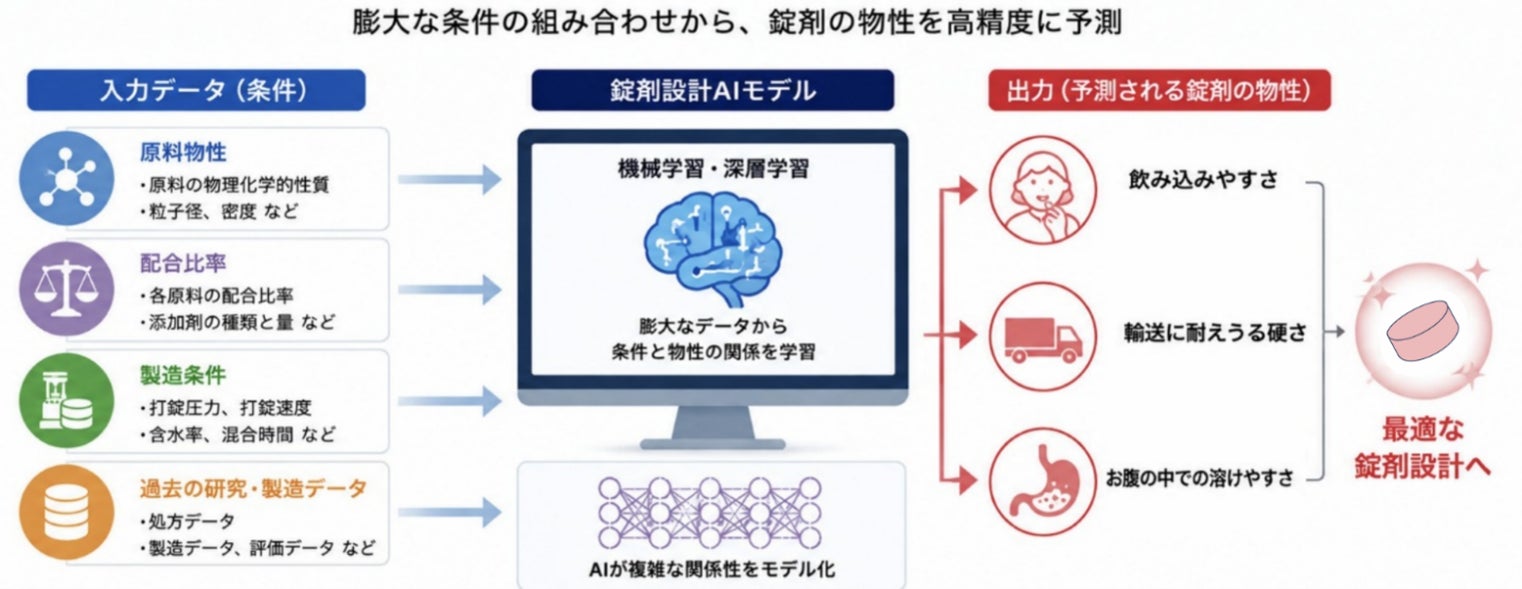
The developed AI has learned from past research and manufacturing data to predict multiple elements of supplement tablets, including "ease of swallowing," "hardness resistant to breakage during transportation," and "solubility within the body." The AI can rapidly and accurately predict and compare thousands to tens of thousands of formulation condition combinations that would be difficult for humans to evaluate.
This is expected to lead to improved quality through the calculation of optimal formulation solutions (e.g., faster dissolution, smaller and easier-to-swallow designs), stabilization of product quality (achieving consistent design quality regardless of the person in charge), shortened development periods, and reduced raw material loss (see Figure 1).
Figure 1. Image of the Formulation Design AI Model
Future Outlook
Kirin views the expertise and unique data held by its group companies as crucial sources of competitive strength. By combining these with cutting-edge technologies such as AI, Kirin aims to transform research and development and create new customer value. This initiative with FANCL leverages researchers' experiential knowledge in tablet design as data, fostering collaboration between humans and AI to enhance the precision and speed of product development, while also delivering tangible benefits to customers such as improved ease of swallowing and quality. Moving forward, Kirin will continue to promote both "productivity improvement" and "value creation" as outlined in "KIRIN Digital Vision 2035" (https://www.kirinholdings.com/jp/innovation/dx/) by utilizing unique data in areas such as materials, formulations, manufacturing, and quality evaluation held by its group companies, aiming to create new customer and societal value in the domains from food to medicine.
【Published Paper】
Journal Name: Pharmaceutics
Paper Title: Application of AI in Tablet Development: An Integrated Machine Learning Framework for Pre-Formulation Property Prediction
Authors: Masugu Hamaguchi, Tomoki Adachi, Noriyoshi Arai (and other co-authors)
Publication Information: Pharmaceutics (2026, Vol 18, Issue 4, Article Number 452)
【Comments from Development Organization and Personnel】
Kirin Holdings Company, Limited, R&D Division, Kirin Central Research Institute
This joint research, which began with an encounter at an internal research presentation, involved our organization in building the AI model and developing the application. Tablet design, while seemingly simple, is actually a very deep and complex field. Through dialogue with FANCL researchers, we worked to formalize the knowledge and know-how related to tablet design. Furthermore, by integrating physical information such as raw material properties and manufacturing conditions into the AI, we have built an AI that can be practically utilized in actual R&D settings, going beyond a mere proof of concept. We aim to expand the scope of AI application and contribute to further value creation.
FANCL CORPORATION, General Research Institute, Functional Foods Research Laboratory, Director
Tomoki Adachi
When I was personally involved in product development, even after finding a good formulation, I always felt there might be "even better combinations." Also, when development faced difficulties, I often found myself unsure whether to continue exploring the current approach or switch to a different one. The AI Tablet Designer developed this time addresses these challenges.
In the future, by having AI and humans think together, we will be able to complete product development with the confidence that we have "done everything possible" more than ever before. Furthermore, by expanding the range of items that can be predicted by AI, we aim to pursue even higher quality and more valuable designs, meeting customer expectations.
FACT BOX
- Source: PR TIMES
- Category: 技術開発
- Organizations: Pharmaceutics