'2026 Disaster Preparedness Survey'
More than half (54.8%) agree that everyday items should be useful during disasters
Among those with disaster experience, 67.8% have felt concerned about items left at home during evacuation
Master Lock Sentry Japan Co., Ltd. (Headquarters: Higashi-Gotanda, Shinagawa-ku, Tokyo; hereinafter 'MLSJ') announces, in conjunction with Disaster Prevention Day on September 1, the concept of 'phase-free preparedness' and proposes a new disaster resilience approach utilizing safes that serve both daily life and emergency situations. The company also releases the results of its '2026 Disaster Preparedness Survey.'
In July this year, the Disaster Management Agency Establishment Act was promulgated, strengthening nationwide disaster prevention and mitigation efforts ahead of the agency's launch in November. Additionally, in July, the 'Reiwa 8 Kumamoto Earthquake,' with a maximum seismic intensity of 7, struck Kumamoto Prefecture—once again reminding us that earthquakes can occur anywhere, at any time. Amid these developments, interest in reviewing daily preparedness and implementing disaster measures to protect valuable belongings during emergencies is growing.
The 'phase-free' concept (※), promoted by the Cabinet Office, refers to integrating disaster-resilient functions and systems into daily life, rather than clearly separating 'daily life' from 'emergency situations.' For example, a stool that stores emergency supplies can be used daily as a shoe bench at the entrance and, during a disaster, carried out as an emergency go-bag. Items that serve dual purposes—used daily and also protect lives and livelihoods during disasters—are gaining attention, moving away from special emergency-only supplies.
According to the '2026 Disaster Preparedness Survey,' 17.5% of respondents were aware of 'phase-free,' and 19.4% had some understanding, totaling 36.9%—meaning roughly one in three people are familiar with the concept. Among those with disaster experience, this figure rises to 61.4%, indicating greater awareness among survivors.
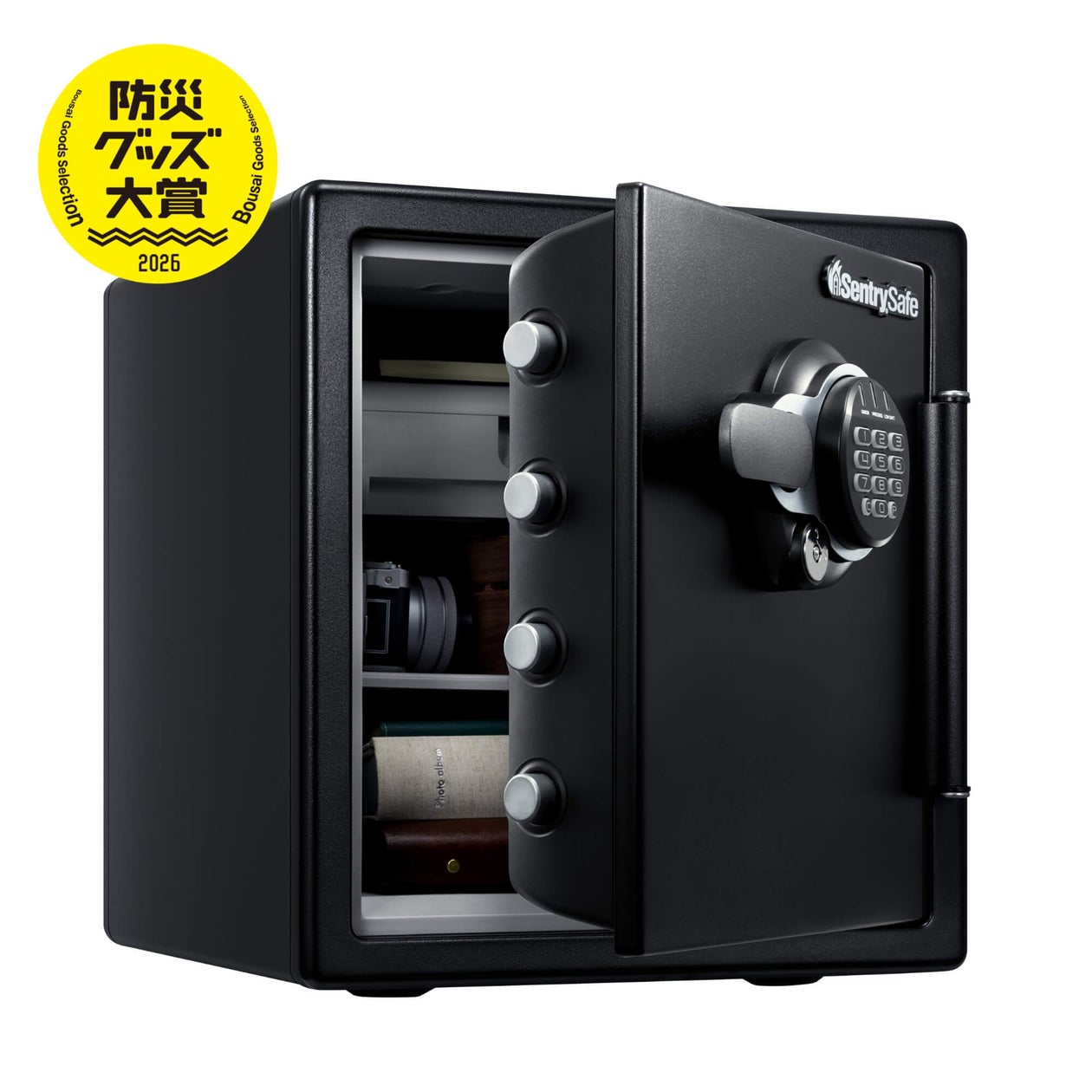
MLSJ proposes using safes as phase-free items.
JTW123GEL Big Bolt Series JTW Model
A locked safe not only serves as a security measure but also functions as a storage space to consolidate and safeguard important, easily lost items such as passbooks, seals, contracts, insurance policies, certificates, and sentimental items. During disasters, it transforms into a 'safety space' protecting valuables from fire, flooding, and structural damage.
With a fireproof, waterproof, and highly robust safe, it becomes easier to make the decision to 'leave and escape' without attempting to carry valuables, ensuring safety.
※ Phase-Free Promotion Study Group: Disaster Management Information Page - Cabinet Office
https://www.bousai.go.jp/kaigirep/kentokai/phase_free/index.html
A Long-Term 'Family Safety Space' to Protect Your Household
The everyday role of a safe goes beyond mere theft prevention. It establishes a 'designated place' for important family items like passbooks, insurance policies, and cherished mementos. Protecting these items from loss, theft, fire, and water damage is also a crucial function.
Unlike emergency food or disaster kits—items bought solely 'for the worst case'—a safe can be used daily as a reliable storage solution for valuable belongings.
Disasters such as earthquakes cannot be accurately predicted. They might happen tomorrow—or decades from now. Therefore, disaster preparedness should include not only items 'stored and forgotten,' but also items that are used daily and serve purposes beyond emergencies.
In daily life: a place to consolidate and store the family's most important belongings.
During disasters: a place to protect those belongings from fire, flooding, and other hazards.
We propose the safe not as a temporary disaster item, but as a 'family safety space' that protects your family's valuables continuously, in both daily and emergency situations.
'Leave-It-and-Escape Preparedness' Enables 'Evacuate Only'
Tsunamis from earthquakes, typhoons, heavy rains, and fires—all require early evacuation to save lives. However, in reality, people may delay evacuation or even return home after evacuating due to concerns such as 'I must take my passbook and cash,' 'Is it safe to leave important documents behind?' or 'What if fire or theft occurs after I evacuate?'
The current survey shows that 45.3% 'hesitated slightly but evacuated relatively quickly,' a relatively high rate. However, 16.7% 'took time due to hesitation or preparation, causing delayed evacuation,' and 12.0% 'returned home or to the building after evacuating,' indicating that many still experience hesitation during evacuation.
Therefore, MLSJ proposes the concept of 'evacuate-only disaster preparedness.' This new approach leverages everyday fireproof and waterproof safes. It complements the recommended emergency go-bags or backpacks ('take-with-you preparedness') with a new form of preparedness. By securing important, everyday items and essentials needed for post-disaster recovery in a safe, evacuation becomes the only viable option during emergencies. We define this as 'leave-it-and-escape preparedness,' a new disaster resilience concept enabling swift evacuation.
By storing valuables in a fireproof and waterproof safe, there is no need to attempt to carry everything during an emergency.
Believe that 'the safe will protect your valuables,' and evacuate without hesitation.
A safe not only protects belongings from disasters but also reduces hesitation and indecision during evacuation, supporting the life-saving decision to 'evacuate only.'
Comment from Ryohei Ando, Representative Director, MLSJ
In Japan, one of the world's most disaster-prone countries, we propose 'evacuate only' as a new disaster preparedness mantra.
It's natural to think, 'I must take my passbook' or 'I want to retrieve my sentimental items' during a disaster. However, such hesitation could delay evacuation.
By deciding in advance where to protect your valuables, you can prioritize life-saving actions when it matters most. We call this approach 'leave-it-and-escape preparedness.'
On Disaster Prevention Day, we encourage every household to consider not only 'what to take when evacuating,' but also 'how to evacuate without hesitation.'
Our fireproof and waterproof safes, winners of the 2026 Disaster Preparedness Goods Award, will be promoted as a key option for phase-free disaster resilience.
Phase-Free Storage Using Safes
Safes can store not only valuables like passbooks and seals, but also everyday items essential for post-disaster life recovery.
Rather than simply storing and forgetting, the key to phase-free storage is regularly checking and updating the contents as part of daily life.
Examples of items to store in a safe using 'phase-free storage'
1. Small amount of cash
FACT BOX
- Source: PR TIMES
- Category: Survey