The assumption that "I don't snore, so I don't have Sleep Apnea Syndrome (SAS)" might be leading to the oversight of a serious illness. The General Incorporated Association for Snoring and Apnea Improvement conducted an awareness survey on "Sleep Apnea Syndrome Without Snoring" targeting 200 men and women nationwide. The results revealed that approximately 44.5% of people were unaware that "SAS is possible even without snoring." This survey explores hints for visualizing the existence of "hidden SAS," which is difficult to self-diagnose, and for leading to early detection through the awareness of those around and small everyday signs.
Survey Background
Sleep Apnea Syndrome (SAS) is a condition that, if left untreated, not only increases the risk of high blood pressure and heart disease but can also cause accidents due to severe daytime sleepiness. While "loud snoring" is generally known as a typical sign, in reality, depending on body type, bone structure, and throat condition, snoring may not be noticeable. This survey was conducted with the aim of clarifying the extent to which the misconception of "no snoring = no worries" is prevalent and how SAS can be detected through signs other than snoring.
Survey Summary
・Approximately 45% (44.5%) responded that they "did not know" about the existence of "SAS without snoring."
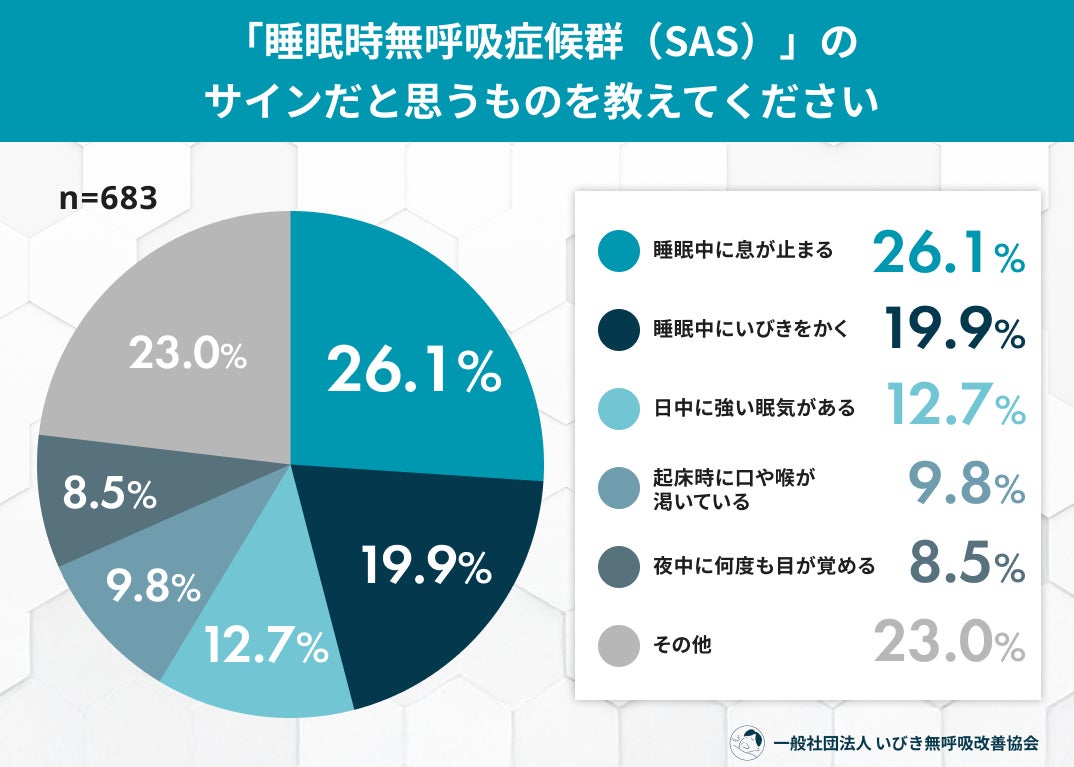
・The most recognized sign of SAS was "stopping breathing during sleep" at 26.1%, followed by "snoring" at 19.9%.
・Regarding discovery methods for cases without snoring, about 1 in 4 people (27.5%) cited "指摘 by family/cohabitants."
・The most important factor to avoid overlooking the possibility of SAS was considered to be "not dismissing指摘s from family/cohabitants" at 25.0%.
・When informed about the possibility of "SAS without snoring," 82.0% responded that they "would like to be tested (including somewhat)."
Detailed Data
Q1. What do you think are the signs of "Sleep Apnea Syndrome (SAS)"?
・Stopping breathing during sleep: 26.1%
・Snoring during sleep: 19.9%
・Severe daytime sleepiness: 12.7%
・Dry mouth or throat upon waking: 9.8%
・Waking up multiple times during the night: 8.5%
・Other: 23.0%
→ Awareness of "stopping breathing" and "snoring," which are symbolic of SAS, is high.
FACT BOX
- Source: PR TIMES
- Category: News