Mitsubishi Research Institute, Inc. (President and CEO: Kenji Yabuta, hereinafter MRI) and PKUTECH Inc. (President: Liu Shenqiu, hereinafter PKUTECH) have jointly developed "AI Memory RAG," a RAG technology that enables generative AI to provide answers by considering the chronological changes of information and the background of decision-making. While conventional RAG primarily focuses on retrieving similar information in isolated instances, AI Memory RAG enables cross-sectional analysis and answers based on past discussions and decision-making processes, supporting swift and appropriate decision-making in practical work.
1. Background
As the use of generative AI in business operations expands, RAG (Retrieval-Augmented Generation) is widely used as a method to leverage proprietary corporate data. RAG is a technology that enhances the accuracy of answers by retrieving not only pre-learned information but also other relevant information (such as a company's own data). However, conventional RAG faced the following challenges:
Difficulty in tracking changes in continuously accumulating information, such as daily updated news and meeting minutes.
Difficulty in providing answers that consider past discussions, the history of changes, and consensus-building processes.
Difficulty in grasping the relationships between seemingly independent events and changes over time.
In particular, "chronological order" and "accumulation of context" are crucial in the intelligence domain (Note 1) where MRI is involved, and in the meeting minutes management and inquiry support domain where PKUTECH operates. General RAG could not adequately address these aspects.
Amidst this, in recent years, "AI Memory" has emerged, attracting significant interest. This technology allows generative AI to continuously remember and utilize past information, conversation history, and accumulated knowledge to perform context-aware reasoning and generate responses. Based on this AI Memory, MRI and PKUTECH have developed "AI Memory RAG," a RAG technology that can "trace the history" by adding technology to preserve and retrieve chronological information and context in an appropriate data format (patent pending).
2. Overview and Features of AI Memory RAG
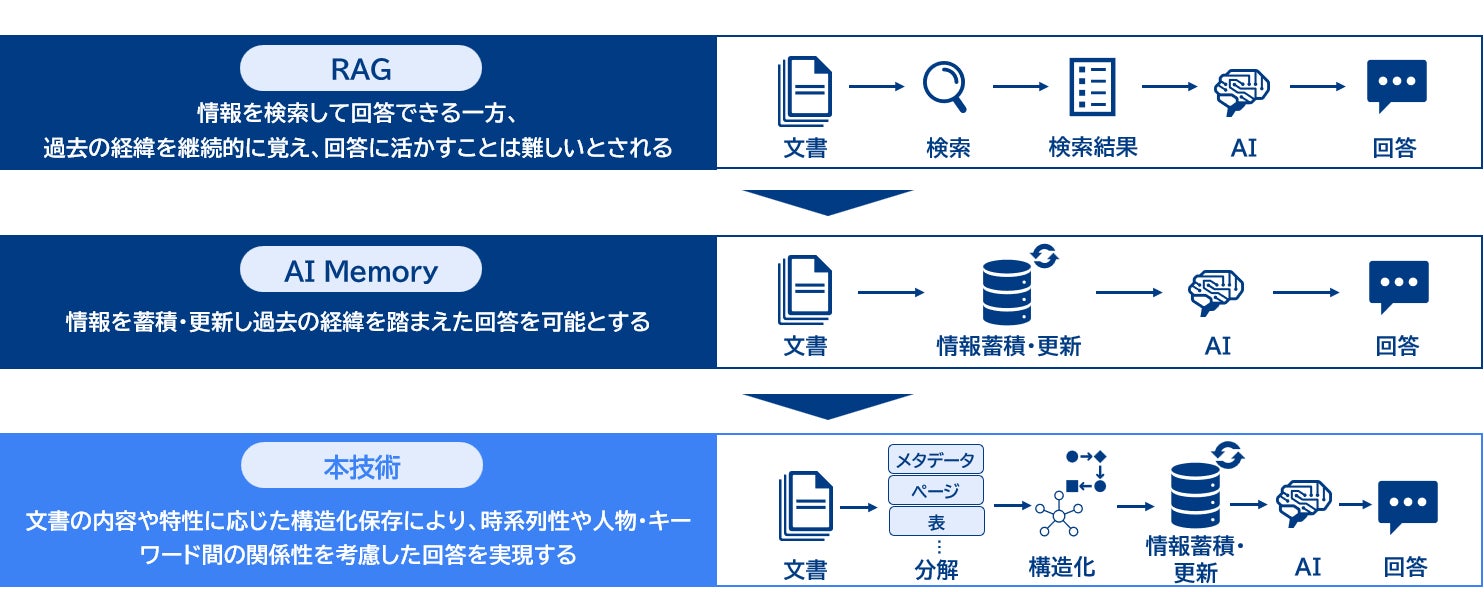
AI Memory RAG (hereinafter, this technology) assumes news articles and meeting minutes as primary search targets and extends the data storage method of existing AI Memory. Its features include structuring documents based on their content and characteristics to consider chronological changes and relationships between people and keywords. Specifically, first, document data such as news articles and meeting minutes are decomposed into multiple granularities, such as pages, chapters, tables, and metadata. Then, the storage format is automatically determined based on the content of the decomposed data, and it is stored in the following structures:
Chronological Structure: Stores the progression of discussions and events along a timeline.
Graph (Network) Structure: Structures the relationships between speakers, keywords, and related individuals.
Repository (Revision History) Structure: Manages information where revision history is important, such as requirement definition documents and laws.
During response generation, the structured data described above is combined with the AI Memory's inquiry processing mechanism. Instead of a single similar search like conventional RAG, the inquiry content is analyzed, and a procedure for acquiring necessary data and reasoning (response plan) is generated. For example, when inquiring about the history of specification changes in a system development project:
Retrieve related meeting minutes chronologically.
Analyze past statements of decision-makers and their relationships with stakeholders.
Extract the points in time when decision-makers' intentions changed and the factors causing those changes.
By going through multiple steps like these, the history of changes is retrieved, and a response is generated. This enables a cross-sectional understanding of information relationships and the flow of changes, allowing for analysis that includes the background of decision-making.
Figure: Comparison of this technology with existing technologies
3. Application Examples
This technology is envisioned for use in the following areas:
News Monitoring and Intelligence Analysis: Extracting relationships and signs of change from continuously flowing news and reports to grasp future changes and risk indicators.
Development Management and Meeting Minutes Management: Preserving discussions and changes from requirement definition to design and development, enabling searches and answers based on "why a particular specification was chosen" and "who made what decision."
Knowledge Inheritance: Facilitating knowledge sharing by presenting past history, reasons for decisions, and response status from inquiry history and failure records, thereby reducing the burden of handover and ensuring stable response quality.
4. Future Plans
We aim to enhance practicality through further accuracy verification and demonstrations, and to deploy it in MRI's and PKUTECH's AI solutions. MRI is considering its use as news monitoring and knowledge management technology within its AI solution "Intelligence Platform" that supports corporate intelligence operations. PKUTECH is proceeding with its implementation as knowledge management technology in areas such as development management, meeting minutes management, and inquiry support, and will incorporate it as "Egeria-AI Memory RAG" into PKUTECH's AI agent platform "Egeria Series" (Note 2).
Both companies will continue to promote joint research and technological development to advance the practical application of generative AI in business, contributing to improved customer productivity and advanced decision-making support.
Note 1: Launched "Intelligence Platform" Utilizing AI Agents to Strengthen Response Capabilities to International Situation Changes in Corporate Management (News Release, March 5, 2025)
Note 2: Providing "Egeria® AI Agent Platform," Our Proprietary Technology, and Companion AI Business Consulting Services that Address Real-World AI Implementation Challenges (PKUTECH Inc.)
Reference
Mitsubishi Research Institute, Inc.
1. Name: Mitsubishi Research Institute, Inc. 2. Head Office Location: 2-10-3 Nagata-cho, Chiyoda-ku, Tokyo 3. Representative's Title and Name: President and CEO Kenji Yabuta 4. Business Description: Think tank and consulting services, IT services 5. Capital: 6,336.24 million yen 6. Established: May 1970 7. Department in Charge: AI Consulting Division
PKUTECH Inc.
1. Name: PKUTECH Inc. 2. Head Office Location: 7F, RBM Kanda Building, 3 Kanda Nishifukuda-cho, Chiyoda-ku, Tokyo 3. Representative's Title and Name: President Liu Shenqiu 4. Business Description: AI and data analysis, multi-cloud infrastructure and security, low-code development platform 5. Capital: 97.5 million yen 6. Established: February 2007 7. Department in Charge: DX Consulting Division
FACT BOX
- Source: PR TIMES
- Category: 技術開発