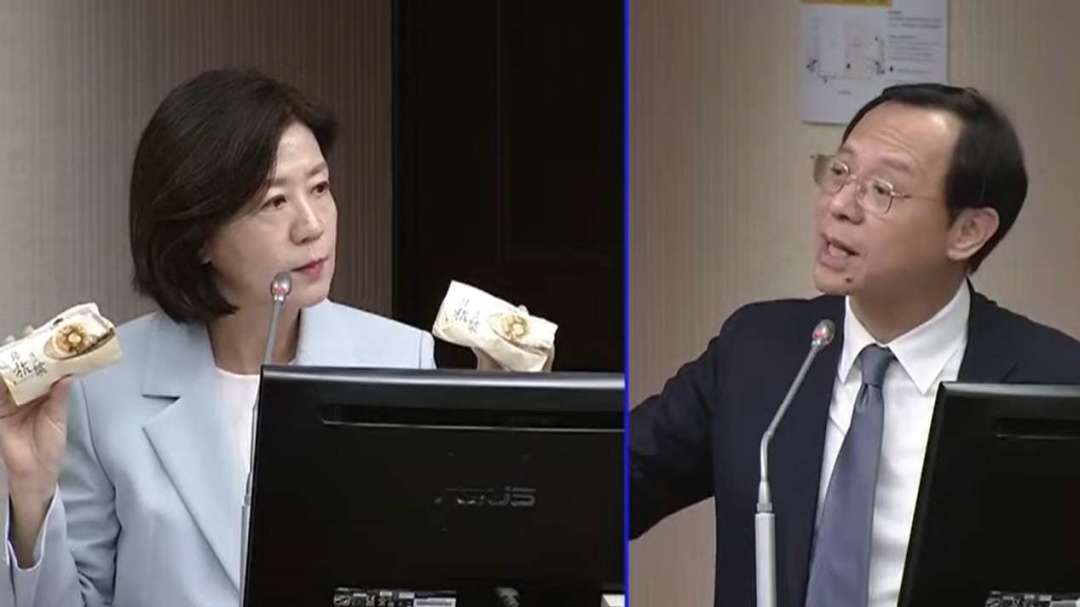
The cancer-risk edible oil scandal continues to escalate, with Taiwan's Legislative Yuan holding a heated debate today (8th) on the current food safety inspection system. Legislators questioned the collapse of the existing 'three-tier quality control' system, pointing out that companies detected abnormalities as early as May but chose to conceal them—revealing that the mechanism relying on self-regulation by businesses has failed. Minister of Health and Welfare Shih Chong-liang committed to leading the introduction of a 'third-party mandatory inspection mechanism,' no longer allowing companies to conduct their own testing. He also announced plans to study the addition of a 'tracker clause' to impose strict penalties on companies that conceal major food safety information.
Legislator Wang Yu-min held up a rice ball purchased that morning from a convenience store during questioning, directly criticizing the Ministry of Health and Welfare (MOHW) for allowing products suspected to be on the problem list to remain on shelves even after the 'full recall' announcement, leaving consumers confused. Wang harshly criticized the MOHW for chaotic decision-making, noting that initially, only partial recalls were implemented based on expert meetings, and it was only after local governments such as Taichung and Taipei took decisive action to impose full bans that the central government belatedly followed suit—demonstrating a clear lag in response.
Regarding the MOHW's submitted 'Improvement Measures Report,' Wang expressed dissatisfaction, calling the 266-character document insufficient to demonstrate reform resolve. She pointed out that the current 'three-tier quality control' system has completely collapsed, especially the first-line defense of self-inspection by businesses. According to Article 7, Paragraph 5 of the Food Safety Act, businesses are required to immediately report any issues, but in this incident, companies detected abnormalities in May and chose to conceal them—evidencing that relying entirely on self-regulation for food safety is futile.
Beyond manufacturing process failures, source control of raw materials has also become a focal point. Wang noted that from January to May, Taiwan imported as much as 599,000 tons of Brazilian soybeans. Due to their high moisture content, these beans carry a risk of carcinogen formation, yet the MOHW has failed to clearly trace the precise flow of these high-risk raw materials, offering only 'under investigation' as an explanation.
Wang questioned how products could pass initial raw material inspections but later fail during processing, indicating that current sampling frequency and standards are no longer aligned with industry realities. The 'mixed-bean' phenomenon—where manufacturers blend soybeans from different sources or quality grades—greatly increases traceability challenges. She demanded that the MOHW revise sampling frequencies and abandon the侥幸 mentality that 'dilution renders harm harmless.'
Regarding mixed beans and raw material control, Shih Chong-liang explained that many manufacturers mix different batches of raw materials during production, causing soybeans that passed initial inspections to produce variable outcomes after blending and processing. Past sampling standards focused on single sources or batches and failed to reflect the risk distribution after mixing. In the future, the MOHW will require manufacturers to increase inspection frequency and implement stricter batch-by-batch sampling for processes involving mixed raw materials, preventing 'safe raw materials from being contaminated by substandard ones.'
Shih Chong-liang admitted that this incident exposed serious flaws in the first-tier self-management mechanism, with companies' failure to honestly report directly causing the government to miss the golden window for product recalls. He publicly pledged systemic reform, including government-led introduction of a 'third-party mandatory inspection mechanism' for major raw material suppliers, ending reliance on self-testing by businesses. The MOHW will also study the addition of a 'tracker clause' to strictly punish companies that conceal major food safety information, with zero tolerance.
Regarding public concerns over the safety of market products, Shih clarified that all currently circulating products have been verified to use safe-batch raw materials. For the flow of Brazilian soybeans, the MOHW has established close coordination with local health bureaus such as in Changhua County to fully trace their distribution.
Shih emphasized that central and local governments are partners. Moving forward, inspection frequency will be comprehensively increased for manufacturing process anomalies. After the incident response concludes, a more complete and detailed review report will be issued, strengthening government oversight from border entry to end-point inspections to ensure zero tolerance for food safety risks.
FACT BOX
- Source: PR Times
- Category: News