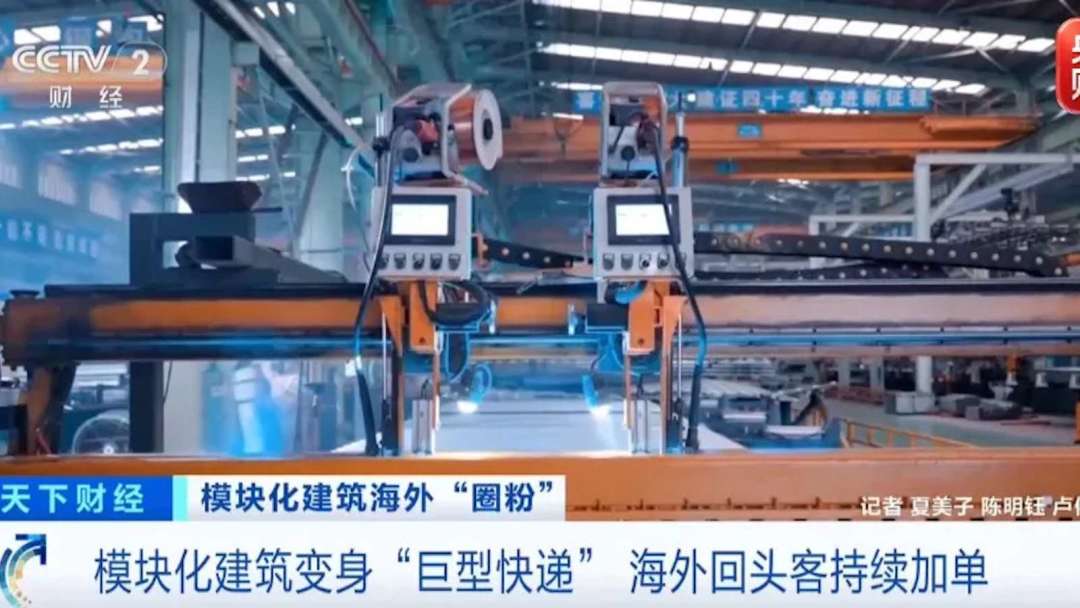
Can you imagine? Houses being shipped like parcels — a new wave of modular construction from China is capturing global attention.
According to CCTV, modular construction involves breaking down buildings into individual modules, manufacturing them in factories, and then transporting them to sites for final assembly. This method represents a more integrated form of prefabricated construction.
Data from Shenzhen Customs reveals that from January to April this year, Chinese companies exported movable housing units worth RMB 1.68 billion through the Shenzhen port, a 19.6% year-on-year increase. These exports reached over 150 countries and regions.
A UK buyer reported that 63 modules for a Chinese-made modular senior living apartment were shipped from a Chinese factory and assembled on-site in just two weeks after arriving at a UK port.
A buyer from Papua New Guinea said that 84 'giant parcels' shipped from China crossed the ocean for over a month and were transformed on-site into a fully functional hotel.
A senior executive at a digital energy equipment company stated that global demand for modular data centers has surged over the past two years. The company has cumulatively delivered over 1,000 megawatts of modular prefabricated data center projects across Malaysia, Indonesia, the Middle East, Italy, and other regions.
At a smart construction industrial park in Shenzhen, Guangdong, there are no scaffolds or dust. Instead, a four-story vertical factory operates at full capacity. The park has an annual delivery capacity of approximately 20,000 to 30,000 modular building units.
These are not ordinary portable cabins but advanced modular buildings. In simple terms, ceilings, floors, plumbing, electrical wiring, and even waterproofing layers for bathrooms are all manufactured on factory assembly lines. They are then shipped overseas and assembled on-site like building blocks.
Market research firms predict that the global modular construction market will surpass USD 142.8 billion by 2030. CCTV highlights that China is leveraging its full industrial chain advantages — from design and R&D, smart manufacturing, ocean freight, to overseas installation — turning 'house construction' into a standardized industrial export business.
FACT BOX
- Source: PR Times
- Category: News