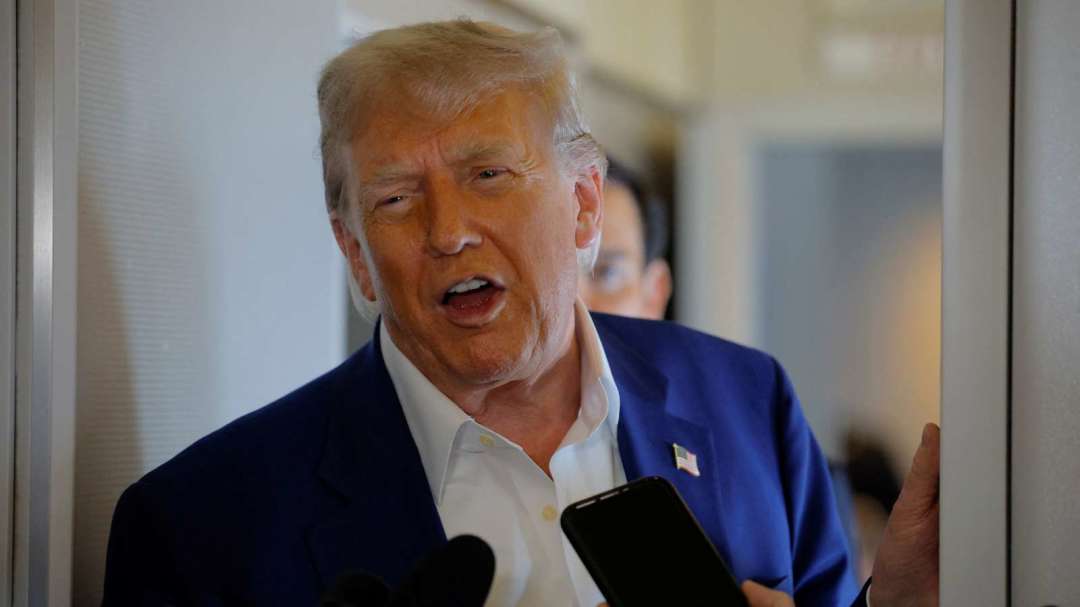
U.S. President Trump stated yesterday that it remains uncertain whether the United States and Iran will fall back into full-scale war, but emphasized that recent American airstrikes have significantly weakened Iran's military capabilities. He revealed that Iran has proactively reached out to the U.S. to seek an agreement to halt the escalation of conflict in the Middle East. However, he questioned whether Tehran can be trusted and whether it would abide by any agreement.
While returning from a visit to the United Kingdom aboard Air Force One, Trump told reporters that U.S. forces had again struck Iran. "We hit them hard," he said, adding that the U.S. had made clear it would retaliate with "20 to 1" force whenever Iran attacks American interests, and that the military action the previous night had put this into effect. Regarding Iran's retaliation that day, Trump described it as merely a response to the U.S. offensive, but said the U.S. had subsequently imposed even stronger countermeasures.
When asked whether the U.S. and Iran were heading back toward full-scale military conflict, Trump admitted, "I don't know," but stressed that if hostilities escalate again, the U.S. would be able to "win the war very quickly." He stated that the U.S. military already holds a decisive advantage and that Iran has little left, which is why it is urgently seeking negotiations.
Trump disclosed that Iran had "called us not long ago" to pursue an agreement, but he remained highly skeptical. "They really want a deal, but I don't know if they're worth talking to, and I don't know if they'll honor any agreement—that's the real issue," he said. To date, the Iranian government has not responded to Trump's claim of having initiated contact.
Meanwhile, U.S. Central Command (CENTCOM) announced yesterday that U.S. forces had launched another wave of attacks on Iran, aimed at degrading Iran's ability to attack commercial and civilian vessels in the Strait of Hormuz. The Strait of Hormuz is one of the world's most critical energy shipping routes and has been a focal point of recent U.S.-Iran tensions. During the conflict, the strait has been largely blocked for extended periods, driving up energy prices and raising market concerns about inflation, prompting major central banks to adopt more hawkish monetary policies.
The U.S. military said it launched retaliatory strikes after three commercial ships were attacked while transiting the Strait of Hormuz on Tuesday. The U.S. Treasury Department also simultaneously revoked previous waivers allowing Iran to export oil. According to CENTCOM, the two waves of U.S. military operations targeted approximately 170 Iranian military sites.
Notably, both the U.S. and Iran had only recently confirmed a memorandum of understanding (MoU) to end hostilities, but the ceasefire now faces renewed uncertainty. Earlier on Wednesday, during the NATO summit in Ankara, Turkey, Trump said, "I think the ceasefire is over," and added, "I don't want to deal with them anymore. As far as I'm concerned, it's all over." He said the U.S. delegation had initially hoped to advance a peace agreement, but now believes negotiating with Iran is a waste of time.
Iran's Foreign Ministry issued a statement on Thursday, accusing U.S. airstrikes of violating the MoU signed less than four weeks ago, and emphasized that Iran would resolutely defend its national sovereignty and territorial integrity and punish the aggressors.
In financial markets, geopolitical risks continue to support oil prices. On Thursday (9th), during Asian trading hours, September-dated Brent crude futures remained above $78 per barrel, while U.S. West Texas Intermediate (WTI) crude futures traded at $73.55 per barrel.
FACT BOX
- Source: PR Times
- Category: News