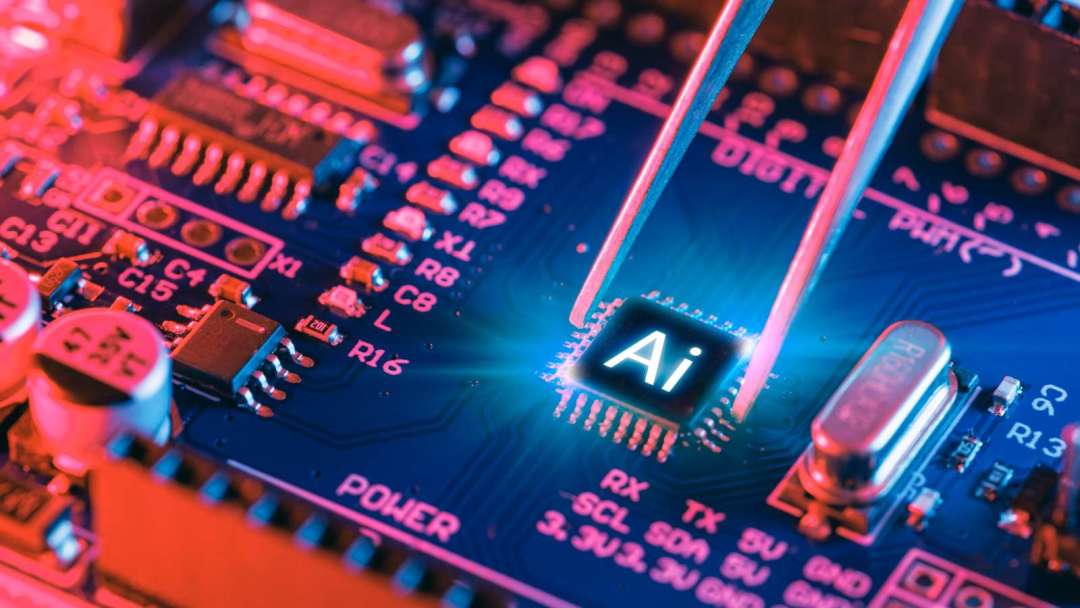
Despite semiconductor stocks officially entering a bear market, analysts at Bank of America (BofA) believe that the recent market sell-off is merely a 'summer rebalancing' and not a fundamental reversal, and continue to have a positive outlook on semiconductor stocks.
According to a report by MarketWatch, the semiconductor group has seen dramatic fluctuations in recent performance. After a significant surge in the first half of the year, the Philadelphia Semiconductor Index (SOX) officially entered a bear market (prices fell more than 20% from the recent high) last Friday (the 17th), closing 20.2% lower than the historical closing high recorded on June 22nd.
The SOX index experienced significant volatility last Friday, once plummeting by 5.7%, then briefly turning red, but ultimately closing down 1.63%.
However, Bank of America analyst Vivek Arya stated that the recent correction in semiconductor stocks was influenced not only by fundamental factors such as the rising costs of memory chips but also by the seasonal volatility of the SOX index.
Arya pointed out that in the past 16 years, the SOX index has underperformed the S&P 500 index in 10 of them during the third quarter. Additionally, in the second quarter of this year, semiconductor stocks had accumulated an approximate 80% increase.
Despite recent market volatility, Arya remains optimistic about the long-term prospects of semiconductors, networking equipment, and semiconductor equipment stocks. He also expects global artificial intelligence (AI) related spending to more than double by 2030, reaching 1.7 trillion dollars.
In terms of individual stocks, Broadcom (AVGO-US) and AMD (AMD-US) both saw their stock prices close down approximately 1% last Friday. Intel (INTC-US) and NVIDIA (NVDA-US) both fell approximately 2%.
Notably, NVIDIA's market capitalization was briefly surpassed by Apple (AAPL-US), but at the close, it regained its position as the highest-valued publicly traded company in the United States.
Another key factor driving this sell-off was the release of the latest model, Kimi K3, by the Chinese startup Moonshot AI.
Jefferies analyst Matt Ma pointed out that this open-source model, with 2.8 trillion parameters, can already compete with Anthropic's Fable 5 and OpenAI's GPT-5.6 Sol, and is more market-competitive due to its lower cost.
Siebert Financial's investment head Mark Malek described the situation from a sharper angle: 'On the same morning that Wall Street was still doubting whether AI's economic benefits could hold up, the gap in cutting-edge AI technology between China and the U.S. suddenly narrowed significantly.'
Memory stock performance was mixed. Micron Technology (MU-US) saw a slight dip in stock price, while SanDisk (SNDKV-US) plummeted nearly 4%. In contrast, storage device manufacturers Seagate Technology (STX-US) and Western Digital (WDC-US) rose 5.66% and 2.23%, respectively.
Arya pointed out that memory chip spending currently accounts for approximately 35% to 40% of the capital expenditures of ultra-large-scale data center operators, which is two to three times the historical level.
He expects that both the spot and contract prices of memory components will maintain strong performance this quarter and noted that the spot price of dynamic random access memory (DRAM) has been rising for eight consecutive weeks, while the price trend of NAND Flash has also remained strong.
Additionally, Arya stated that as the visibility of the long-term investment cycle for AI infrastructure improves, he estimates that the semiconductor manufacturing equipment market size will continue to expand, with revenue expected to reach 190 billion dollars in 2027 and further increase to 250 billion dollars in 2028.
At the same time, he believes that TSMC's (2330-TW) announcement to raise its investment commitment in the United States to 265 billion dollars may further pressure Intel and Samsung to expand their investments in the United States.
Arya also noted that ASML (ASML-US) expects its deep ultraviolet (DUV) and extreme ultraviolet (EUV) lithography equipment shipments to maintain annual growth of over 30% in 2027 and 2028. Combined with market expectations of price increases for related equipment, this will bring positive news to the overall semiconductor equipment industry.
In terms of individual stock performance, at the close of trading last Friday, Applied Materials (AMAT-US) stock fell 5.57%, KLA (KLAC-US) fell 3.02%, and Lam Research (LRCX-US) fell 2.39%.
FACT BOX
- Source: PR Times
- Category: Survey
- Organizations: SanDisk