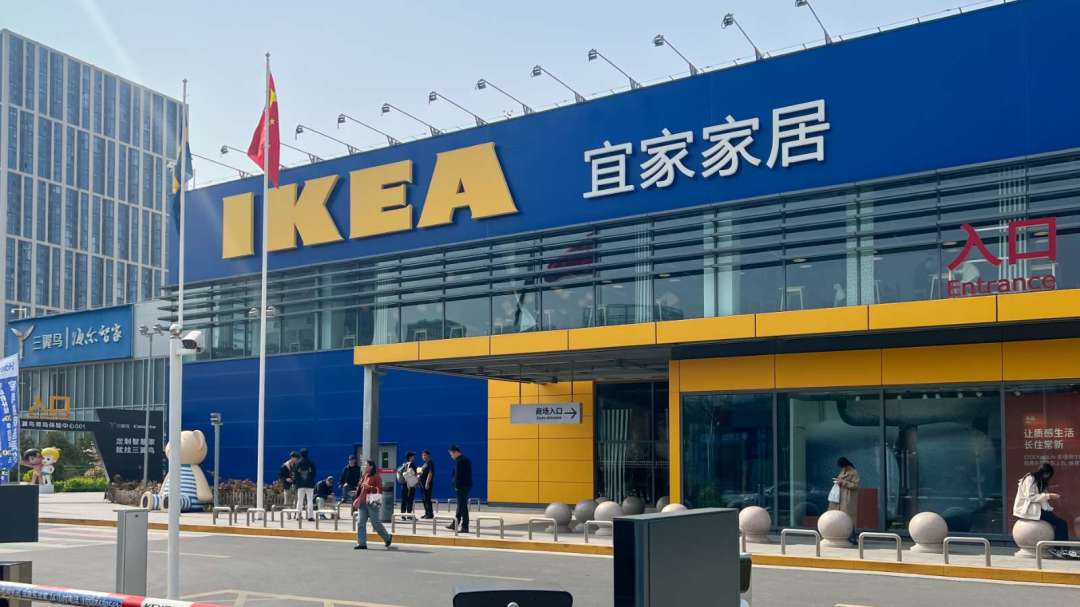
Commercial real estate services and investment management firm JLL has been exclusively mandated by Ingka Group, the parent company of IKEA, to sell eight IKEA-owned idle properties across eight Chinese cities: Shanghai, Guangzhou, Tianjin, Harbin, Nantong, Xuzhou, Guiyang, and Ningbo.
According to a report by the Beijing Daily on Sunday (19th), this is the largest-scale centralized disposal of self-owned assets by IKEA since entering the Chinese market nearly 30 years ago, reflecting a comprehensive strategic restructuring by the home furnishings retail giant in China.
JLL stated that all eight assets being brought to market are self-owned properties of Ingka China. These assets are now fully vacated, free of lease restrictions, and can be delivered immediately in their current condition.
All eight properties are located in mature commercial districts or key development zones within their respective cities, with complete building structures and clear ownership rights, making them suitable for conversion into long-term rental apartments, community retail spaces, cultural-tourism complexes, or corporate headquarters.
Among the assets for sale, the seven properties in Shanghai Baoshan, Guangzhou Panyu, Tianjin Zhongbei, Harbin, Nantong, Xuzhou, and Ningbo correspond to the seven large IKEA stores that IKEA China collectively closed in February this year. The Guiyang IKEA store had already ceased operations in 2022 and has now been uniformly included in the asset disposal list.
For over two decades, IKEA has long pursued a capital-intensive expansion model in China—acquiring land on the outskirts of cities and constructing self-owned, tens-of-thousands-of-square-meter mega-stores. The one-stop warehouse-style large stores were once the core driver for brand expansion.
However, in recent years, online home e-commerce and local instant retail have continuously diverted offline foot traffic. The frequency of customer visits to large home furnishing stores has declined year by year, while fixed costs such as land ownership, property maintenance, and labor remain high, with inefficient stores continuously squeezing profit margins.
IKEA China's sales dropped by 7.6% in the 2024 fiscal year, shrinking by over 30% compared to its peak sales in China in 2019.
Regarding the closure of multiple stores, IKEA China previously stated that, facing global economic uncertainty, the wave of digitalization, and profound changes in consumer behavior, the retail industry is undergoing an unprecedented transformation. IKEA is continuously evaluating and strengthening its global business portfolio, channel layout, and operational structure to better align with customer needs. Specific measures include enhancing the efficiency of each square meter of commercial space through transformation, closure, or addition of business units.
While scaling back large-format stores, IKEA China is positioning small-format stores and e-commerce as new growth drivers. In April 2026, IKEA's Tongzhou store in Beijing will officially open in Bayi, marking IKEA's first small-format store in Beijing. The company plans to open more than ten small-format stores within the next two years.
New initiatives are also underway in e-commerce. On July 1st this year, IKEA China launched a pilot of Taobao Flash Delivery in three cities—Hangzhou, Beijing, and Shenzhen. Consumers can purchase selected IKEA home products via the Taobao Flash Delivery platform and enjoy delivery in as fast as one hour.
FACT BOX
- Source: PR Times
- Category: News