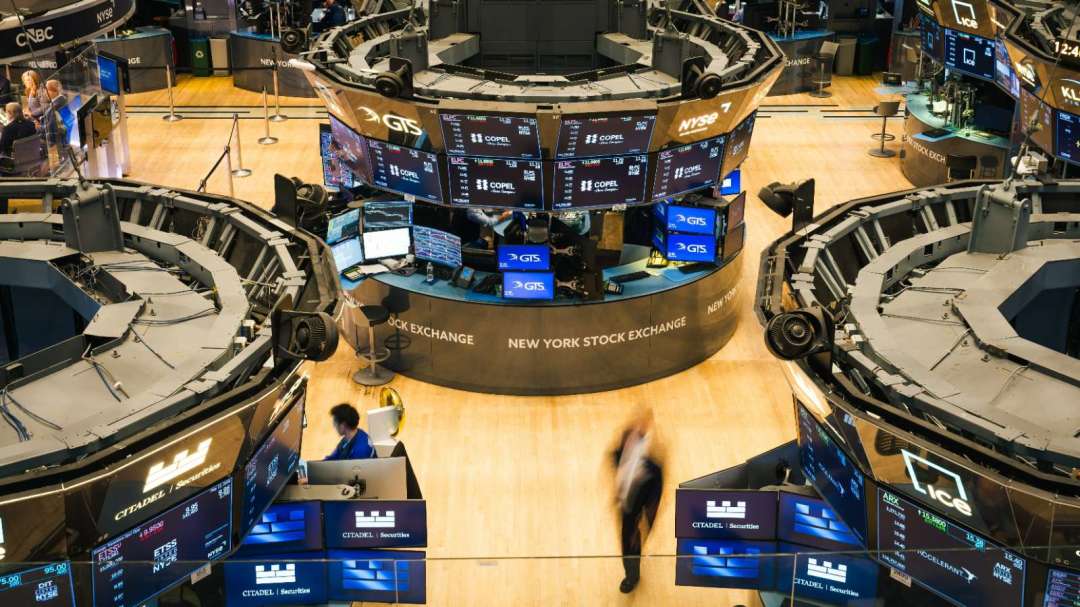
U.S. stocks opened higher on Monday (20th) but lost momentum, trading in a narrow range before closing lower across the three major indices. With no major economic data released and the Federal Reserve in its pre-meeting blackout period, investor attention shifted to the密集 wave of corporate earnings reports this week, alongside ongoing concerns over U.S.-Iran tensions and oil prices.
Renewed hostilities between the U.S. and Iran lifted international oil prices and U.S. Treasury yields, weighing on overall market sentiment. Apple (AAPL-US) fell over 2%, dragging down the Dow Jones Industrial Average.
The Dow closed down over 300 points, the S&P 500 edged down 0.19%, and the Nasdaq Composite slipped 0.05%, while the Philadelphia Semiconductor Index rose 0.6%.
iShares Semiconductor ETF (SOXX-US), which plunged 10% last week, rebounded 0.45% on Monday; Micron (MU-US) gained 1.9%. SanDisk (SNDK-US) rose 2.67%. SK Hynix (SKHY-US), however, still closed down 1.86%.
The U.S. conducted its ninth consecutive day of airstrikes on Iran. However, Iranian Foreign Ministry spokesperson Esmail Baghaei stated that despite continued U.S. attacks, intermediaries are still exchanging messages with Iran, and both sides could negotiate based on national interests—briefly boosting market hopes for a diplomatic resolution.
But Trump later posted on Truth Social that Iran would pay "many times over" for the deaths of three U.S. soldiers, reigniting market risk aversion and pushing oil prices higher. West Texas Intermediate (WTI) crude futures rose 0.9% to $83.23 per barrel; Brent crude futures gained about 1.3% to $89.22 per barrel.
This week, 77 S&P 500 companies are set to report earnings, including Alphabet and Tesla. Investors will look for clues on AI investment returns and broader market direction.
Markets expect Alphabet’s search advertising and Google Cloud businesses to continue recovering, but investors are more focused on the scale of AI capital expenditures and how quickly those investments translate into profits.
Tesla’s Q2 deliveries beat expectations, but investors remain divided on whether auto gross margins can stabilize and the timeline for Robotaxi rollout. Intel and Texas Instruments’ earnings may offer fresh insights into AI infrastructure spending and semiconductor demand.
Other major earnings this week include General Motors (GM-US), Lockheed Martin (LMT-US), Honeywell (HON-US), and American Express (AXP-US).
U.S. stock market performance on Monday (20th):
Dow Jones Industrial Average fell 307.16 points, or 0.59%, to 51,839.26.
Nasdaq Composite declined 12.17 points, or 0.05%, to 25,508.07.
S&P 500 dropped 14.41 points, or 0.19%, to 7,443.28.
Philadelphia Semiconductor Index rose 69.96 points, or 0.60%, to 11,743.85.
NYSE FANG+ Index gained 107.00 points, or 0.62%, to 17,280.90.
Key Stocks
Tech giants within the NYSE FANG+ Index showed mixed results. Meta (META-US) dipped 0.02%; Apple (AAPL-US) fell 2.14%; Alphabet (GOOGL-US) rose 1.51%; Microsoft (MSFT-US) gained 2.15%; Amazon (AMZN-US) increased 1.12%.
Philadelphia Semiconductor stocks rebounded. AMD (AMD-US) rose 1.58%; Broadcom (AVGO-US) gained 1.98%; Nvidia (NVDA-US) up 0.23%; Applied Materials (AMAT-US) fell 0.75%; Qualcomm (QCOM-US) down 0.85%; Micron (MU-US) up 1.94%.
Taiwanese ADRs were mixed. TSMC ADR (TSM-US) rose 0.99%; ASE ADR (ASX-US) fell 3.93%; UMC ADR (UMC-US) plunged 4.47%; Chunghwa Telecom ADR (CHT-US) gained 0.38%.
Company News
AMD (AMD-US) closed up 1.58% to $503.57 per share. AMD is set to deliver its first AI rack system, Helios, seen as the first truly competitive alternative to Nvidia’s Grace Blackwell and Vera Rubin systems.
Microsoft (MSFT-US) surged 2.15% to $402.29 per share. Microsoft announced it will offer systems powered by AMD’s Helios architecture on its Azure cloud platform. Wolfe Research analyst Chris Caso noted that Microsoft’s renewed adoption of AMD GPUs signals Helios’ competitiveness. AMD will host its "Advancing AI" event later this week, while Microsoft’s stock rose less than 1% intraday.
Intel (INTC-US) rose over 2% to $97.06 per share. Intel plans new layoffs in its data center division to ensure proper staffing and skills for long-term business support. Intel is scheduled to release its Q2 2026 earnings after market close on Thursday (23rd).
Alibaba (BABA-US) ADR jumped 4.67% to $120.34 per share. The company announced it will launch a new AI model, Qwen 3.8 Max, claiming its capabilities are second only to Anthropic’s Fable 5 model.
Energy infrastructure firm Hut 8 (HUT-US) soared 10.37% to $100.93 per share. Hut 8 signed a 15-year, $9.8 billion lease agreement with an existing client, fully commercializing its Beacon Point data center in Texas with 1GW capacity.
Domino’s Pizza (DPZ-US) rose 2.11% to $328.97 per share. Domino’s Q2 revenue slightly exceeded expectations, with the CEO noting significant growth in delivery and carryout orders, pushing shares up over 1%.
In contrast, SpaceX (SPCX-US), despite announcing another Starship rocket launch attempt on Thursday (23rd), fell 3.34% to $119.85 per share, hitting a new low. The company had previously canceled a launch due to engine issues.
Wall Street Analysis
Crisafulli, founder of Vital Knowledge, believes investors still think Trump has no intention of significantly escalating U.S. military presence in the Middle East, such as deploying ground troops. If true, a diplomatic solution will ultimately be necessary.
Deutsche Bank analyst Jim Reid noted that the ultimate winners and losers in the AI race remain unclear. Chinese AI models are pricing closer to mid-tier U.S. models while approaching the performance of high-end systems, meaning they offer comparable AI capabilities at significantly lower cost—posing a challenge to the U.S. AI industry model based on high compute power and capital investment.
José Torres, senior economist at Interactive Brokers, believes earnings will differentiate winners and losers in AI capital spending. Companies proving AI investments are translating into revenue and profit will gain market favor; those failing to deliver returns or lacking commercialization strategies may face Wall Street punishment.
Darrell Cronk, president of Wells Fargo Investment Institute, said semiconductor and AI trades are undergoing a healthy reality check. Recent technical weakness increases the risk of further pullbacks to long-term support levels, including testing the 200-day moving average.
He added that while a short-term technical rebound isn’t surprising given oversold conditions, the medium-term uptrend has been broken.
(All figures are updated as of press time; please refer to actual quotes for accuracy)
FACT BOX
- Source: PR Times
- Category: News
- Organizations: Apple / Alphabet / Tesla