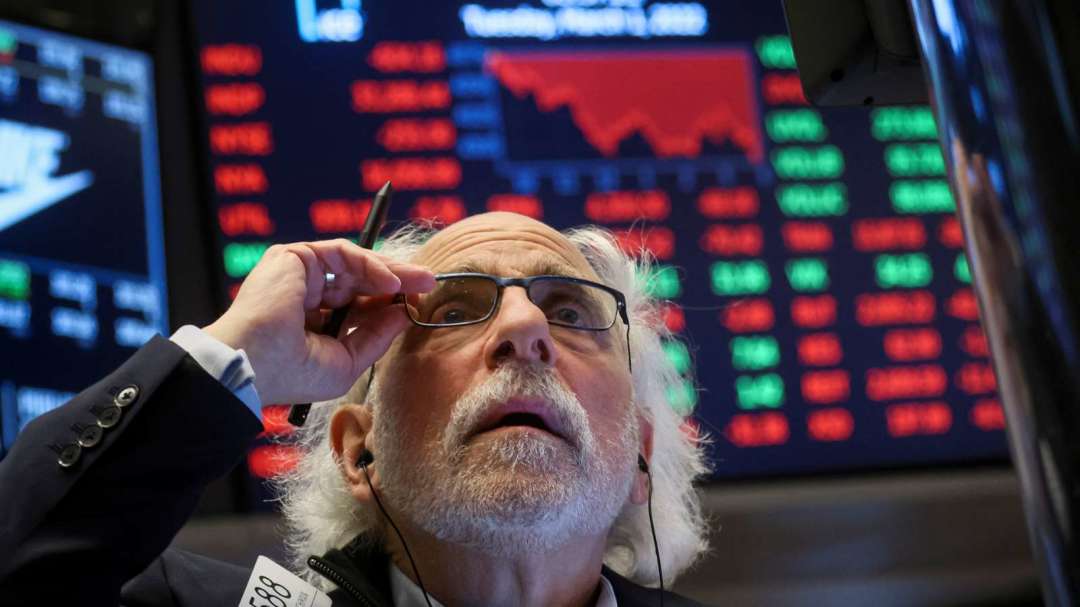
Following his accurate call on the market bottom in March, Michael Hartnett, chief investment strategist at Bank of America, has once again issued a warning. He argues that market positioning has become so crowded it is now unhealthy, and investor optimism is nearing bubble-like levels. The best move for investors this summer, he says, is not to 'buy the dip,' but to retreat.
According to BofA’s latest fund manager survey, its proprietary Bull & Bear Indicator has surged to 9.6, hitting a record high.
Hartnett states plainly: readings at this level have historically pointed to one conclusion — it's time to hedge, not chase higher prices.
His recommended strategy is clear: exit risk assets and shift toward duration, defensive assets, high-dividend stocks, and the U.S. dollar — not adding on weakness.
As a key indicator, he highlights the U.S. 'Magnificent 7' tech giants ETF (MAGS-US). A break below $65 could drag down cyclical stocks broadly; conversely, holding above $70 would signal a renewed market strength.
Hartnett’s biggest concern is that if mega-cap tech firms unexpectedly announce cuts to AI-related capital expenditures — while failing to push the 'Magnificent 7' stocks to new highs — financials, brokerages, and industrials could face massive short attacks, potentially triggering a broad market crash.
This week’s EPFR fund flow data partially validates Hartnett’s concerns. Equities attracted $55.8 billion in inflows, bonds gained $20 billion, while money market funds suffered an unprecedented $119.6 billion net outflow — the largest weekly withdrawal since April 2026.
Meanwhile, tech stocks pulled in $48.8 billion over the past three weeks, a record high. Emerging market equities saw $25 billion in weekly inflows, the highest since April 2025.
Hartnett admits that fund manager surveys have limited predictive power for market direction. But their real value lies in revealing how consensus-driven market sentiment has become. The more concentrated the consensus, the stronger the case for contrarian action.
Four 'Won’t Happen' Assumptions Fueling Optimism
BofA’s July survey shows that current market optimism rests on four assumptions:
- No hard landing for the economy, - The Fed won’t raise rates, - AI capital spending won’t be cut, - Democrats won’t win majorities in both houses during the midterm elections.
Hartnett points out this is precisely why nearly no bearish positions remain in the market.
Macro optimism has reached its highest level since February 2022. Bank stocks in the U.S., Japan, the U.K., and Europe have all hit multi-year or even decades-long highs — a vivid sign of the ongoing 'boom trade.'
Yet Hartnett argues that precisely because nearly everyone is betting on prosperity, the logic for going contrarian is stronger than ever: go long on long-duration bonds, defensive assets, and high-dividend stocks, while shorting industrials and bank stocks.
Here are Hartnett’s three key contrarian signals:
Signal 1: 54% of managers bet on 'no landing' — contrarians turn to long bonds and defensive stocks.
While most believe in a soft or even 'no landing,' Hartnett argues that now is the time to favor long-duration government bonds and defensive equities for better risk-reward.
Signal 2: 83% believe the Fed won’t hike — contrarians go long the dollar.
A staggering 83% of fund managers expect the Fed to hold rates steady before the November midterms.
But Hartnett warns: if current trends continue, U.S. CPI could reach 3.9% by end-2026 (three-month moving average at 0.3%).
With the Strait of Hormuz blocked again and U.S. crude inventories at a 45-year low (just 43 days of supply), fund managers have slashed their year-end oil price forecasts from $86 to $71 per barrel.
He argues that if the Fed unexpectedly pivots to hiking, going long the dollar remains the safest hedge.
Signal 3: 61% believe AI capex won’t shrink — contrarians short semiconductors, the most crowded trade.
Despite rapid expansion in AI-related capex, 61% of respondents believe cloud giants won’t cut spending before end-2026.
But Hartnett notes that these tech giants’ free cash flow has turned negative, and bond market financing pressure is rising. Oracle’s credit default swap (CDS) spread has widened from 59 to 87 basis points since September, nearing previous highs.
The recent outperformance of the 'long MAGS, short SOX' trade hints that capex cuts may be near.
Semiconductor Stocks Technically Weakening
Technical charts for semiconductor stocks have clearly weakened. The Philadelphia Semiconductor Index (SOX) now trades at a 33% premium to its 200-day moving average, down sharply from 76% on June 3 — a level of overbought only seen during the dot-com peak in March 2000.
SOX has fallen 20% from its peak, while the 3x leveraged SOXL ETF has plunged 55%.
Curiously, despite the sharp price drop, capital shows no sign of exiting. Hartnett reports that the eight largest semiconductor ETFs pulled in $2.3 billion this week alone, totaling $46 billion year-to-date — 31% of their total AUM.
Over the past three weeks, tech stocks have drawn a record $48.8 billion in inflows. Hartnett describes this as 'institutionally driven, consequence-ignoring momentum chasing.'
Latest EPFR data further highlights market euphoria. Equities saw $55.8 billion in net inflows, bonds $20 billion, gold a mere $500 million, and crypto a slight outflow of $100 million.
In contrast, money market funds suffered a historic $119.6 billion outflow — the largest weekly cash exodus since April 2026.
Breaking it down: investment-grade bonds saw 15 consecutive weeks of inflows, gaining $9.5 billion this week; emerging market equities attracted $25 billion, the highest since April 2025.
Tech stocks pulled in $15.6 billion weekly, setting a new three-week cumulative record; financials gained $2.7 billion, the highest weekly inflow since January 2026.
In Hartnett’s view, it is this massive cash shift into equities and tech that has driven the Bull & Bear Indicator to extreme historical highs — the core reason he urges investors to stay cautious this summer and prioritize profit-taking over adding exposure.
FACT BOX
- Source: PR Times
- Category: Survey
- Organizations: EPFR
- Products / services: MAGS-US ETF / Bull & Bear Indicator