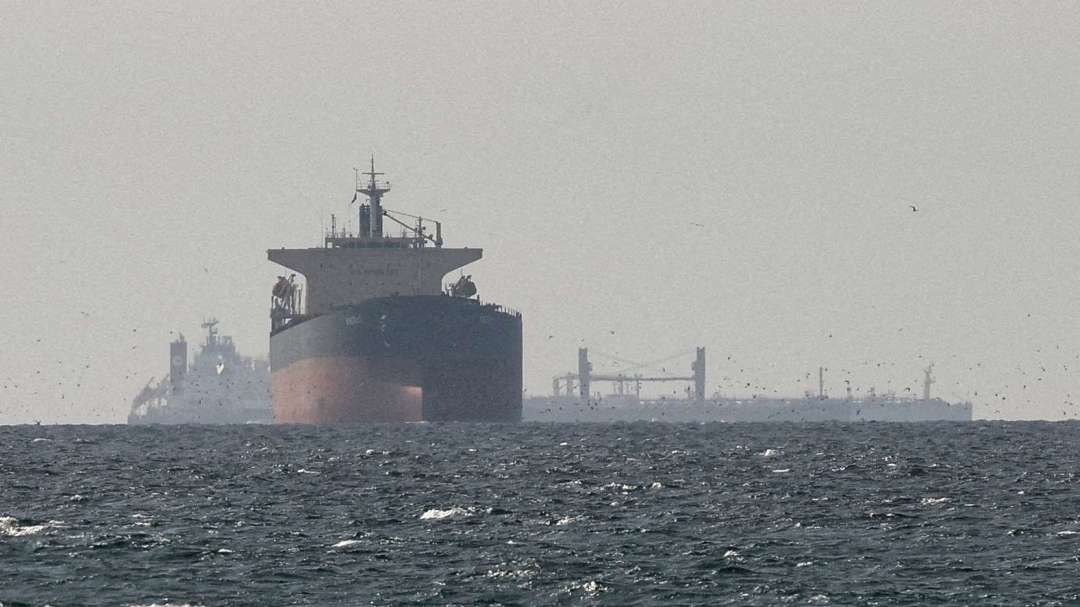
Iran said on Monday (20th) that two tankers exploded and lost power, heightening global concerns over shipping safety in the Strait of Hormuz. Meanwhile, the U.S. military has launched attacks on Iran for the ninth consecutive day.
According to Reuters, Iran's Islamic Revolutionary Guard Corps (IRGC) stated on Monday that two tankers exploded and lost power after attempting to pass through a southern waterway it described as 'unsafe.' The Revolutionary Guard accused the vessels of using this route under encouragement from the U.S. military.
However, the IRGC statement did not disclose the names of the vessels involved, their flags, crew information, or whether there were any casualties. Reuters said it could not immediately verify the incident.
The Revolutionary Guard warned that as long as it perceives continued 'aggressive actions' by the U.S. in the region, the waterway will remain unsafe, stating: 'This route will no longer be suitable for petrochemical transport, and not even a single drop of oil or natural gas can pass safely.'
Data from the London Stock Exchange Group (LSEG) shows that four vessels passed through the Strait of Hormuz on Sunday (19th), down from eight the previous day.
The data indicates that since last Friday (17th), at least three product tankers and one Very Large Crude Carrier (VLCC) have entered the strait to load oil.
International oil prices rose 2% on Monday, surpassing $90 per barrel.
Separately, Iran's Islamic Revolutionary Guard Corps (IRGC) said on Monday it had launched ballistic missiles at U.S. aircraft at Aqaba Airport in Jordan, and struck U.S. military assets and equipment at Al-Adiri Camp and Ali Al Salem Air Base in Kuwait, as well as U.S. targets inside Syria.
Bahrain's Interior Ministry reported that air defense alerts sounded in the country on Monday morning; Kuwaiti forces said they intercepted enemy drones launched during Iran's attacks.
These attacks are part of an escalating conflict between the U.S. and Iran. After a temporary ceasefire agreement signed a month ago collapsed, hostilities have intensified, further fueling the struggle for control over the Strait of Hormuz. The conflict has disrupted energy supplies and deepened global inflation concerns.
U.S. Central Command (CENTCOM) stated in a release that it had launched a 'new wave of attacks' aimed at 'degrading' Iran's ability to attack commercial vessels in this critical shipping lane. The statement provided no further details.
Iran's semi-official Tasnim News Agency, citing its own reporters, reported that U.S. missiles struck multiple Iranian cities early Monday morning.
According to Tasnim, explosions were heard in cities including Tabriz, Chabahar, Konarak, Bandar Mahshahr, and Bandar Imam Khomeini.
U.S. Secretary Marco Rubio stated that the U.S. would continue military actions against Iran as long as it attacks global commercial shipping.
Rubio said: 'The Strait of Hormuz is an international waterway, and they continue to attack vessels navigating these international waters.'
He emphasized: 'As long as Iran insists on controlling an international waterway, we must respond. However, the United States remains open to diplomatic solutions.'
Meanwhile, the Kuwaiti government said a seawater desalination plant was attacked for the second consecutive day, causing a fire, calling it a direct strike on critical civilian infrastructure.
Since the U.S. and Iran resumed open hostilities, concerns have persisted about whether energy supplies can safely pass through the Strait of Hormuz. Both sides have accused each other of repeatedly violating the ceasefire agreement, leading to its collapse.
The UK Maritime Trade Operations (UKMTO) reported late Sunday that it had received a report of a vessel catching fire near the Omani coast, though the cause of the fire has not yet been confirmed.
FACT BOX
- Source: PR Times
- Category: News