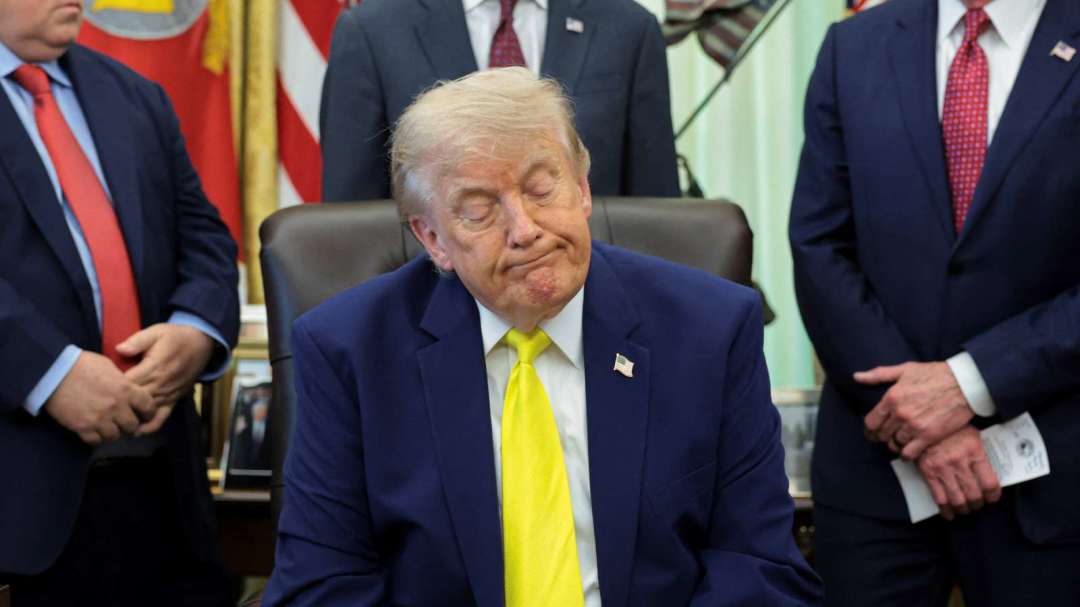
On Thursday, April 23 (Eastern Time), as military tensions with Iran continue to escalate, the Republican-controlled US House of Representatives passed, by a narrow margin of 214 to 208 votes, a resolution under the War Powers Act. The resolution demands an end to US military actions against Iran that lack congressional authorization and calls for the withdrawal of US forces involved in hostile operations against Iran.
In fact, this marks the second time recently that the House has passed a similar resolution, signaling that President Trump is facing increasing political pressure within Congress as the conflict drags on and the risk of regional spillover grows.
The resolution was introduced by Democratic Representative Pramila Jayapal, with its core demand being the withdrawal of US military forces from hostile actions against Iran unless Congress formally declares war or separately authorizes such actions through legislation.
In the final vote, all Democrats supported the resolution, along with four Republican representatives: Tom Barrett of Michigan, Brian Fitzpatrick of Pennsylvania, Warren Davidson of Ohio, and Thomas Massie of Kentucky.
This is not the first attempt by Congress to halt this conflict. In June, the House previously passed a similar resolution by 215 to 208 votes, and the Senate followed with a 50 to 48 vote.
However, the Trump administration has yet to accept any of these congressional resolutions, consistently arguing that such measures infringe upon the President’s constitutional authority as Commander-in-Chief.
Analysts note that despite passing twice, this resolution is unlikely to immediately halt military operations in the short term.
US media analysis suggests that even if such War Powers resolutions limiting presidential military authority pass Congress, the executive branch may refuse to implement them, potentially triggering further legal battles. Indeed, the Trump administration has previously questioned the legality of similar resolutions.
Moreover, there is currently no strong political consensus in Congress powerful enough to force the government to cease military actions. The Republican Party still controls the House, and Trump maintains significant influence within his party.
In this vote, only four Republican lawmakers defected to support the Democrats, reflecting emerging dissent within the party on Iran policy, but no clear shift in the overall stance.
Therefore, what observers and political analysts are focusing on is not whether this resolution will immediately change military operations, but rather the political implications it signals: as the conflict persists, casualties rise, and regional instability deepens, the Trump administration is under growing political pressure from Congress.
At the very moment of this vote, US-Iran military tensions continue.
According to foreign media reports, following recent US strikes on Iran, Iran launched retaliatory attacks on US military bases in the Middle East. At the same time, Houthi militant attacks on Saudi-linked oil tankers have spread risks to the critical Red Sea shipping route, prompting Trump to threaten larger-scale military retaliation.
What began as a conflict focused on Iranian nuclear and military facilities has now become entangled with multiple fronts across the Middle East, energy supplies, and maritime security, making the nature of the conflict increasingly complex and difficult to resolve.
This makes it increasingly difficult for the Trump administration to frame the operation as 'short-term and limited,' and opposition voices are gradually spreading from Democratic ranks into the Republican Party.
Interestingly, even as criticism grows within Congress, Republican lawmakers are actively pushing a $95 billion military aid package and a roughly $1.15 trillion defense spending bill.
Analysts argue this reveals a contradiction in US politics: on one hand, legislative efforts aim to restrict presidential military actions without authorization, while on the other, continued funding is provided for broader military and defense expenditures.
At its core, this standoff touches on a long-standing unresolved issue in the US constitutional system: how to divide war powers between the President and Congress. While the President, as Commander-in-Chief, holds operational command authority, the Constitution grants Congress the power to formally declare war and authorize prolonged military engagements.
Following the end of the Vietnam War in 1973, Congress passed the War Powers Act to prevent presidents from launching prolonged military actions without congressional approval.
However, the Trump administration has consistently maintained that the White House possesses executive discretion to take military action when necessary and has repeatedly challenged congressional attempts to limit presidential authority through resolutions.
Meanwhile, Democrats insist that the administration’s continued military actions against Iran without formal authorization exceed the boundaries of presidential executive power.
Analysts point out that previous War Powers resolutions have not actually ended US military operations. While the House’s renewed passage may not immediately alter battlefield dynamics, it does indicate that the confrontation between the White House and Congress is becoming increasingly 'institutionalized.'
If the conflict continues to expand, or if US military casualties, energy prices, and shipping risks rise further, the congressional push to limit presidential military power is expected to intensify.
For financial markets, this vote does not necessarily mean the US will immediately withdraw from the Iran theater, but it does heighten policy uncertainty. Whether the Trump administration will continue advancing military operations or seek a new balance between military pressure, domestic politics, and diplomatic negotiations remains to be seen.
FACT BOX
- Source: PR Times
- Category: News