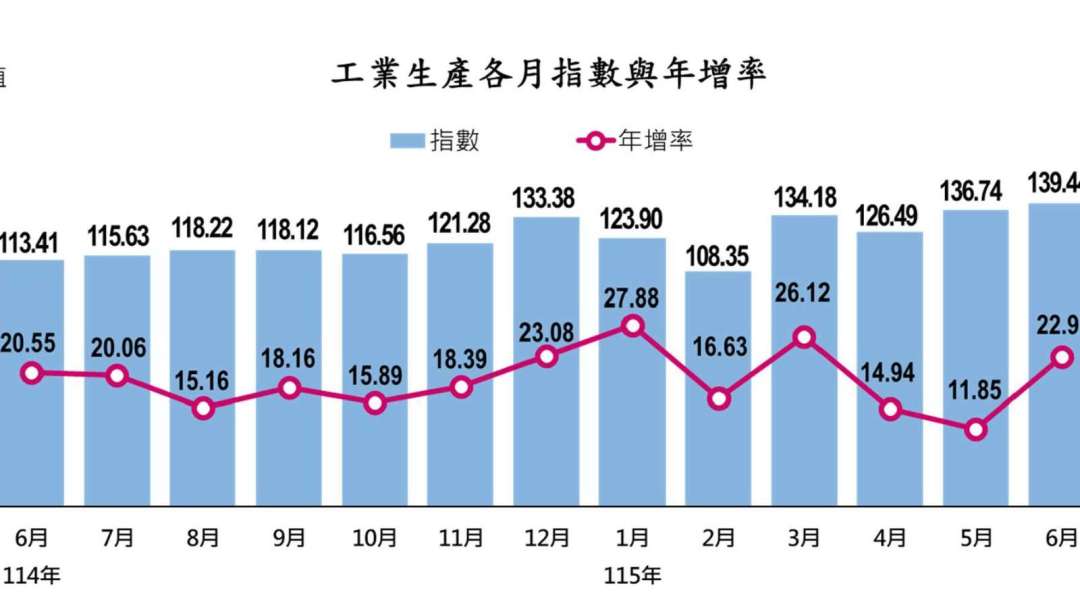
The Ministry of Economic Affairs (MOEA) released June's industrial production statistics today (23rd), showing that robust demand for artificial intelligence (AI) and high-performance computing (HPC) propelled the industrial production index to 139.44, a 22.95% year-on-year increase. The manufacturing production index reached 142.00, up 24.34% annually—both figures marking record highs and the 28th consecutive month of positive growth. Cumulative industrial output from January to June 2023 rose 19.82% compared to the same period last year, demonstrating strong momentum.
According to data from the MOEA's Directorate-General of Budget, Accounting and Statistics, the seasonally adjusted manufacturing production index increased 4.01% month-on-month in June. The information and electronics industry, which holds the largest weight in manufacturing, surged 33.89% year-on-year, becoming the primary driver of overall industrial growth. The electronics components sector rose 30.37%, fueled by sustained strong demand for HPC and AI applications, boosting production of 12-inch wafer foundry services, motherboards, DRAM, IC packaging and testing, and IC design.
Furthermore, the computer, electronic, and optical products industry grew 45.05% year-on-year, driven by robust demand for cloud data services and related infrastructure, along with continued investment in semiconductor equipment. This led to significant increases in production of servers, switches, semiconductor testing equipment and components, SSDs, fiber-optic transmission devices, and components. Cumulative output for the first half of 2023 showed the electronics components sector up 20.81% and the computer, electronic, and optical products sector up 81.85% year-on-year.
In traditional industries, machinery equipment production rose 17.24% year-on-year, supported by ongoing semiconductor capacity expansion and lower base effects due to maintenance shutdowns at some steel plants in the same month last year. The machinery sector benefited from increased capital spending by advanced semiconductor process and high-end packaging and testing firms, driving higher output of semiconductor production equipment and components, pollution control equipment, and related parts.
Conversely, the chemical materials and fertilizers industry declined 11.66% due to weak market demand and production halts for maintenance or output adjustments. The automotive and parts sector fell 1.72% as overseas customers adopted conservative ordering and automakers adjusted inventories. However, production of electric sedans and electric buses increased due to policy incentives, partially offsetting the decline. Overall industrial output for the first half of 2023 maintained a solid 19.82% year-on-year growth.
Looking ahead, despite ongoing geopolitical risks and international trade disputes affecting the global economy, expanding AI applications, strong capital expenditures by global cloud service providers, and accelerated government investments in AI infrastructure are expected to provide robust momentum for Taiwan’s advanced semiconductor processes, high-end packaging and testing, and server-related supply chains, sustaining manufacturing growth.
According to MOEA surveys, 10.9% of manufacturers expect July output to increase from June, 75.1% anticipate no change, and 14.0% foresee a decline. The production trend index, calculated by output value, stands at 50.8, indicating an expected increase in July’s production index compared to June. This reflects a cautiously optimistic outlook for Taiwan’s manufacturing sector.
FACT BOX
- Source: PR Times
- Category: Survey
- Products / services: SSD