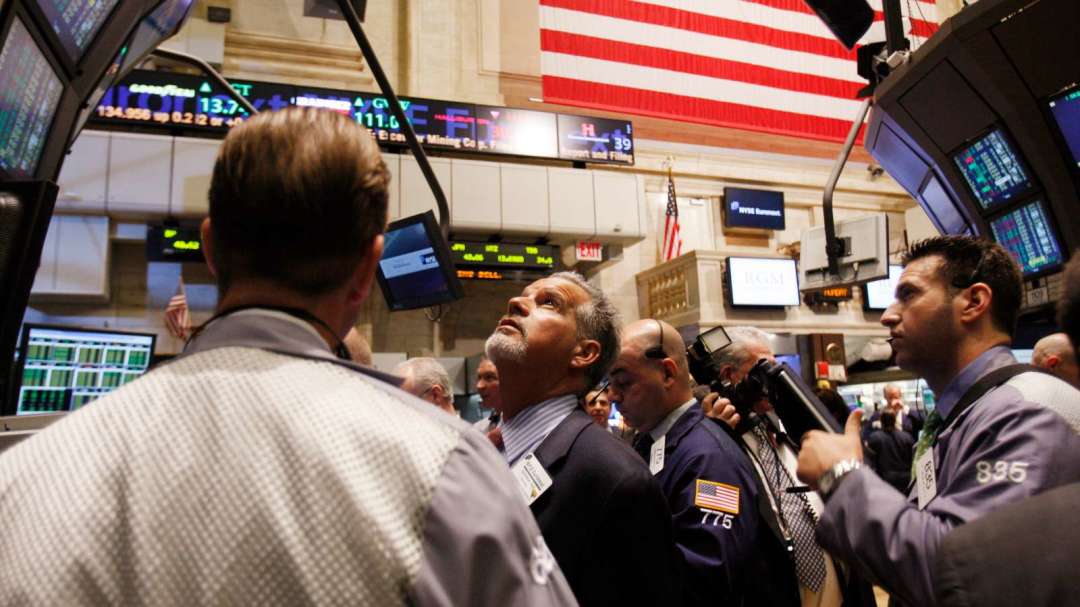
US stocks closed lower on Thursday (23rd), with the Nasdaq Composite plunging over 2%. Earnings reports from large tech companies reignited market concerns over massive AI spending, while rising oil prices intensified inflation fears, pushing US Treasury yields higher.
The S&P 500 fell over 1%, with broad-based declines. Alphabet (GOOGL-US) and Tesla (TSLA-US), among the first of the 'Magnificent Seven' tech giants to report quarterly results, both delivered second-quarter performances that disappointed investors, causing their stock prices to plummet and wiping out hundreds of billions in market value.
Brent crude futures closed above $100 per barrel for the first time since May, while US crude futures also settled above $92, further pressuring US equities.
Escalating Middle East tensions have heightened market concerns over global oil supply. The US military launched fresh airstrikes against Iran, while Iran fired on US military bases in neighboring countries. After Yemeni rebels, the 'Houthis,' attacked two Saudi oil tankers in the Red Sea, President Trump vowed 'major military retaliation' against Iran and the group.
Oil prices surged as a result, and with the Federal Reserve's (Fed) next policy meeting just days away, inflation concerns intensified further.
Among the S&P 500's 11 sectors, performance diverged on the day, with only four sectors rising. The best performer was the industrial sector, up 1.77%, driven primarily by defense stocks such as Lockheed Martin (LMT-US) and RTX (RTX-US). Lockheed Martin's shares surged 10.5% after the company raised its 2026 revenue and profit forecasts.
Alphabet dropped 7% on the day, becoming the second-largest drag on the S&P 500. The company's announcement of higher spending plans and cash burn triggered investor concerns.
Alphabet's sharp decline also dragged down the communication services sector by 5.20%, making it the worst-performing sector among the S&P 500's 11 sectors.
The consumer discretionary sector was the second-worst performer, closing down 5.12%. The biggest drag came from Tesla, whose shares plunged 14.5% after the company reported negative free cash flow in the second quarter—the first time in over two years.
Wall Street's 'fear index,' the VIX, closed up 2.06 points at 18.7, briefly rising to 20.3 during the session—the highest level in nearly a month.
As oil prices continued to climb, inflation concerns pushed the yield on the US 10-year Treasury note to its highest level since early 2025. However, according to CME Group's FedWatch tool, traders still estimate a roughly 64% chance that the Fed will hold rates steady at its upcoming meeting.
US stock market performance on Thursday (23rd):
Dow Jones Industrial Average fell 506.93 points, or 0.97%, closing at 51,711.65.
Nasdaq Composite fell 553.21 points, or 2.15%, closing at 25,137.69.
S&P 500 fell 90.66 points, or 1.21%, closing at 7,408.30.
Philadelphia Semiconductor Index fell 66.83 points, or 0.54%, closing at 12,343.84.
NYSE FANG+ Index fell 329.33 points, or 1.91%, closing at 16,948.49.
Only four of the S&P 11 sectors rose on the day. (Image: finviz)
Key Stocks
All five tech titans in the NYSE FANG+ index closed lower. Meta (META-US) fell 3.36%; Apple (AAPL-US) fell 1.30%; Alphabet (GOOGL-US) plunged 7.13%; Microsoft (MSFT-US) fell 2.24%; Amazon (AMZN-US) dropped 4.57%.
Most Philadelphia Semiconductor Index components closed lower. Nvidia (NVDA-US) fell 1.56%; Broadcom (AVGO-US) fell 1.09%; Micron (MU-US) rose 3.20%; Qualcomm (QCOM-US) fell 2.57%; Applied Materials (AMAT-US) rose 1.60%; Texas Instruments (TXN-US) fell 3.13%; AMD (AMD-US) fell 2.29%.
Taiwanese ADRs all declined. TSMC ADR (TSM-US) fell 1.34%; ASE ADR (ASX-US) fell 2.54%; UMC ADR (UMC-US) fell 1.97%; China Telecom ADR (CHT-US) fell 1.07%.
Corporate News
Intel (INTC-US) reported second-quarter earnings after market close that beat market expectations, with adjusted EPS of 42 cents and revenue of $16.1 billion—the fastest quarterly revenue growth since 2011. Its guidance also exceeded expectations, sending its stock up as much as 11% in after-hours trading.
AMD CEO Lisa Su announced on Thursday that Helios, the company's second-generation AI server targeting NVIDIA's flagship products, has entered full-scale production and will begin shipping by the end of the third quarter. OpenAI also announced it will deploy Helios racks at scale by the end of this year and accelerate adoption through 2027.
Thomas Kurian, CEO of Google Cloud under Alphabet, said existing customers' actual spending is about 50% higher than originally committed, with strong demand driving rapid growth in Google Cloud's business in Q2, forcing the company to rent additional capacity from third-party providers in the short term due to insufficient in-house computing resources.
Economic Data
Initial US jobless claims last week came in at 187,000, compared to an expected 211,000 and a prior 209,000.
Continuing US jobless claims last week were reported at 1.796 million, versus an expected 1.8 million and a prior 1.788 million.
Wall Street Analysis
Matt Miskin, investment strategist at Manulife John Hancock Investments, said, 'Oil prices rising at this pace pose a significant risk to the macro economy and markets.' He added that low unemployment data will also force the Fed to focus more on fighting inflation.
Miskin noted that even as some companies report strong earnings, investor reactions remain muted, as the market struggles to determine whether current high valuations are justified. 'Overall, the data is actually very good, but many companies have factors that cause their stocks to fall,' he said, citing concerns over capital expenditures. 'As soon as any weakness appears, stocks get sold off.'
Ross Mayfield, investment strategist at Baird, believes the level of the 2-year Treasury yield is 'potentially more important' for assessing the Fed's future rate path. According to the CME FedWatch tool, the market now prices in over an 80% chance of a rate hike in September, up from 52% a week ago.
Mayfield said, 'This conflict is really hard to ignore—not just because of oil, but because the entire yield curve is under pressure. I think fundamentals are still strong enough to support the market with some continuity over the long or at least medium term. But over the next two to three months, the market focus will likely shift back to Iran.'
FACT BOX
- Source: PR Times
- Category: News
- Organizations: Alphabet / AMD / NVIDIA
- Products / services: Google Cloud