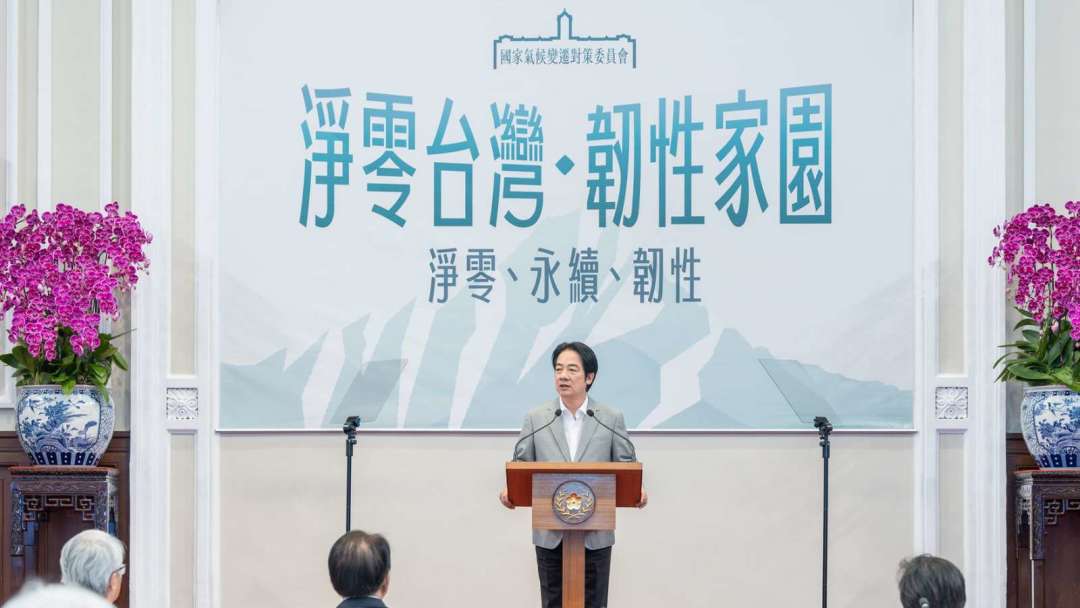
The 'National Climate Change Response Committee' convened today (23) at the Presidential Office, chaired by President Lai Qingde. Lai emphasized that in response to global extreme climate impacts, the government must proactively identify risks and prepare accordingly. He proposed three core strategies—'enhancing societal action,' 'strengthening energy stability,' and 'safeguarding territorial resilience'—to maintain food self-sufficiency, increase energy autonomy, and strengthen disaster prevention and public health, ensuring Taiwan's continued sustainable development.
Lai noted that in the past six months, Western Europe experienced its hottest June on record, while the global average temperature for June ranked as the second highest in history. Entering July, the World Meteorological Organization confirmed the formation of the El Niño phenomenon, expected to intensify between July and September, significantly increasing the likelihood of extreme weather events such as heatwaves, droughts, and heavy rainfall worldwide. Climate risks are becoming more frequent, complex, and directly impacting our daily lives.
Lai stated that Taiwan, as an island nation where mountains, rivers, and oceans are closely interconnected, with highly concentrated populations and industries, maintaining food self-sufficiency, enhancing energy autonomy, and strengthening disaster prevention and public health are crucial national capabilities in responding to climate change and international developments. However, in recent years, a single heavy rainfall event has simultaneously triggered landslides in mountainous areas and urban flooding. Increasing numbers of high-temperature days not only raise demand for water and electricity but also cause agricultural losses and health risks. Ocean warming and sea-level rise are also threatening the safety of fisheries and coastal communities.
Faced with these compound challenges affecting national security and food supply, Lai proposed three core strategies. First, enhancing societal action. The government must provide clear information, timely warnings, and concrete action guidelines so that the public can understand climate risks, prepare accordingly, and possess the capacity to participate in climate adaptation.
Second, strengthening energy stability. Taiwan's energy supply is highly dependent on imports. In the face of international energy price volatility and extreme climate risks, the government must not only continue expanding domestic low-carbon energy sources but also enhance grid resilience, energy storage, and dispatch capabilities to ensure stable power supply, supporting both livelihoods and industrial development. As of this (July), Taiwan has installed a total of 508 offshore wind turbines, with cumulative installed capacity reaching 4.9 GW, ranking fifth globally. Last year (2025), offshore wind power generation exceeded 10 billion kWh for the first time.
Third, safeguarding territorial resilience. Lai stated that forests, farmland, rivers, wetlands, coastlines, and oceans are Taiwan's precious natural resources, essential for water conservation, flood regulation, and stable food production. The government will continue strengthening scientific monitoring and ecological restoration, integrating long-term extreme climate risks into agricultural production and land-use planning.
Lai emphasized that the government's actions are aligned with international efforts, from the Kunming-Montreal Global Biodiversity Framework to global adaptation goals. Taiwan will continue to engage with the international community to build more robust climate governance capabilities. These three core strategies will be implemented through reports focusing on public participation, territorial adaptation, and energy transition, enhancing societal action, territorial resilience, and energy stability.
FACT BOX
- Source: PR Times
- Category: News