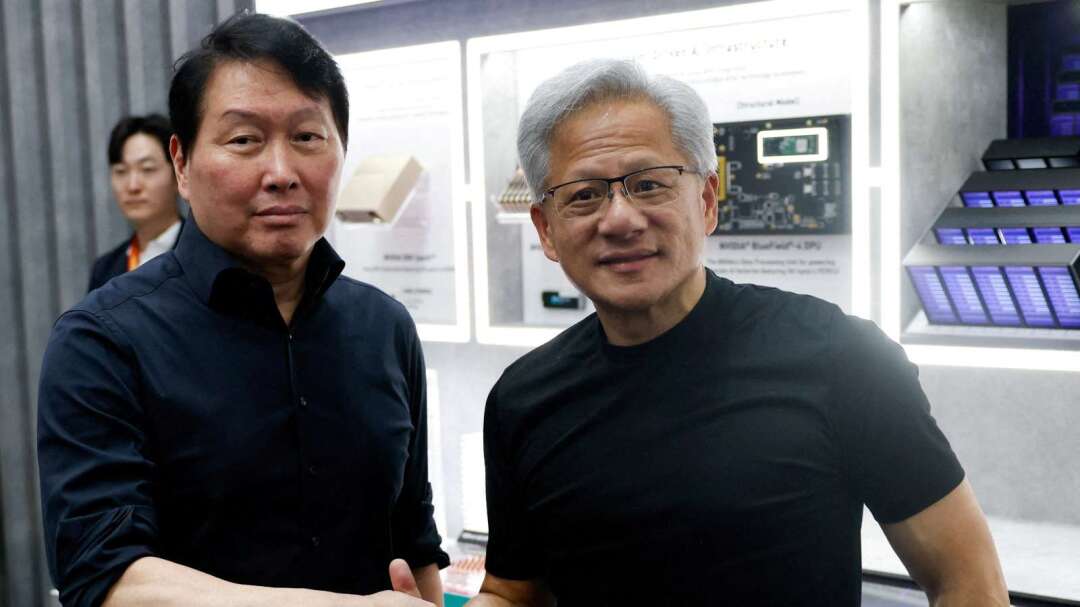
Jensen Huang, CEO of Nvidia (NVDA-US), recently stated in a podcast interview with Bloomberg that South Korea's semiconductor and industrial capabilities are currently in a 'golden era' and could become a key pillar of global artificial intelligence (AI) infrastructure. He also indicated that Nvidia's collaboration with Korean companies will continue to expand.
According to details disclosed by Huang, Nvidia has finalized multiple strategic agreements with the SK Group. The scale of future cooperation between the two parties in areas such as memory procurement, AI supercomputers, and data center construction is expected to exceed $500 billion.
Nvidia has committed to purchasing large quantities of memory chips from SK Hynix (SKHY-US) for several consecutive years and will jointly advance technological development from HBM2, HBM3, and HBM3E to HBM4 and HBM4E.
Additionally, SK Telecom recently plans to expand its AI cloud infrastructure to a maximum capacity of 2 gigawatts, and Nvidia will supply corresponding supercomputer systems, forming a two-way cooperative model of mutual procurement.
Regarding the industry outlook for the next decade, Huang made a bold prediction, suggesting that as AI agents and robots begin large-scale computational tasks, the demand for chips will no longer be limited to human users but will extend to machines and agents themselves.
He estimates that this trend could drive the global semiconductor industry to expand tenfold over the next decade.
However, Huang acknowledged that the pace of industrial expansion faces real-world bottlenecks. Currently, resources required for high-bandwidth memory (HBM), land, power, and data center construction are all in short supply. Even with full industry efforts, doubling annual production capacity is already difficult, and further acceleration is extremely challenging.
He explained that unlike consumer electronics, semiconductor chips cannot be rapidly replicated and scaled like consumer hardware due to constraints in land acquisition, power supply, and factory construction. This implies that the pace of AI infrastructure advancement over the next decade may continue to be limited by physical resource supply bottlenecks.
When asked about the competitive landscape between the U.S. and China in the AI field, Huang took a relatively balanced view. He believes both countries possess excellent AI research talent, and despite differences in resource conditions and policy restrictions, both will continue to drive AI technology forward.
He also noted that China may produce more AI research personnel annually than the rest of the world combined, so the U.S. must maintain a learning and open collaboration attitude to sustain its advantage in this competition.
FACT BOX
- Source: PR Times
- Category: Partnership