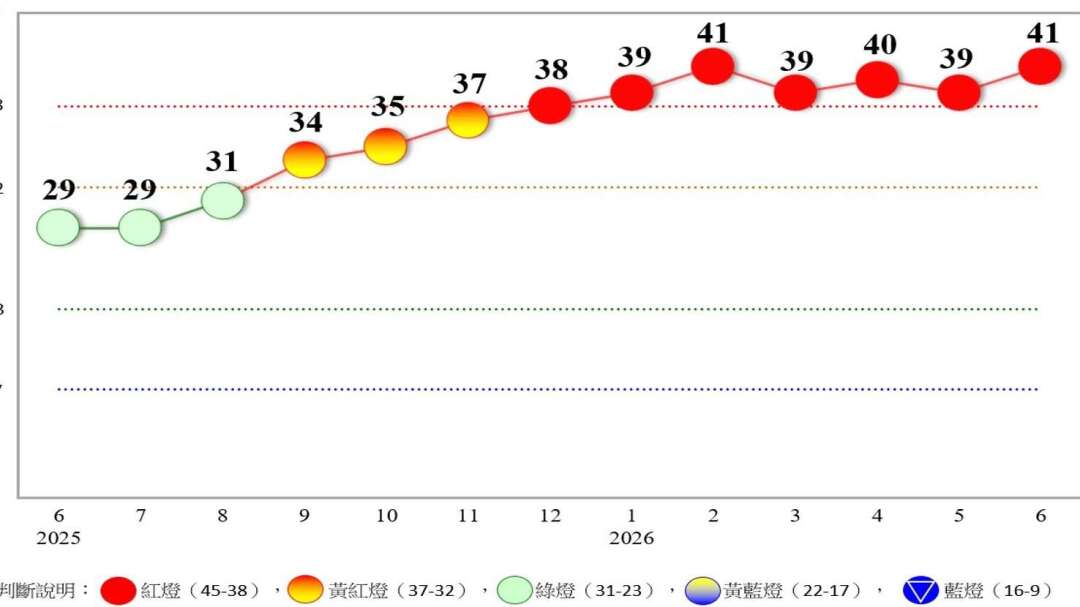
The National Development Council (NDC) announced today (27) that the composite index for June reached 41 points. Among the nine component indicators, the year-on-year change in average overtime hours for the industrial and service sectors rose from 0.9% last month to 4.5%, shifting the signal from green to yellow-red. The year-on-year change in the manufacturing sales volume index increased from the downwardly revised 8.4% last month to 14.9%, moving from yellow-red to red—each contributing an additional point. The remaining seven indicators maintained their previous signal colors.
The stock price index change remained in the red zone, indicating a vibrant capital market. Meanwhile, the import value of machinery and electrical equipment continued to grow at a high rate of 89.4%, reflecting ongoing corporate capacity expansion. The NDC stated that export momentum is expected to continue through the second-half peak restocking season for consumer electronics.
On economic indicators, the trend-adjusted leading index stood at 104.17, up 0.57% from last month. Five out of seven components increased, including the stock price index, export order sentiment index, real semiconductor equipment import value, real M1B money supply, and manufacturing business climate survey index.
The trend-adjusted coincident index reached 108.17, up 0.94% month-on-month. All five components—wholesale, retail, and food service sales, total electricity consumption, manufacturing sales volume index, industrial production index, and real machinery and electrical equipment import value—showed upward trends, indicating continued expansion in real economic activity.
Looking ahead, the NDC noted that global AI infrastructure expansion and accelerated AI applications, combined with the onset of the peak restocking season for consumer electronics in the second half, are likely to sustain export momentum.
On the investment front, major domestic semiconductor firms have increased capital expenditures, driving supply chain production line expansions and upgrades. Additional investments by global tech giants in Taiwan, along with government support for digitalization and net-zero transformation among SMEs, are further boosting investment momentum.
On consumption, stable employment, high stock market levels generating wealth effects, and economic spillovers from major events and sports competitions are expected to sustain private consumption. However, ongoing U.S.-Iran tensions, evolving monetary policies of major central banks, and changes in U.S. tariff policies could pose potential risks to global trade and inflation.
FACT BOX
- Source: PR Times
- Category: Survey