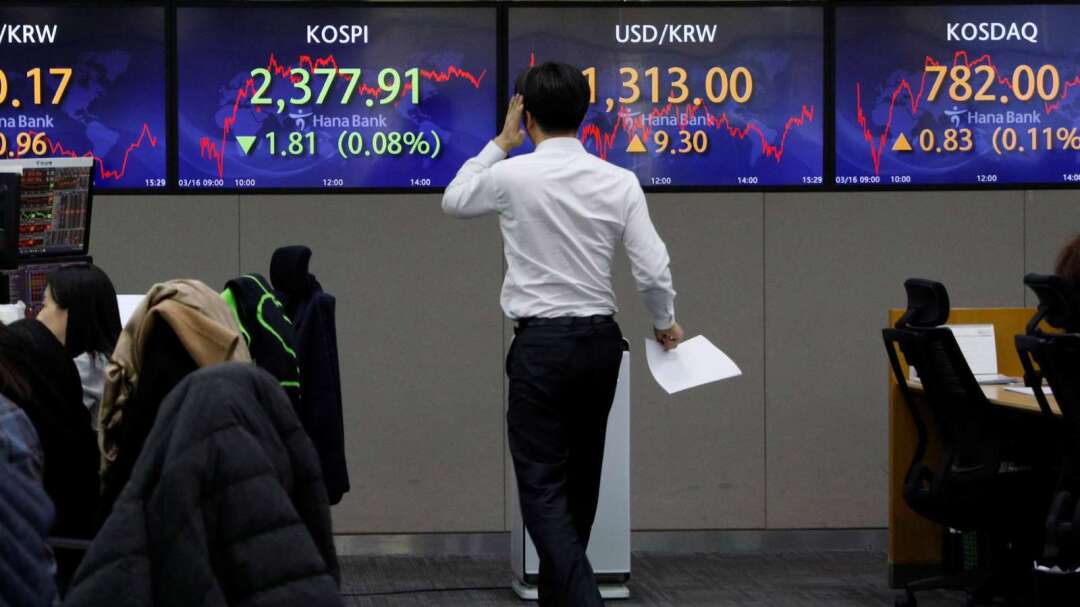
NVIDIA's (NVDA-US) unprecedented AI supply agreement has raised market concerns, and the intensification of competition among Chinese chip manufacturers has led to a significant decline in the Japanese and South Korean stock markets, with semiconductor-related stocks becoming the focus of the sell-off.
The Japanese Nikkei 225 index fell by 4.2% or 2732 points, reaching its lowest level since May 22 at 62198.85 points, while the TOPIX index temporarily fell by 2.7%.
The South Korean KOSPI index plummeted by 8%, reaching its lowest level since April 20 at 6212.26 points.
Semiconductor equipment and memory-related stocks led the decline, with Tokyo Electron, Advantest, Samsung Electronics, and SK Hynix all seeing declines of more than 9%. Among them, SK Hynix temporarily plummeted by 30%, setting a historical record for the largest intraday decline, while Advantest temporarily plummeted by 18%, marking the largest decline since November of last year.
The weakness in tech stocks is primarily due to market concerns about the financial risks associated with NVIDIA's $750 billion AI cooperation deal, which has led to a significant increase in its credit default swap (CDS) costs. Hideyuki Ishiguro, Chief Strategist at Nomura Asset Management, stated that after the news of the large-scale investment project was revealed, the market believed that NVIDIA's credit risk had increased, and thus adopted a more conservative attitude towards the related supply chain.
Additionally, The Information reported that a state-backed Chinese company has begun producing immersion deep ultraviolet (DUV) lithography equipment, which has also dragged down the semiconductor group. Ishiguro pointed out that China's breakthroughs in the semiconductor equipment sector pose a threat to Japanese suppliers who have long had a competitive advantage, and thus are bearish for the entire industry.
In terms of U.S. stock futures, the Nasdaq 100 futures fell by 0.2%, and the S&P 500 futures fell by 0.3%. The Dow Jones futures saw a slight increase, with an increase of less than 0.1%.
Market tension reflects investors' uncertainty about a series of major events this week, particularly the upcoming earnings releases from Amazon (AMZN-US), Meta Platforms (META-US), and Microsoft (MSFT-US). The future of semiconductor stocks will depend on whether large-scale cloud service providers (hyperscalers) continue to expand their capital expenditures, even though these tech giants' stock prices have been weak recently. Apple (AAPL-US) will also release its earnings this week.
Stephanie Link, Chief Investment Strategist at Hightower, said, "This week, we will hear all major cloud service providers further increase their capital expenditures, so these stocks may face pressure. But as long as they continue to invest in capital expenditures, it is a good thing because it helps the U.S. economy."
The Federal Reserve (Fed) will announce its interest rate decision on Wednesday. The market widely expects the Fed to remain on hold, but investors hope to gain more clues about the direction of monetary policy from the statement and the chairman's remarks. According to the CME FedWatch tool, the latest federal funds futures show that the market expects the Fed to raise rates by 1 code (25 basis points) in September.
Investors will also continue to monitor oil prices and bond market trends, as international Brent crude oil futures prices have fallen below $90 per barrel following a temporary ceasefire between the U.S. and Iran, while the yield on U.S. 10-year Treasury bonds has fallen to around 4.65%.
FACT BOX
- Source: PR Times
- Category: 其他
- Organizations: Meta Platforms